Manual vs AI-Based Paraphrasing: Which Is Better for Content Paraphrasing in 2026?
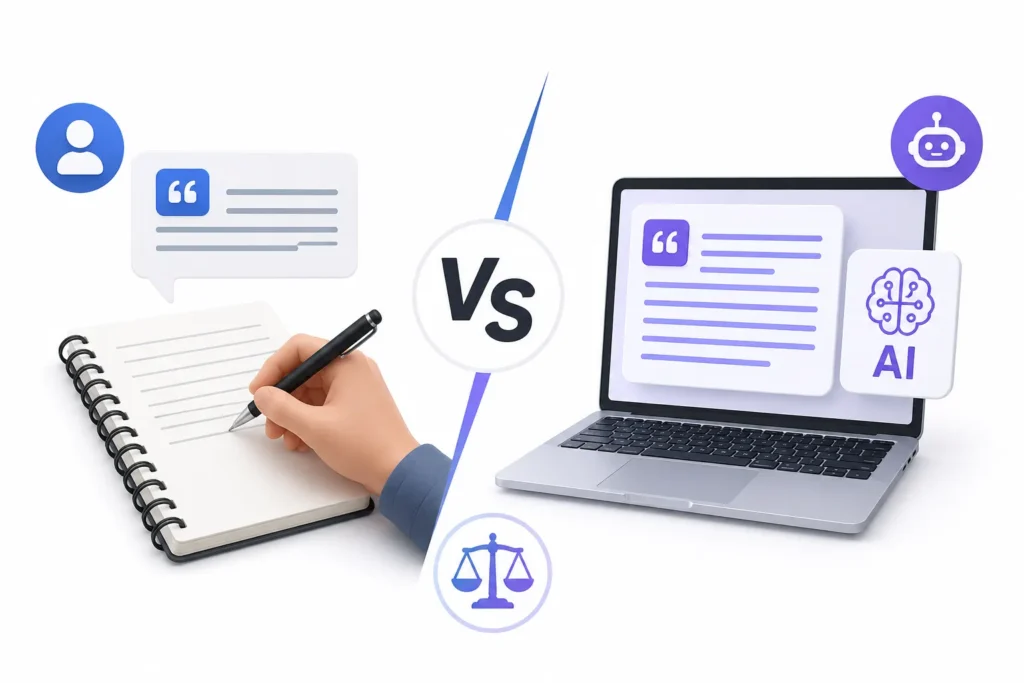
Manual vs AI-Based Paraphrasing: Which Is Better?
The question of Manual vs AI-Based Paraphrasing is a topic of growing significance as businesses, researchers, and students grapple with its implications in 2026. In today’s digital age, powered by artificial intelligence, content paraphrasing has become a speedy process; however, speed may not always equal quality. Selecting an effective method for content paraphrasing can be crucial in maintaining original content, readability, and SEO performance.
What is Content Paraphrasing?
Content paraphrasing is the rewriting of content but in a new way retaining the original meaning. It is popular in the academic world, digital marketing, and professional documentation to enhance originality and clarity. Manual vs AI-Based Paraphrasing is an important aspect of modern content creation, helping users choose the right approach for maintaining quality, accuracy, and uniqueness.
There is more to content paraphrasing than just changing words. It needs to be restructured, enhanced with a better flow, and kept accurate and interesting.
Manual vs AI-Based Paraphrasing: Key Difference
The key difference in manual vs AI-based paraphrasing lies in how content paraphrasing is performed.
- Manual paraphrasing relies on human understanding, interpretation, and rewriting.
- AI-based paraphrasing uses algorithms to automate the content paraphrasing process.
While AI improves speed, manual content paraphrasing ensures deeper accuracy and contextual relevance.
Manual vs AI-Based Paraphrasing: Comparison Table
| Feature | Manual Paraphrasing | AI-Based Paraphrasing |
| Quality | High (context-aware) | Moderate to high (tool-dependent) |
| Accuracy | Very high | Variable |
| Speed | Slow | Very fast |
| Originality | Strong | Needs review |
| Human Touch | Yes | Limited |
| SEO Performance | Strong | Requires optimization |
| Cost | Higher | Lower |
Benefits of Manual Content Paraphrasing
Manual content paraphrasing is preferred when quality and accuracy are critical.
Key Advantages:
- Deep understanding of context and meaning
- High level of originality and uniqueness
- Better alignment with SEO and user intent
- Natural tone and improved readability
Manual content paraphrasing is ideal for research papers, academic writing, and high-quality business content.
Benefits of AI-Based Content Paraphrasing
Content paraphrasing using AI provides speed and scalability, fitting for big content needs.
Key Advantages:
- Fast rewriting of large volumes of content
- Cost-effective for bulk content paraphrasing
- Easy to use with minimal effort
- Useful for initial drafts and quick edits
However, AI-generated content paraphrasing often requires human refinement to achieve high quality.
Limitations of Both Approaches
These techniques have their drawbacks in terms of the quality of content paraphrasing.
Manual Content Paraphrasing Limitations:
- Time-consuming process
- Higher cost
- Limited scalability
AI-Based Content Paraphrasing Limitations:
- Risk of generic or repetitive output
- Possible loss of original meaning
- Requires editing for SEO and readability
- May trigger AI detection tools
Which Is Better for SEO?
Search engines such as Google value originality, usefulness, and user-experience. Therefore, good paraphrasing of content is a must for higher rankings.
Manual content paraphrasing is more effective due to the natural integration of keywords along with providing context and enhancing engagement. While paraphrasing content using artificial intelligence can be helpful for SEO, it needs to be done in conjunction with human editing.
Best Approach: Hybrid Content Paraphrasing Strategy
The most effective approach in 2026 is combining both methods of content paraphrasing.
Recommended Strategy:
- Use AI tools for initial drafts and bulk content paraphrasing
- Apply manual editing to refine quality and meaning
- Ensure plagiarism-free and humanized content
- Optimize for SEO and readability
This hybrid approach balances efficiency and quality in content paraphrasing.
Industry Use Cases
Different industries apply content paraphrasing based on their requirements.
- Education & Research: Prefer manual content paraphrasing for accuracy
- Digital Marketing: Use AI + human editing for scalable content paraphrasing
- Corporate Sector: Combine both methods for efficiency
- Content Agencies: Use hybrid workflows for large-scale projects
Common Mistakes to Avoid
Improper use of content paraphrasing can reduce content quality.
- Relying completely on AI without editing
- Over-paraphrasing and losing meaning
- Ignoring SEO optimization
- Not checking for plagiarism
- Using low-quality tools
Avoiding these mistakes improves the effectiveness of content paraphrasing.
Future Trends in Content Paraphrasing
The future of content paraphrasing is evolving with advancements in AI technology.
- More advanced AI paraphrasing tools
- Better contextual understanding
- Increased demand for humanized content
- Growth of hybrid content workflows
Businesses must adapt to these trends to stay competitive.
Conclusion
Manual vs AI-based paraphrasing: which is better? It depends on your objectives. Manual paraphrasing of content is of higher quality and accuracy, while AI-based paraphrasing of content is faster and more scalable.
Call to Action
Need professional paraphrasing content advice that is quick, accurate and SEO-friendly? Collaborate with experts who combine AI capabilities, data analysis, and human knowledge to produce plagiarism-free high-quality content. Contact us today to get started.
Book a free consultation for appointment
Email us at : grow@simbi.in