Best AI Detection Tools 2026 Compared: Turnitin vs Copyleaks vs Winston AI (2026 Guide)
Why Most AI Detection Tool Comparisons Miss the Bigger Picture
When you started looking for the best AI detection tools, you have seen a lot of articles out there that state they’re 99% accurate or the most reliable. This guide isn’t comparing features! Rather, it examines the logic behind Turnitin’s, Copyleaks’ and Winston AI’s decisions, their areas of strength and weakness, and what the results truly mean in real-world scenarios.But those claims rarely answer the questions that actually matter:
- Why are there variations in the outcomes of different AI detectors for the same document?
- Is it possible to have one detector identify a document as AI-generated and another detector identify it as human?
- Does a higher AI score always mean AI was used?
- Who should educators, business and content teams be able to rely on for a detector?
READ THIA ALSO : Turnitin AI Detection Removal Services Ultimate Smart Guide
Before Comparing the Tools: What Exactly Are They Trying to Detect?
The biggest misconception about AI detection is that it is a tool that “detects ChatGPT. They don’t. AI detectors do not ask the question, “Was this written by ChatGPT? AI detectors do not ask the question “Was this written by ChatGPT?”
Rather, they consider if the writing shares characteristics with patterns that manifest themselves in AI-generated writing. They analyse sentence uniformity, predictability, repetition and other aspects of writing structure. That is why two different tools might come up with two different probabilities for the same document because they are calculating probabilities and not looking for a hidden signature from an AI model.
Why Most AI Detection Tool Comparisons Miss the Bigger Picture
The instructor uses an AI tool to mark two sets of homework.
Document A: A student writes a research paper without any input from another student. The writing is extremely formal and systematic; this results in a 92% AI score.
Document B: Another student uses AI to write an essay, but edits a lot of it before turning it in. Only a 28% AI score is given by the detector.
Summary: The high scores do not necessarily indicate the use of AI, nor do the low scores indicate that AI was not used. AI detection tools are able to use pattern recognition to provide a probability score of whether it was created by AI or not rather than being able to determine authorship.
How We Evaluated the Three Tools
Rather than making comparisons on marketing claims, we will be evaluating each tool by practical questions:
1. Are they presented clearly and do they make sense?
2. Is it consistent?
3. What value its reports have for decision making?
5. Who will use the tool?
5. In what situations is it most reliable?
6. In what ways will it tend to get wrong?
Turnitin vs Copyleaks vs Winston AI: At a Glance
| Feature | Turnitin | Copyleaks | Winston AI |
| Primary Focus | Academic integrity and education | Enterprise AI detection and business workflows | Content creators and SEO professionals |
| Designed For | Schools, colleges, and universities | Businesses, publishers, and developers | Bloggers, freelancers, marketers, and agencies |
| Key Strength | Combines AI detection with plagiarism detection | Multilingual AI detection with API integrations | Simple interface with fast AI content analysis |
| Best Use Cases | Student essays, research papers, classroom assessments | Enterprise compliance, publishing, business documents, multilingual content | Blog posts, website content, SEO writing, freelance projects |
| Reporting Style | Detailed academic reports | Comprehensive enterprise reports | Easy-to-read content reports |
| Integrations | Learning Management Systems (LMS) | API and enterprise integrations | Limited third-party integrations |
| Ease of Use | Moderate | Moderate | Very Easy |
| Where It Excels | Academic institutions and educational workflows | Large organizations managing diverse content | Individuals and small content teams |
| Limitations | Not ideal for non-academic content or individual users | Advanced features may be more than casual users need | Fewer enterprise and academic features compared to Turnitin and Copyleaks |
| Best Choice For | Educators and universities | Enterprises and publishers | Bloggers, SEO professionals, and content marketers |
Same Document, Three Different Results: Why It Happens
A user is forced through the three different AI scores of three different detectors. Obviously that’s not the end of the world, just one tool is not the answer. The training data, thresholds, and the way of interpreting the results are unique for each detector. This means that a given document can be judged differently by each of the systems, depending on the characteristics of the system that is used. Users shouldn’t assume that any content identified by AI is plagiarized, but rather consider it as part of a multi-stage review.
Which Tool is the Best for Your Work?
Do not refer to the best detector, but ask, “Which detector will be best for my work?
| Your Need | Recommended Tool |
| University assignments | Turnitin |
| Enterprise content review | Copyleaks |
| Blog writing and SEO | Winston AI |
| API integration | Copyleaks |
| Academic plagiarism + AI detection | Turnitin |
| Freelance content verification | Winston AI |
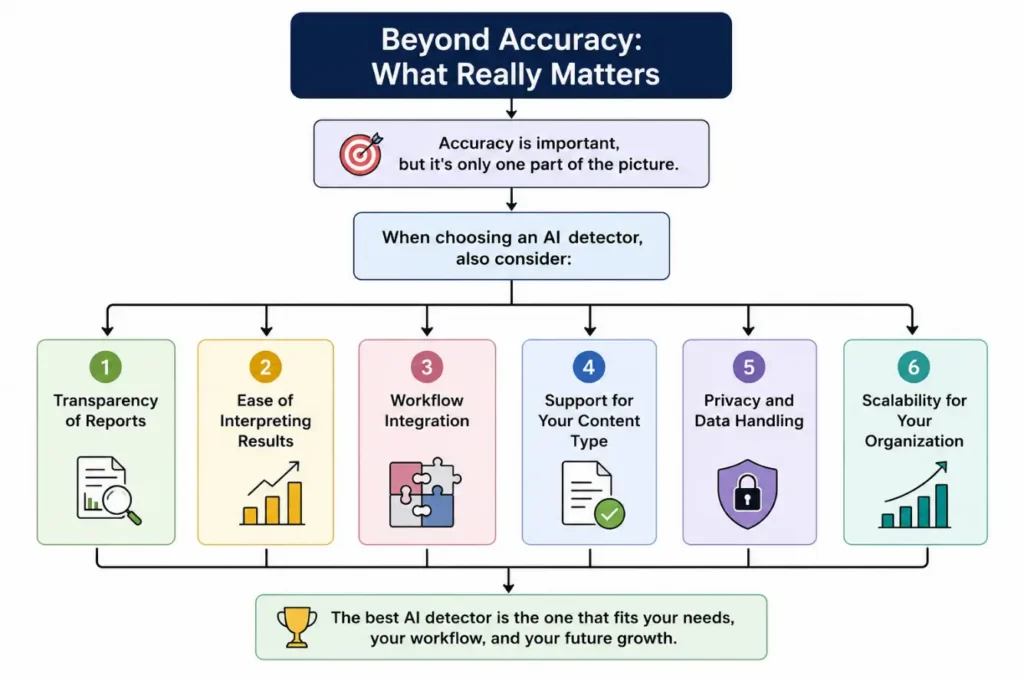
The Right Tool Is Better Than the “Most Accurate” Tool
No AI detector can be 100% certain if a text was written by a human or generated by AI. What these tools provide is evidence—not a verdict. The reason for the difference between Turnitin, Copyleaks and Winston AI is that they are created for different users. It’s much better to know those differences than to go for the highest claimed accuracy percentage. The ideal AI detection tool is the one that fits into your workflow, gives you reports you can confidently read, and gives you the information you need to make a decision, but not the judgment.
Book a free consultation for appointment
Email us at : grow@simbi.in