From Classrooms to Analytics: How Modern Surveys Are Reshaping Education in India and the Role of Data Analytics in Classroom Education in India
Why Educational Institutions Are Relying More on Structured Data
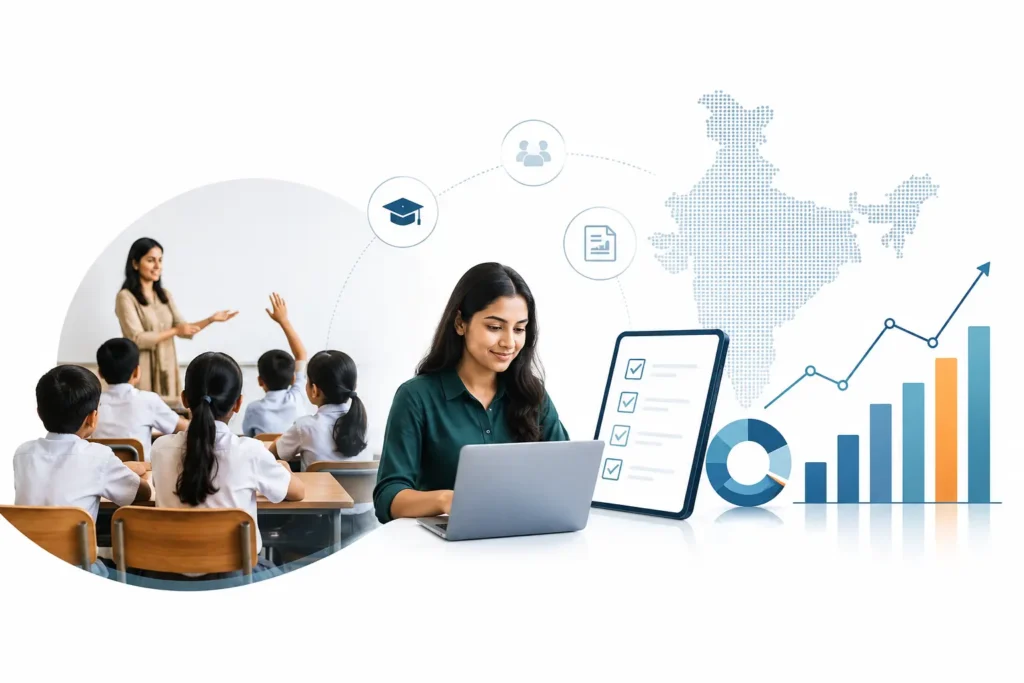
The education sector in India is going through a significant transformation due to the impact of the digital learning, policy changes, and the growing competition between the institutions. Schools, universities, training centers and edtech companies are now called to not only provide superior academic experiences but also to keep operational efficiency on the upswing. Education surveys have gained a crucial position in this environment to comprehend student expectations, the performance of the institution and learning outcomes.
Gathering systematic feedback and academic data, institutions will be able to detect gaps, enhance decision-making, and build more student-centered learning settings. With the growing data-centric education systems, professional education surveys are assisting organizations to eliminate assumptions and make sound strategic decisions.
Understanding the Purpose of Education Surveys
Education surveys are systematic research methods used to gather information from students, teachers, administrators, and institutions. These surveys help evaluate teaching quality, student engagement, infrastructure, operational performance, and policy effectiveness.
Modern education surveys are designed not only to measure satisfaction levels but also to uncover deeper academic and behavioral insights. Institutions use these findings to improve curriculum design, optimize learning experiences, and strengthen institutional planning across different educational environments.
Different Types of Education Surveys
Exploring the role of data analytics in classroom education in India is essential for understanding how best to facilitate student learning.
Student Experience Surveys
These surveys focus on student engagement, learning experiences, satisfaction levels, and academic challenges.
Institutional Assessment Surveys
Used to evaluate faculty performance, infrastructure quality, and administrative efficiency.
Policy and Academic Research Surveys
Government agencies and research organizations use these surveys to support educational reforms and long-term planning.
Each type of education survey serves a unique role in improving educational quality and institutional performance.
Why Education Surveys Matter in India
India has one of the world’s largest and most diverse education systems, making structured data collection increasingly important for both academic institutions and policymakers.
Key reasons behind the growing demand for education surveys include:
· Support for education reforms such as the National Education Policy
· Need for better student-centric learning models
· Growth of digital and hybrid education platforms
· Increasing competition among schools and universities
· Rising demand for measurable academic outcomes
Organizations that invest in effective education surveys gain stronger visibility into institutional strengths, weaknesses, and future opportunities.
How Education Surveys Are Conducted
Survey Design and Planning
Research teams create questionnaires aligned with academic objectives and target audiences.
Sampling Strategy
Representative groups of students, teachers, or institutions are selected using structured sampling methods.
Data Collection Methods
Education surveys are conducted through multiple channels, including:
· Online forms and mobile applications
· Face-to-face field interviews
· Telephonic interactions
· Institutional database systems
Data Validation and Analysis
Collected information is cleaned, verified, and analyzed using statistical and AI-based tools.
Reporting and Insights
Insights are delivered through dashboards, reports, and visual analytics that support institutional decision-making.
This structured process ensures that education surveys produce reliable and actionable outcomes.
Features That Strengthen Modern Education Surveys
Professional survey systems now include advanced capabilities that improve research quality and scalability.
· Customized survey design for educational research
· Multi-mode online and offline data collection
· Real-time reporting dashboards
· AI-powered analytics and predictive insights
· Strong data validation and quality control systems
· Compliance with privacy and security standards
These features make education surveys more effective for both academic institutions and research organizations.
Through an understanding of the role of data analytics in classroom education in India, institutions can evolve and meet the needs of their students.
Benefits of Using Education Surveys Effectively
Better Academic Decision-Making
Institutions can make informed improvements based on measurable student and faculty feedback.
Improved Student Experience
Feedback-driven changes help create more engaging and supportive learning environments.
Stronger Policy Evaluation
Government bodies can assess the impact of educational reforms and initiatives.
Higher Operational Efficiency
Schools and universities can optimize administrative and academic processes.
Competitive Institutional Growth
Data-driven institutions often perform better in rankings, admissions, and student satisfaction.
These advantages show why education surveys are becoming increasingly important across India’s academic sector.
Where Education Surveys Are Commonly Used
The role of data analytics in classroom education in India can streamline processes and enhance educational outcomes.
Schools and Universities
Assessing curriculum quality, student engagement, and institutional performance.
EdTech Companies
Understanding user behavior and improving digital learning platforms.
Government Education Projects
Managing large-scale educational assessments and census programs.
Research Organizations
Conducting academic, behavioral, and policy-related studies.
Skill Development Institutes
Evaluating training outcomes and employability programs.
Across these sectors, education surveys help institutions improve both planning and performance.
Technologies Powering Modern Education Surveys
Digital transformation has significantly improved how educational data is collected and analyzed.
· Survey platforms such as SurveyMonkey and Qualtrics
· Data analysis tools including Microsoft Power BI
· AI and machine learning for predictive analytics
· Mobile applications for rural and field-based data collection
· Cloud-based systems for secure storage and scalability
These technologies make education surveys faster, more scalable, and more accurate.
Common Challenges That Affect Survey Quality
Even well-designed education surveys can fail if critical issues are ignored.
· Poor questionnaire design leading to unclear responses
· Non-representative sampling methods
· Weak validation and quality control processes
· Ignoring regional and linguistic diversity
· Collecting data without generating actionable insights
Avoiding these mistakes improves the reliability and usefulness of education surveys.
Choosing the Right Education Research Partner
Selecting an experienced research provider is essential for producing meaningful educational insights. Institutions should evaluate:
· Expertise in educational and academic research
· Use of AI-driven analytics and digital tools
· Nationwide survey execution capabilities
· Strong compliance and data security standards
· Ability to deliver strategic insights rather than only raw data
The role of data analytics in classroom education in India is increasingly recognised as a cornerstone of effective teaching practices.
By understanding the role of data analytics in classroom education in India, educators can innovate their teaching methodologies.
A professional partner helps institutions maximize the value of education surveys through accurate analysis and reporting.
Future Trends in Education Surveys
The future of education surveys is becoming more intelligent, automated, and personalized.
· AI-driven predictive learning analytics
· Real-time classroom feedback systems
· Integration with Learning Management Systems
· Multilingual and voice-enabled survey tools
· Personalized student performance tracking
These innovations are expected to redefine how educational institutions understand and support learners across India.
Final Thoughts
Education surveys are research techniques that are systematic in nature and they are carried out to collect data on students, teachers, administrators and institutions. Such surveys assist in determining the quality of teaching, student interactions, infrastructure, performance of operations, and effectiveness of policy.
The designed modern education surveys are aimed at measuring the level of satisfaction, but also to reveal more profound academic and behavioral details. These findings are used by institutions to enhance curriculum design, maximize learning experiences, and institutional planning in various learning settings.
Looking for Professional Education Survey Solutions?
We provide end-to-end education survey services, including questionnaire design, field data collection, AI-powered analytics, reporting, and academic research support tailored for schools, universities, edtech companies, and research institutions across India.
Connect with us to transform education surveys into actionable academic insights.
Book a free consultation for appointment
Email us at : grow@simbi.in
Contact Simbi Labs today to discover how modern education survey solutions can transform classroom insights, improve data accuracy, reduce survey errors, and deliver better learning outcomes across India.