End-to-End Survey Data Collection Services: A Complete Guide for Research Projects
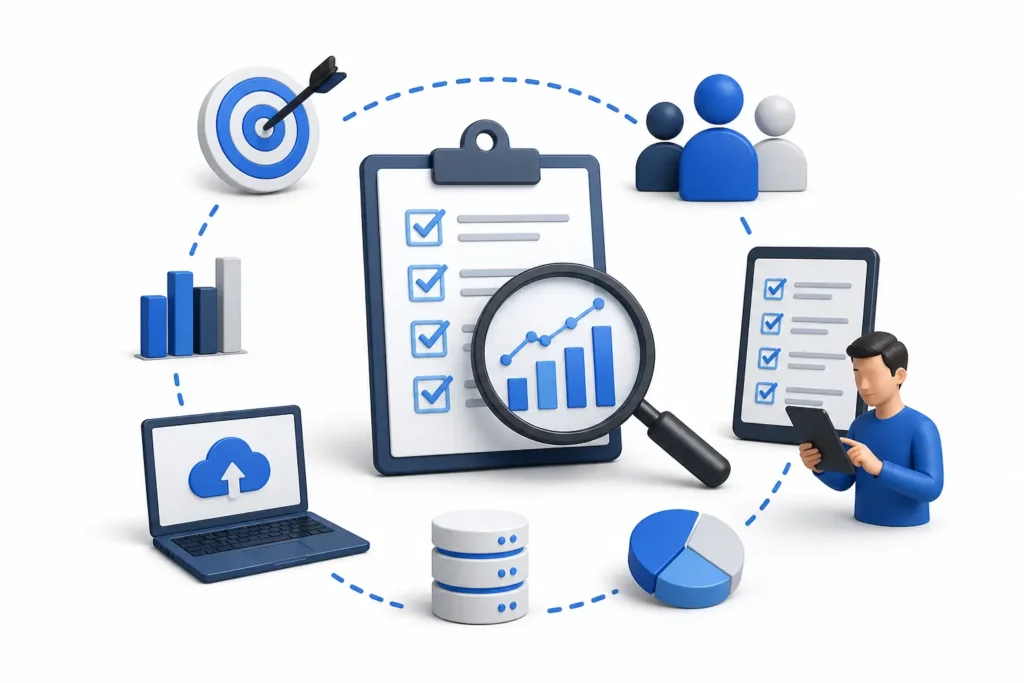
End-to-End Survey Data Collection Services assists researchers, companies, institutions, NGOs, and students in gathering the correct, structured and reliable data presented by the appropriate respondents. These services include all the survey process, research planning and questionnaire design, field execution, data validation, analysis-ready formatting and reporting. In a country like India where markets, languages, customer behavior, and field conditions are widely differentiated, end-to-end support is essential in a country where the markets, languages, customer behavior, and field conditions are widely differentiated.
What Are End-to-End Survey Data Collection Services?
End-to-End Survey Data Collection Services are a full research support solution through which a professional data collection company handles all the steps of the survey process. One well-organized team allows clients to deal with one team rather than several individuals in planning, fieldwork, data entry and validation.
They can be online surveys, offline field surveys, telephonic interviews, customer feedback studies, household survey, retailer survey, B2B interviews, academic research surveys and social research projects.
The objective is straightforward, gather quality primary data that can be utilized in business decision-making, in academic research, in policy research, or in the market analysis.
Why End-to-End Survey Support Is Important in India.
India is a multi-faceted and intricate research market. A survey in Mumbai might need a different approach compared to a survey in Hyderabad, Delhi, Patna, Bengaluru or rural Maharashtra. Quality of the data may be influenced by language, culture, education level, access to the internet, income group and availability of respondents.
To the companies, an effective survey data is useful in product introduction, market penetration, customer satisfaction researches, competition, price research and improvement of services. To the researchers and students, primary data that is accurate is used to support dissertations, thesis work, research papers and institutional studies.
This is the reason why End-to-End Survey Data Collection Services are useful. They minimize confusion, enhance coordination and make sure that the overall process of research adheres to a definite methodology.
How End-to-End Survey Data Collection Services Work
A professional survey data collection project follows a structured step-by-step process.
1. Understanding the Research Objective
The first step is to understand the purpose of the survey. The objective may be to study customer behavior, market demand, product preference, awareness level, service satisfaction, or community needs.
Clear objectives help define the right respondent profile, sample size, location, and survey method.
2. Designing the Survey Methodology
Survey methodology includes selecting the target audience, sample plan, data collection mode, location coverage, and timeline. This stage is important because poor planning can lead to inaccurate or incomplete results.
A professional data collection agency ensures that the survey design is practical and aligned with the research goal.
3. Preparing the Questionnaire
A good questionnaire is clear, unbiased, and easy to answer. It may include multiple-choice questions, rating scales, open-ended questions, demographic details, and observation points.
For Indian respondents, questionnaires may also need to be adapted into local languages for better understanding and response quality.
4. Training the Survey Team
Field investigators, callers, or online survey coordinators are trained before data collection begins. Training covers survey objectives, question flow, respondent handling, ethical practices, and data entry standards.
This step is especially important for End-to-End Survey Data Collection Services because trained teams improve consistency and reduce errors.
5. Survey Execution
Data is collected through online forms, face-to-face interviews, telephonic surveys, field visits, retail audits, or hybrid methods. The method depends on the target audience and research requirement.
For example, online surveys may work well for urban professionals, while offline field surveys may be better for households, retailers, healthcare respondents, or rural communities.
6. Data Validation and Quality Checks
After data collection, responses are checked for incomplete answers, duplicate entries, inconsistent responses, wrong respondent profiles, and suspicious patterns.
Quality checks may include supervisor review, call-back verification, GPS tagging, photo evidence, and data cleaning.
7. Final Data Delivery and Reporting
The final data is delivered in Excel, Google Sheets, dashboards, SPSS-ready formats, summaries, or research reports, depending on the client’s requirement.
Key Features of Professional End-to-End Survey Data Collection Services
A good provider of End-to-End Survey Data Collection Services can do so much more than simple response collection.
The main characteristics are; trained field teams, digital survey tools, language support in the region, project coordination, respondent screening, data validation, secure data handling and structured reporting.
The flexibility in online and offline research is also offered by professional agencies. This is critical in India as some of the target groups are digitally active but others need face-to-face interaction.
Benefits for Researchers and Companies
End-to-end support is time saving, enhances accuracy and lessens on project management burden. Instead of arranging with several vendors or freelancers, customers can rely on a single professional team to take care of the entire survey process.
To businesses, such services offer sound insights into customers, enhanced understanding of the market, superior competitor analysis and enhanced decision-making.
In the case of researchers and students, End-to-End Survey Data Collection Services allow making sure that the primary data is gathered in a systematic and credible manner.
The other advantages are quicker implementation, increased reach to respondents, fewer field errors, clean data and increased confidence in research results.
Industry Use Cases in India
Market Research
The survey data collection services are used by businesses to research the customer preferences, product demand, brand awareness, pricing expectations, and purchase
behavior.
Healthcare and Pharmaceutical Research
The survey data collection services are used by businesses to research the customer preferences, product demand, brand awareness, pricing expectations, and purchase behavior.
Academic Research
Surveys are used by students, scholars and universities in dissertations, thesis projects, social research, management studies and research in public policy.
Retail and FMCG
Retail audits, interviews with shopkeepers, customer surveys and dealer feedbacks helps companies to know the availability of products, movement of sales and the competition in the market.
Social and Development Research
The data of the survey is used by NGOs and institutions to investigate the needs of the community, the services offered publicly, the level of awareness, the livelihood patterns, and program impact.
Tools and Technologies Used
The use of digital tools in modern End-to-End Survey Data Collection Services enhances the speed, accuracy, and transparency. Examples of common tools are Google Forms, Microsoft Forms, KoboToolbox, SurveyMonkey, mobile survey apps, CRM tools, Excel dashboards, GPS tagging, and data validation systems.
The technologies can be used to track the field progress, minimize human error, and streamline responses. Nevertheless, human expertise is still relevant in interacting with respondents, communicating in local languages, and making judgments in the field.
Common Mistakes to Avoid
The major error is to begin a survey without a definite research goal. A second one is the use of a poorly designed questionnaire that confuses or results in biased responses.
Wrong selection of the respondents, poor training of the surveyor, no supervision, and poor data validation are also some of the reasons why many of the projects fail. Selecting the lowest provider may also result in low quality/ unusable data.
The planning, training, monitoring, and quality control assist a professional data collection partner to prevent the occurrence of these mistakes.
How to Choose the Right Service Provider
Some of the questions to answer before selecting a provider are their experience, team capacity, geographic coverage, technology use, quality/control process, and reporting form.
An effective data collection firm in India must learn about survey methodology, field operation, handling of respondents, privacy of data and industry-specific needs.
The appropriate partner must also be open regarding the timeframes, deliverables, cost, and validation procedures.
Future Trends in Survey Data Collection
Hybrid online-offline survey, mobile-based fieldwork, AI-based data cleaning, real-time dashboards, GPS-enabled monitoring, and more robust data security practices will shape the future of survey data collection in India.
Firms that integrate digital technologies with trained field staff will be in a better position to produce precise research results that are reliable.
Conclusion
End-to-End Survey Data Collection Services is a complete support of the researchers, corporations, institutions, NGOs, and students who require the correct and well structured data. Since planning and questionnaire design through to survey execution, validation, and reporting are all services provided by these services to ensure that each and every aspect of the research process is done in a professional manner.
A reliable survey partner in the diverse research environment in India can help to make your project a lot more reliable, efficient and decision ready.
In need of professional end-to-end survey data collection service in India? Collaborate with a seasoned research and field survey team to gather the right data, legitimizing responses, and transforming survey findings into valuable knowledge.
Book a free consultation for appointment
Email us at : grow@simbi.in