
Turnitin vs Manual Editing: Which Is Better for Plagiarism Removal?
Two Approaches, One Goal
When plagiarism concerns appear in academic or professional writing, most people immediately search for fast solutions like Turnitin vs Manual Editing. Some rely entirely on software reports like Turnitin plagiarism checker, while others prefer hands-on revision through manual rewriting.
This creates an important debate: Turnitin vs manual editing—which actually works better for plagiarism removal?
The answer depends on what you are trying to fix.
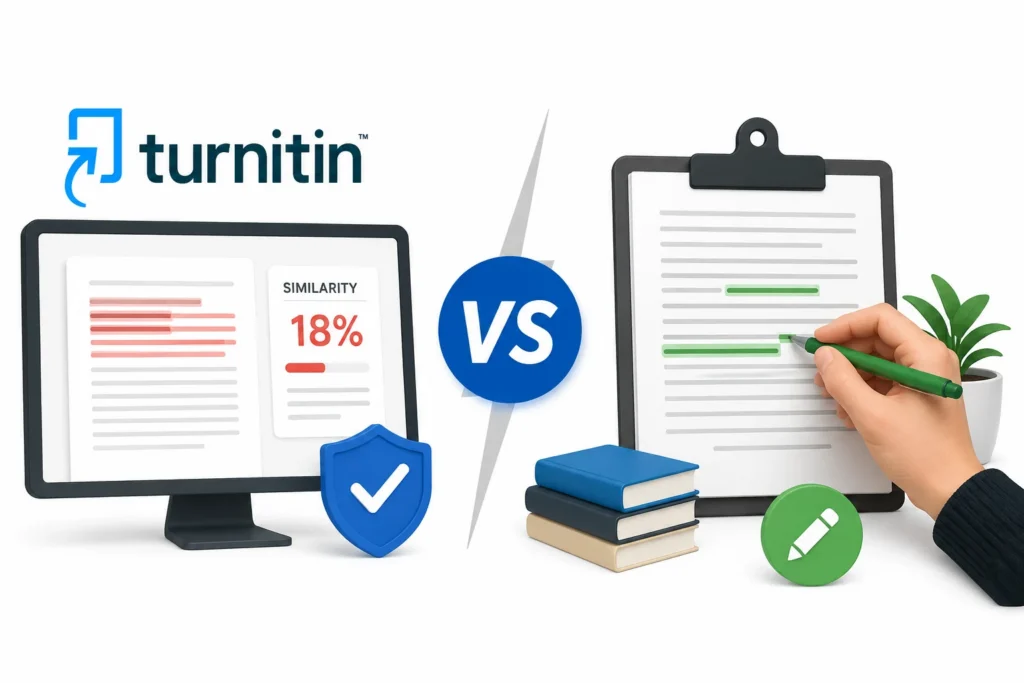
Turnitin vs Manual Editing: Turnitin is excellent for detection and identifying overlap, but it does not improve your writing. Manual editing, on the other hand, allows real transformation of content structure, originality, and clarity.
Understanding how both approaches work can help you choose the right strategy for effective plagiarism removal.
What Turnitin Actually Does
Many students misunderstand Turnitin’s purpose.
Turnitin is not a plagiarism remover.
It is a detection system designed to compare submitted documents against:
- Academic databases
- Research publications
- Websites
- Institutional archives
- Previously submitted student papers
It highlights matched content and generates a similarity score.
This makes Turnitin plagiarism checker useful for identifying potential overlap—but it does not rewrite or improve the content for you.
Think of it as a diagnostic tool rather than a correction tool.
Where Turnitin Performs Best
Turnitin is highly effective for identifying:
Source Overlap
It quickly detects exact or closely matching text.
Citation Problems
Improperly attributed material often becomes visible immediately.
Repeated Structural Matches
Large copied blocks are easy to identify.
Draft Evaluation
Students can review reports before final submission.
This makes Turnitin useful for plagiarism detection tools and early-stage content review.
However, detection alone does not solve originality problems.
The Limits of Automated Detection
While powerful, Turnitin has clear limitations.
It cannot:
- Rewrite weak paraphrasing
- Improve academic flow
- Add originality
- Interpret context deeply
- Preserve meaning during revision
This is where manual plagiarism removal becomes essential.
Detection software shows where problems exist.
Human editing fixes why they exist.
What Manual Editing Does Better
Manual editing transforms writing rather than simply identifying overlap.
A skilled editor can:
- Restructure ideas naturally
- Improve sentence flow
- Strengthen paraphrasing
- Preserve technical accuracy
- Add original interpretation
This produces stronger original academic writing while lowering similarity more effectively.
Unlike software-driven rewriting tools, human editing considers meaning, tone, context, and academic purpose.
That makes it far more reliable for serious plagiarism removal services.
Why Manual Editing Reduces Similarity More Effectively
Similarity often comes from structural repetition rather than exact word copying.
Turnitin may highlight these overlaps, but only thoughtful rewriting removes them properly.
Manual editing improves:
- Sentence architecture
- Logical progression
- Analytical depth
- Contextual originality
This naturally lowers similarity while strengthening readability.
For meaningful Turnitin similarity reduction, manual intervention is usually the stronger solution.
The Accuracy Factor
Turnitin reports can occasionally create false positives.
Common causes include:
- Properly cited quotations
- Technical definitions
- Institutional templates
- Frequently used academic phrasing
Software cannot always distinguish harmless overlap from problematic similarity.
Manual review adds human judgment.
Editors can evaluate whether flagged content truly needs revision or can remain unchanged.
This reduces unnecessary rewriting and preserves academic precision.
Speed vs Quality
Turnitin delivers results quickly.
Within minutes, users can see similarity reports and source matches.
Manual editing takes more time because it requires analysis, rewriting, and quality review.
However, speed does not always equal effectiveness.
For final submissions, quality matters more than instant percentages.
Strong manual plagiarism removal often saves time long-term by preventing repeated revisions.
When Turnitin Is the Better Choice
Turnitin works best when you need:
- Initial originality checks
- Similarity percentage review
- Citation verification
- Early draft diagnostics
It is ideal for identifying where edits are needed.
But it should rarely be the final step.
When Manual Editing Is Better
Manual editing is best when:
- Similarity remains high after checking
- Paraphrasing needs improvement
- Writing sounds unnatural
- Technical meaning must stay precise
- Final submission quality matters
This is where professional plagiarism removal services provide real value.
The Best Solution: Use Both Together
The smartest strategy is not choosing one over the other.
It is combining both.
Start with Turnitin plagiarism checker to locate overlap.
Then apply manual plagiarism removal to improve originality naturally.
This hybrid process offers:
- Accurate detection
- Better rewriting
- Stronger academic integrity
- Lower similarity risk
- Higher content quality
Together, they produce the strongest results.
Final Verdict
In the debate of Turnitin vs manual editing, there is no true competition.
Turnitin detects.
Manual editing improves.
If your goal is simply identifying overlap, Turnitin is enough.
If your goal is genuine plagiarism removal, stronger originality, and polished academic writing, manual editing is the better solution.
The most effective path combines both—technology for detection and human expertise for refinement.
That is how real originality is built.
Book a free consultation for appointment
Email us at : grow@simbi.in