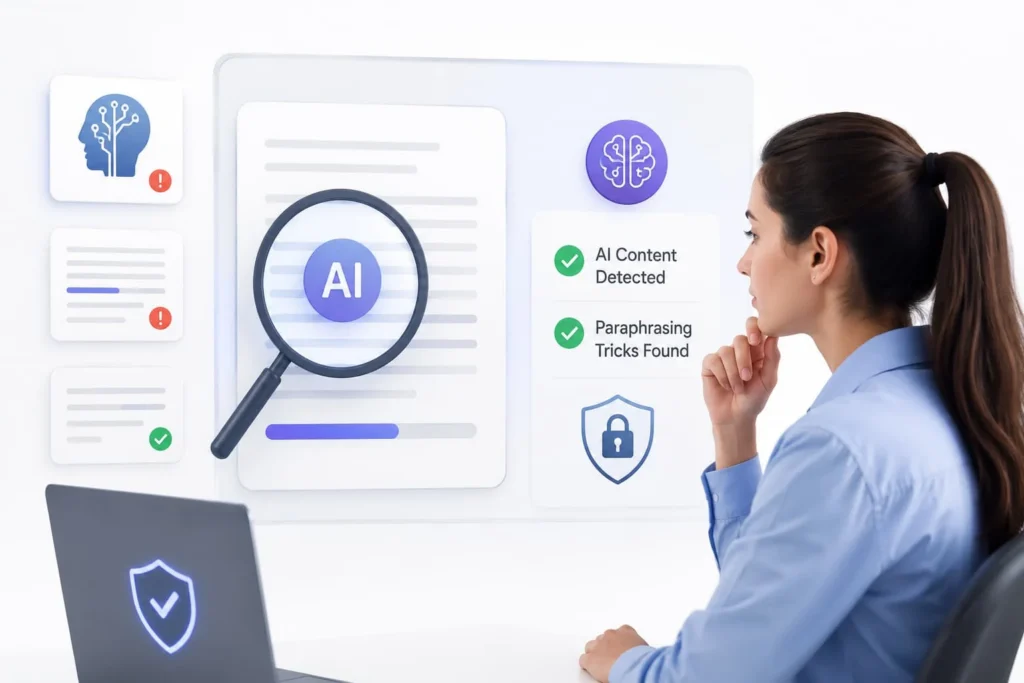
How DrillBit Detects AI Content and Paraphrasing Tricks
Why Students Are Asking This More Often
With AI writing tools becoming more common in education, students are increasingly concerned about how plagiarism systems respond to AI-assisted content.
Many assume that rewriting generated text with paraphrasing tools is enough to avoid detection. Others believe plagiarism software only checks copied sentences.
That assumption is outdated.
Modern systems like DrillBit plagiarism checker are becoming more advanced in how they identify suspicious patterns. In How DrillBit Detects AI Content and Paraphrasing Tricks, it is explained that these tools do not just compare exact wording. They also evaluate structural similarity, paraphrasing behavior, and text consistency.
Understanding how DrillBit detects AI content helps students write more responsibly and avoid accidental originality issues during university submission.
DrillBit Looks Beyond Exact Word Matches
Traditional plagiarism detection focused mostly on direct copy-and-paste overlap.
Modern DrillBit AI detection methods go further.
Instead of scanning only for identical phrases, DrillBit also analyzes deeper writing patterns such as:
- Structural similarity
- Sentence arrangement
- Paraphrase resemblance
- Contextual overlap
- Repeated source transformation patterns
This means simply replacing words is often not enough.
If the structure remains too close to the original source, DrillBit may still flag the content.
This is one reason paraphrasing detection tools have become more effective.
How DrillBit Detects AI-Generated Writing
While DrillBit’s primary strength is plagiarism detection, its analysis systems can identify characteristics often associated with machine-generated writing.
These patterns include:
Predictable Sentence Flow
AI-generated content often follows highly consistent language progression.
Sentences tend to feel polished but mathematically predictable.
Human writing usually contains more natural variation.
This predictability helps support DrillBit AI detection analysis.
Read Also : DrillBit Plagiarism Report Analysis | How to Read and Fix Errors Step-by-Step
Uniform Writing Structure
AI tools often generate balanced paragraphs with similar pacing.
This includes:
- Repetitive sentence length
- Consistent transition style
- Even analytical rhythm
When too much structural uniformity appears, it can trigger deeper AI content analysis.
Generic Academic Tone
AI writing frequently sounds polished but lacks unique interpretation.
It often explains concepts clearly without showing deeper personal reasoning or analytical nuance.
DrillBit may detect this surface-level consistency when reviewing originality.
Why Paraphrasing Tricks Often Fail
Many students try using rewriting tools to avoid plagiarism reports.
Most of these tools simply:
- Replace words with synonyms
- Rearrange phrases mechanically
- Preserve original sentence logic
This creates what detection systems recognize as structural paraphrasing overlap.
Modern paraphrasing detection tools are designed to identify exactly this kind of shallow rewriting.
That is why many “instant plagiarism removers” fail against systems like DrillBit.
Structural Similarity Is a Major Detection Factor
One of the strongest indicators in how DrillBit detects AI content is structural similarity.
Even if wording changes, DrillBit can identify when:
- Sentence order remains unchanged
- Argument flow mirrors source material
- Supporting points appear identically
- Paragraph progression follows original logic
This means originality depends on conceptual rewriting—not cosmetic editing.
Strong plagiarism-free university submissions require genuine re-expression of ideas.
Can Human Writing Get Flagged?
Yes.
Like all automated systems, DrillBit AI detection is not perfect.
Original human writing may sometimes trigger similarity concerns when it appears:
- Highly formal
- Technically repetitive
- Heavily edited
- Structurally predictable
- Built from common academic templates
This is why human review remains essential.
A report flag is a signal for evaluation—not automatic proof of misconduct.
How to Avoid DrillBit Detection Problems Ethically
The best strategy is not trying to trick the system.
Instead, focus on genuine originality.
Effective methods include:
Rewrite From Understanding
Read source material, then explain concepts independently.
Add Personal Analysis
Include your interpretation and reasoning.
Vary Sentence Rhythm
Natural academic writing rarely sounds perfectly uniform.
Verify Citations Carefully
Attribution protects borrowed ideas.
Limit AI Draft Dependence
Use AI for support, not final submission.
These steps naturally reduce DrillBit plagiarism checker concerns.
Why Human Revision Works Better Than Automation
Automatic rewriting tools often weaken content.
They create:
- Broken flow
- Distorted meaning
- Awkward syntax
- Detectable transformation patterns
Human editing preserves clarity and originality.
This produces stronger original academic writing and safer submissions.
The Role of Responsible AI Use
AI is not inherently problematic.
Used responsibly, it can help with:
- Brainstorming
- Outlining
- Research organization
- Grammar improvement
Problems arise when raw AI-generated content is submitted without thoughtful revision.
Ethical writing means transforming assistance into personal academic ownership.
That is the safest response to DrillBit AI detection.
Final Thoughts
Understanding how DrillBit detects AI content and paraphrasing tricks helps students avoid common mistakes.
DrillBit looks beyond exact word matching to analyze structure, predictability, and paraphrase patterns.
Simple rewriting shortcuts rarely work.
The strongest protection is thoughtful human revision, accurate citation, and genuine understanding of your subject.
That is what creates truly plagiarism-free university submissions—and what no detection system can mistake.
Book a free consultation for appointment
Email us at : grow@simbi.in