
Temporary Clinical Research Staffing Solutions: Enabling Agile Clinical Operations in a Dynamic Research Environment

Clinical trials rarely progress exactly as planned. Enrollment can ramp up more quickly than expected, new research sites can open within weeks, protocol changes may add more work, and you might find the staffing levels to be less than anticipated, causing significant study time delays. Sponsors and Contract Research Organizations (CROs) need to adapt their staffing strategies to meet the evolving operational needs of clinical trials today, while maintaining regulatory compliance and study integrity.
This evolving landscape has made Temporary Clinical Research Staffing Solutions an essential component of modern clinical operations. Temporary contracting is not a temporary solution for a more permanent job position, but for the business to be able to put the right experts in place at the right time in their role. Temporary staffing can be helpful for the start-up of a Phase I study, during the study’s enrollment peak, or for special regulatory knowledge needed for a protocol amendment.
Temporary staffing is different from traditional recruitment, as it is based on responsiveness, scalability, and subject matter expertise. Temporary staffing is a growing operational trend in clinical development programs around the world, helping organizations enhance study execution while minimizing long-term commitments to staff.
Workforce Elasticity: Responding to Dynamic Clinical Trial Demands
Clinical development programs are not often still. Study priorities evolve constantly as recruitment performance, the rates of site activation, regulatory feedback, and protocol changes continually mold the shape of the study. Fixed staffing can be problematic when an organization needs to scale up when the workload increases or when expertise is needed on a specific task.
Hiring for studies is elastic, with sponsors hiring more or fewer temporary clinical research personnel as needed. Organizations can save by replacing permanent capacity with trained professionals in the exact location where they’re needed, without unnecessarily paying for excess staff.
Temporary staffing becomes particularly valuable during situations such as:
- Rapid activation of new research sites
- Unexpected participant enrollment growth
- Temporary absence of key clinical personnel
- Peak monitoring and audit preparation activities
- Protocol amendments requiring additional expertise
- Database cleaning and study close-out support
- Specialized therapeutic or regulatory projects
- Short-term clinical research initiatives
This flexible workforce model helps organizations maintain study momentum while minimizing delays caused by resource shortages.
Operational Trigger vs Temporary Staffing Response
| Operational Trigger | Temporary Staffing Response |
| Rapid participant enrollment | Additional Clinical Research Coordinators |
| New site activation | Clinical Research Associates and Site Management support |
| Protocol amendments | Regulatory Affairs and Medical Writing specialists |
| Unexpected workforce vacancy | Immediate experienced professional deployment |
| Monitoring backlog | Temporary CRA allocation |
| Database lock activities | Clinical Data Management professionals |
Rather than viewing temporary staffing as an emergency solution, leading sponsors increasingly incorporate it into long-term workforce planning to improve organizational agility.
Accelerating Study Timelines Without Expanding Permanent Teams
One of the greatest advantages of Temporary Clinical Research Staffing Solutions is the ability to strengthen operational capacity without permanently increasing organizational headcount. Many clinical research portfolios have cyclical patterns of activity, with increased numbers of staff required for study start-up, recruitment, monitoring or close-out, before reverting to baseline numbers.
Over staffing permanent teams for temporary jobs could lead to waste of resources and unnecessary long-term expenses. Temporary staffing is a solution that meets this challenge, enabling companies to meet project demands with the right number of employees at the right time and place.
An effective temporary staffing strategy supports:
- Faster project initiation
- Reduced recruitment delays
- Flexible workforce scaling
- Access to specialized therapeutic expertise
- Improved resource utilization across multiple studies
- Operational continuity during workforce transitions
- Better budget management for short-duration projects
This approach allows sponsors to respond rapidly to operational changes while preserving the flexibility needed to manage diverse clinical development portfolios.
Clinical Workforce Deployment Cycle
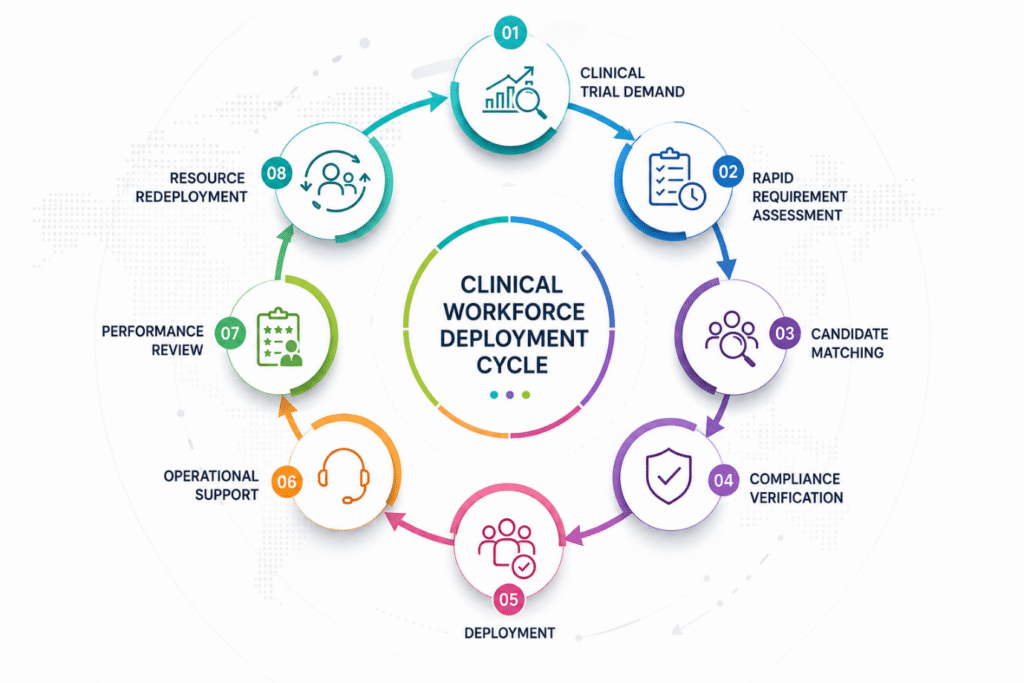
Maintaining Operational Continuity During Workforce Transitions
Replacement staff and reallocation of internal resources cannot be done during a clinical trial. The length of time before the workforce becomes available can impact participant scheduling, monitoring activities, documentation quality, and regulatory timelines. By mitigating these disruptions, temporary staffing allows experienced professionals to be placed into the study with minimal training, allowing them to get to work on the project quickly.
Successful workforce transitions typically depend on:
- Standardized onboarding procedures
- Protocol-specific training
- Clear communication between sponsor and site teams
- Structured knowledge transfer
- Consistent documentation practices
- Continuous performance monitoring
Organizations that establish structured transition processes significantly reduce operational risk while maintaining productivity throughout workforce changes.
Workforce Intelligence Through Flexible Staffing Models
Traditional approaches to workforce models are no longer an option, as clinical research organizations are finding it more and more critical to implement intelligent staffing strategies that are operationally flexible and automate resource planning on the fly. No longer considered as a temporary solution, temporary staffing is now a part of workforce intelligence, allowing sponsors and CROs to match skilled staff with changing study needs.
Temporary staffing fits into workforce planning, allowing staffing to be adjusted as the operational needs of the organization evolve without disrupting the clinical work that is already under way. By doing so, project leaders can implement the use of an experienced workforce wherever it’s needed without losing sight of workforce utilization, study performance or resource availability.
Modern workforce intelligence focuses on:
- Forecasting staffing demand before operational bottlenecks occur
- Maintaining access to pre-qualified clinical professionals
- Aligning specialist expertise with protocol complexity
- Supporting simultaneous studies without overextending internal teams
- Improving workforce utilization across multiple research programs
- Enabling rapid onboarding through standardized deployment processes
Rather than reacting to workforce shortages after they occur, organizations that adopt intelligent staffing strategies proactively strengthen operational resilience throughout the clinical trial lifecycle.
Temporary Staffing Strategy by Clinical Research Scenario
| Clinical Research Scenario | Recommended Temporary Staffing Solution |
| Phase I study startup | Clinical Research Coordinators and Clinical Trial Assistants |
| Rapid site expansion | Clinical Research Associates and Site Management professionals |
| Peak participant recruitment | Additional CRCs and Recruitment Specialists |
| Regulatory inspection readiness | Regulatory Affairs and Quality Assurance professionals |
| Database lock activities | Clinical Data Managers |
| Specialized therapeutic study | Subject Matter Experts with therapeutic experience |
Selecting the appropriate staffing strategy based on the operational context allows organizations to maintain quality while optimizing workforce efficiency.
Temporary Workforce Decision Framework
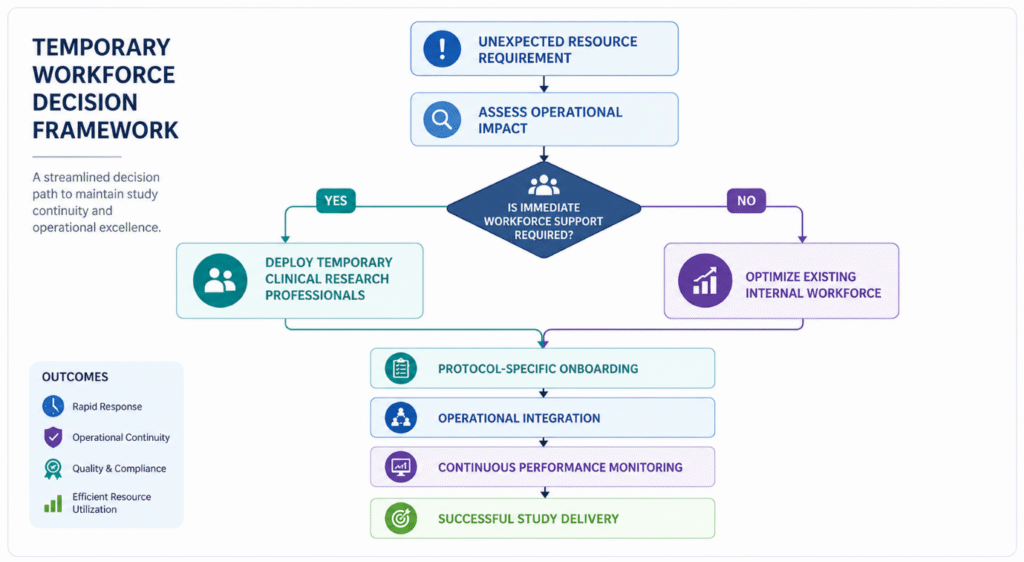
About Simbi Labs India
Clinical research requires flexible and reliable models of workforce. Simbi Labs India supports pharmaceutical companies, biotechnology organizations, Contract Research Organizations (CROs), hospitals, and research institutions by providing Temporary Clinical Research Staffing Solutions tailored to project-specific requirements. Simbi Labs India enables organizations to meet evolving workforce needs, ensure continuity of operations, comply with regulations and deliver quality studies, all in a timely manner, due to its access to experienced clinical professionals with diverse clinical backgrounds, standardized onboarding procedures and scalable deployment capabilities.
In today’s rapidly evolving clinical research landscape, temporary staffing has emerged as a strategic asset for organizations. With increasing time scales in study conduct and changing operational needs, sponsors and CROs need to have staffing models that can evolve while maintaining quality and compliance. By leveraging Temporary Clinical Research Staffing Solutions, organizations can ensure they have the right experts in the right place at the right time, keeping their studies on track, making the most of available resources and adapting to evolving clinical development demands.
Build an Agile Clinical Research Workforce
Unexpected staffing requirements shouldn’t delay clinical progress. Whether you’re launching a new study, expanding research sites, or responding to short-term operational demands, Simbi Labs India provides Temporary Clinical Research Staffing Solutions that enable sponsors and CROs to deploy experienced professionals quickly while maintaining quality, compliance, and operational continuity. Connect with our experts to develop a workforce strategy that adapts to your evolving clinical research needs.
Book a free consultation for appointment
Email us at : grow@simbi.in
Frequently Asked Questions
1. What are Temporary Clinical Research Staffing Solutions?
Temporary Clinical Research Staffing Solutions offer the healthcare industry a way to meet immediate clinical research needs by engaging qualified staff on a temporary basis, allowing sponsors and CROs to keep their studies on track without adding to their permanent workforce.
2. When should organizations consider temporary clinical research staffing?
Temporary staffing can be particularly useful when study start-up, study site activation, participant enrollments are spiking, protocol amendments, regulatory inspections, workforce transition and database lock activities are occurring.
3. Which clinical research professionals can be hired through temporary staffing?
Clinical Research Associates (CRAs), Clinical Research Coordinators (CRCs), Clinical Data Managers, Regulatory Affairs Specialists, Medical Writers, Quality Assurance (QA), Pharmacovigilance (PV) specialists and other clinical experts can be deployed as per the study requirement.
4. How do Temporary Clinical Research Staffing Solutions improve operational efficiency?
They enable rapid workforce deployment, reduce recruitment delays, strengthen workforce flexibility, support specialized expertise, and help organizations respond quickly to changing operational demands while maintaining study quality.
5. Can temporary staffing support multi-center and decentralized clinical trials?
Yes. Temporary staffing models can provide experienced professionals across multiple research sites and decentralized trial environments, helping sponsors scale operations efficiently while maintaining standardized processes.
6. How quickly can temporary clinical research professionals be deployed?
Deployment timelines depend on study scope, functional requirements, and resource availability. Experienced clinical staffing partners with established talent networks can often mobilize qualified professionals significantly faster than traditional recruitment processes.