
Crowd Management in Emergency Department: Strategies for Efficient Care
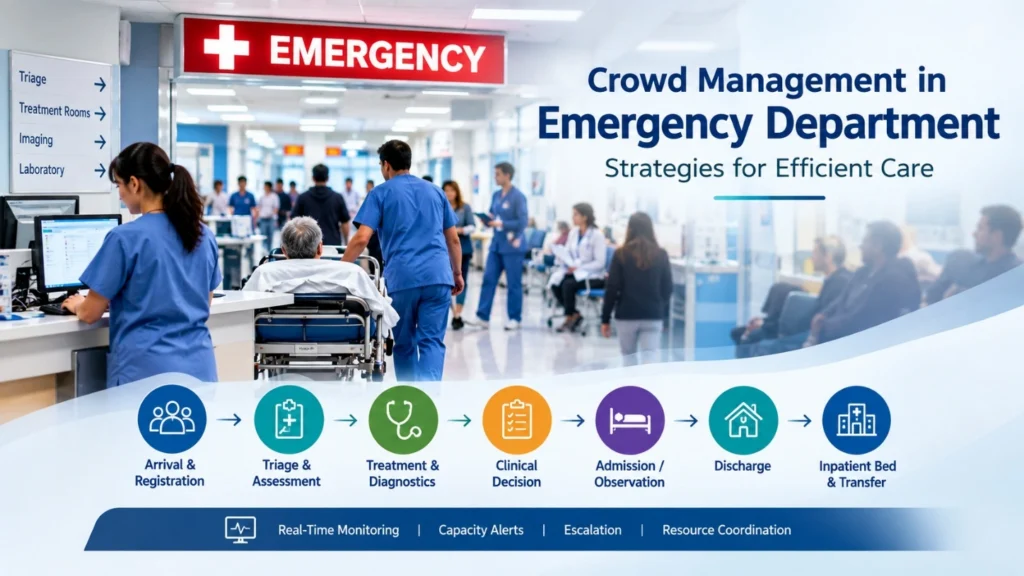
Emergency departments must provide rapid care despite unpredictable patient volumes, limited beds, staffing constraints, and time-sensitive decisions. When demand exceeds capacity, congestion can occur across triage, diagnostics, treatment, admission, and discharge.
Effective crowd management involves coordinating the entire patient-flow system to prioritise care, use resources efficiently, identify delays early, and maintain safe patient movement. It also requires hospital-wide capacity management, as admitted patients waiting for inpatient beds can occupy ED spaces and increase delays for new arrivals.
Understanding the Causes of Emergency Department Crowding
Emergency Department (ED) crowding generally develops through a combination of input, throughput, and output pressures:
1.Input: Refers to the number and type of patients arriving at the emergency department.
Examples include sudden increases in patient arrivals, seasonal surges, or high-acuity cases.
2.Throughput: Includes the processes that occur after patients arrive, such as:
a. Triage
b. Medical assessment
c. Diagnostic investigations
d. Specialist consultation
e. Treatment and clinical decision-making
3. Output: Refers to what happens after a clinical decision is made, including:
a. Discharge
b. Transfer to another facility
c. Admission to an inpatient unit

READ THIS ALSO: Crowd Control Management Plan: Strategies for Safer Events
Operational Challenges and Strategies for Managing ED Crowding
| Crowding Point | Common Operational Problem | Appropriate Management Strategy | Potential Benefit |
| Patient arrival | Sudden increase in patient volume | Rapid registration and structured triage | Faster identification of clinical urgency |
| Initial assessment | Patients waiting for a treatment space | Provider-in-triage and direct assessment | Earlier clinical decision-making |
| Treatment area | Limited beds or examination rooms | Fast-track and acuity-based pathways | Better use of available capacity |
| Diagnostics | Delayed laboratory or imaging results | Turnaround-time monitoring and prioritised workflows | Fewer treatment delays |
| Admission | Admitted patients waiting in the ED | Hospital-wide bed coordination | Reduced boarding |
| Discharge | Delays in completing discharge | Early discharge planning and coordination | Faster release of treatment capacity |
Rapid Triage and Early Clinical Assessment
Triage is essential in emergency crowd management as it prioritises patients according to clinical urgency. A structured system should quickly identify those needing immediate intervention while directing lower-acuity cases to suitable alternative pathways. During high-demand periods, rapid registration, direct bedding, provider-in-triage models, and parallel processing can reduce delays.
Parallel processing allows registration, initial assessment, and selected investigations to occur simultaneously where appropriate. The aim is to reduce the time from arrival to meaningful clinical assessment without compromising safety.
READ ALSO: How Engineers Predict Safe Evacuation Time
Creating Flexible Patient-Flow Pathways
Emergency patients have varying clinical needs, making a single workflow inefficient. An acuity-based system can direct critically ill patients to resuscitation areas, moderate-acuity patients to investigation or observation pathways, and suitable low-acuity cases to fast-track services.
Matching resources to clinical needs can reduce congestion and improve patient flow. Standardised pathways, nurse-initiated protocols, predefined investigations, and early senior review can further minimise unnecessary waiting while maintaining appropriate care.
Key Indicators for Measuring Emergency Department Crowding
| Indicator | What it measures | Why it matters |
| Door-to-clinician time | Time until clinical assessment | Measures front-end delay |
| ED LOS | Total ED stay | Measures overall flow |
| Boarding time | Time admitted patients remain in ED | Indicates output constraints |
| Diagnostic turnaround time | Investigation completion time | Identifies throughput delays |
| Left-before-assessment rate | Patients leaving without assessment | Indicates access problems |
| Treatment-space occupancy | Use of available treatment spaces | Indicates capacity pressure |

Managing Diagnostic and Treatment Bottlenecks
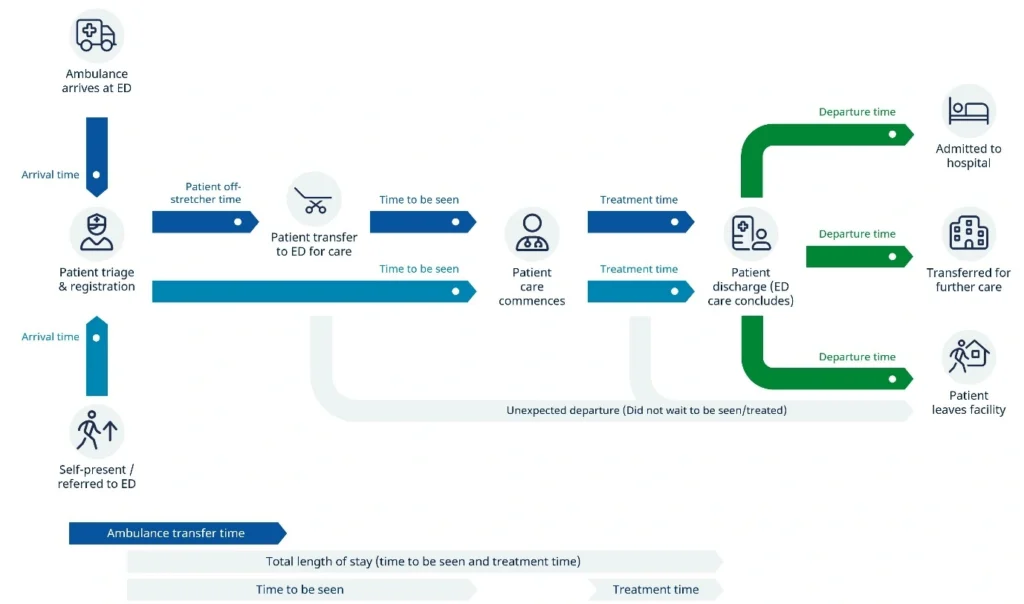
Diagnostic delays can create hidden congestion when patients remain in treatment areas awaiting laboratory results, imaging, specialist review, or reassessment. Monitoring investigation turnaround times and aligning diagnostic capacity with demand can reduce these delays. Real-time dashboards can track patient volume, bed occupancy, boarding, and diagnostic delays, enabling timely escalation measures before congestion becomes critical.
Reducing Emergency Department Waiting Times
Hospital-Wide Management of Boarding and Inpatient Capacity
ED crowding often results from limited inpatient capacity, as admitted patients may remain in the ED while waiting for beds. Coordinated hospital-wide patient flow, including timely discharge, bed allocation, cleaning, and patient transfers, can reduce boarding and maintain emergency capacity.
Technology and Real-Time Capacity Monitoring
Technology can support ED crowd management through real-time dashboards that track arrivals, waiting times, beds, staffing, and patient flow. Historical data can help anticipate demand and guide staffing, while capacity alerts can trigger predefined responses to emerging bottlenecks.
Communication, Safety, and Staff Coordination
Effective crowd management requires clear communication with patients and coordinated roles among clinical, administrative, diagnostic, security, and support teams. Aligning staffing with predictable demand peaks can reduce delays, staff fatigue, and avoidable bottlenecks.
Example of End-to-End Crowd Management
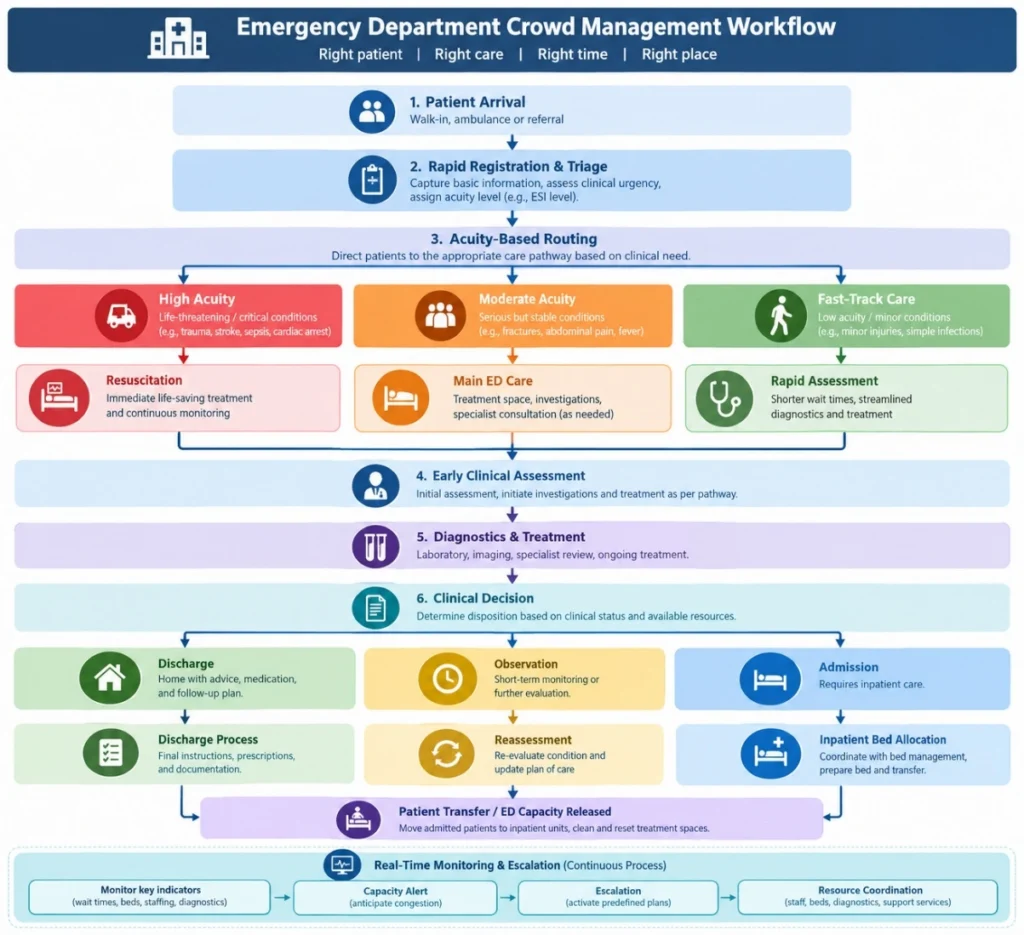
A hospital emergency department with 30 treatment spaces experiences a sudden evening surge, with patients arriving with chest pain, fractures, fever, abdominal symptoms, and minor injuries. As the number of patients increases, waiting times begin to rise and treatment spaces become limited. The department activates its crowd-management approach to maintain safe and efficient patient flow.
Stage 1 – Arrival & Triage: Rapid registration and triage prioritise patients according to clinical urgency.
Stage 2 – Early Assessment: Provider-in-triage enables prompt assessment and early investigations.
Stage 3 – Care Pathways: Patients are directed to high-, moderate-, or low-acuity treatment pathways.
Stage 4 – Capacity Monitoring: Real-time monitoring identifies diagnostic delays and inpatient bed shortages.
Stage 5 – Hospital-Wide Escalation: Bed-management and support teams coordinate transfers and accelerate patient movement.
Stage 6 – Discharge & Bed Recovery: Discharged or admitted patients leave the ED, while treatment spaces are cleaned and returned to service.
Measuring the Effectiveness of Crowd Management
Crowd-management initiatives should be evaluated using operational, clinical, and patient-centred indicators, including waiting times, treatment time, ED length of stay, diagnostic turnaround, and boarding duration. Effectiveness should be assessed holistically by considering efficiency, patient safety, quality of care, staff wellbeing, and patient experience, rather than relying on a single measure.
Building a Sustainable Emergency Department Flow System
Crowd management should be proactive, with predefined capacity levels and corresponding escalation measures. Routine conditions can use standard processes, while increased demand may trigger rapid assessment, additional staffing, or senior oversight; critical conditions can activate hospital-wide bed-management measures to accelerate patient flow and prevent severe overcrowding.
Emergency Department Crowd Management Workflow
Get in Touch with Simbi Labs
Effective emergency department management combines technology, efficient workflows, real-time information, and informed decision-making. Healthcare organisations can connect with Simbi Labs to explore solutions for improving patient flow, operational visibility, and technology-enabled healthcare management aligned with their specific needs.
Book a free consultation for appointmentEmail us at : grow@simbi.in