
Crowd Safety Audit: What Every Public Facility Should Know
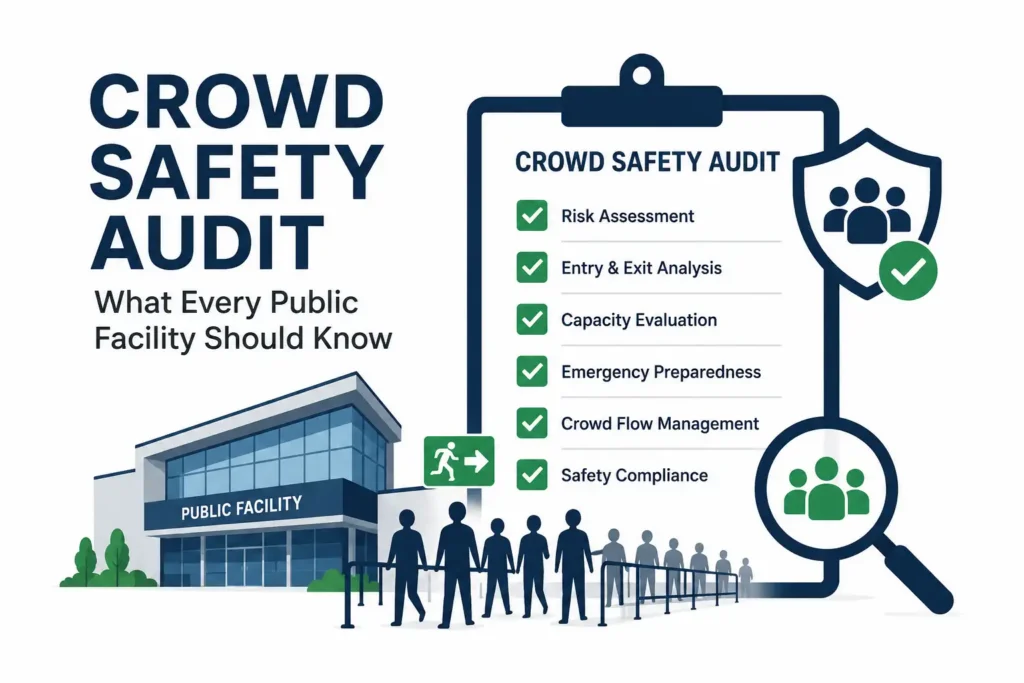
Public facilities such as airports, railway stations, hospitals, shopping malls, stadiums, universities, convention centers, temples, museums, and government buildings serve thousands of visitors every day. Although these spaces are designed to accommodate large crowds, rising occupancy levels, special events, emergency situations, and changing pedestrian patterns can introduce unexpected safety risks.Crowd congestion, inefficient circulation routes, limited emergency exits, unclear wayfinding, and poor queue management can increase the likelihood of accidents during both normal operations and emergency situations.
A crowd safety audit is a structured assessment that examines how people move through a facility, identifies potential risks, and recommends practical improvements to enhance public safety and operational efficiency. Rather than relying only on building codes or visual inspections, modern crowd safety audits combine on-site observations, occupancy analysis, and simulation technologies to deliver evidence-based recommendations.Whether managing a transport hub, hospital, educational campus, or public venue, regular crowd safety audits have become an important part of responsible facility management.
What Is a Crowd Safety Audit?
A crowd safety audit is a systematic assessment of how safely a facility accommodates and manages pedestrian movement during normal operations, peak occupancy, and emergency situations.
Its purpose is to answer important questions such as:
- Can occupants move safely throughout the facility?
- Are entrances and exits adequate for the expected number of visitors?
- Where are congestion hotspots most likely to occur?
- Are emergency evacuation routes effective?
- Is the facility accessible to all users?
- Can the building safely manage special events or peak-hour crowds?
Unlike a standard building inspection, a crowd safety audit focuses on pedestrian movement, human behaviour, operational procedures, and emergency preparedness.
Why Public Facilities Need Crowd Safety Audits
Many public facilities experience significant changes in occupancy throughout the day.
For example:
- Hospitals experience sudden surges in emergency patients.
- Airports face peak departure and arrival periods.
- Railway stations become crowded during rush hours.
- Shopping malls attract large seasonal crowds.
- Universities experience heavy movement between classes.
- Stadiums manage simultaneous entry and exit of spectators.
- Government offices receive high visitor volumes during service hours.
Without regular safety assessments, even well-designed facilities can develop operational risks over time.
Common issues include:
- Overcrowded entrances
- Narrow walkways
- Long queues
- Conflicting pedestrian flows
- Blocked emergency exits
- Poor wayfinding
- Insufficient gathering areas
- Accessibility challenges
A crowd safety audit helps identify these issues before they develop into serious safety concerns.
Objectives of a Crowd Safety Audit
A comprehensive crowd safety audit aims to:
- Improve pedestrian safety
- Reduce congestion
- Strengthen emergency preparedness
- Evaluate evacuation performance
- Improve accessibility
- Optimize facility operations
- Ensure regulatory compliance
- Support long-term infrastructure planning
Crowd Safety Audit Methodology
An effective crowd safety audit follows a structured process that combines engineering analysis, field observations, and digital simulation to evaluate how a facility performs under different operating conditions.
Crowd Safety Audit Workflow
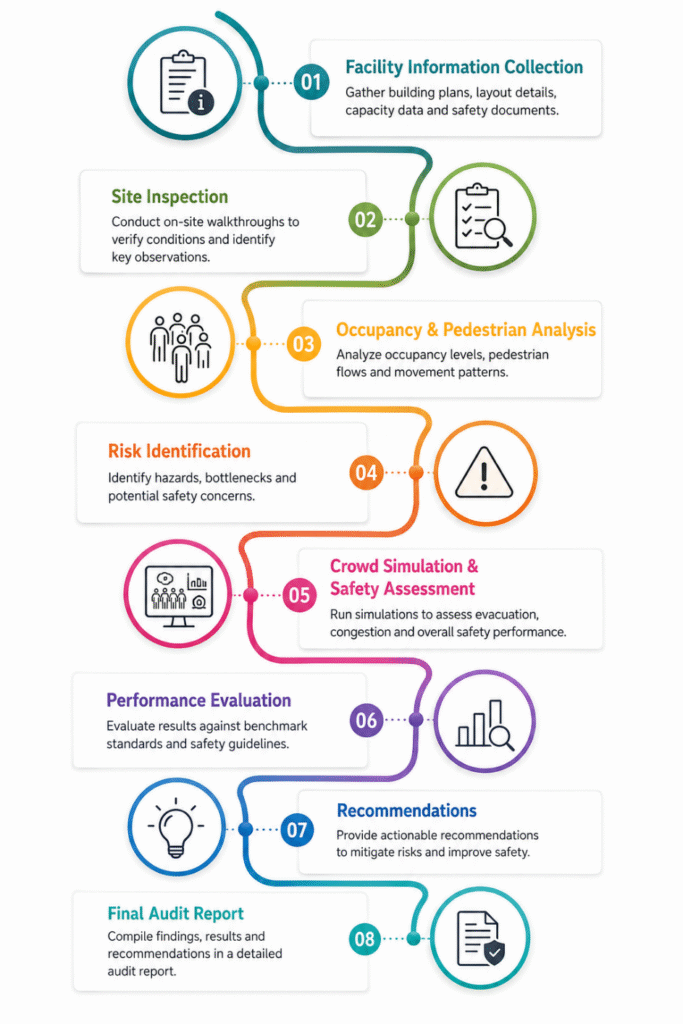
Step 1: Facility Information Collection
The audit begins with gathering essential information about the facility to establish a clear understanding of its design and daily operations.
Typical information includes:
- Building layout
- Floor plans
- Occupancy capacity
- Visitor statistics
- Operating hours
- Emergency plans
- Fire safety systems
- Existing safety policies
BIM models and CAD drawings are especially useful because they provide accurate and detailed information for the analysis.
Step 2: Site Inspection
A comprehensive site inspection is carried out to evaluate how the facility functions under real operating conditions.
Inspectors examine:
- Entrance and exit usage
- Corridor widths
- Staircases
- Elevators
- Waiting areas
- Queue management
- Signage
- Emergency exits
- Accessibility features
- Security checkpoints
Photographs, measurements, and operational observations are recorded throughout this stage.
Step 3: Occupancy and Pedestrian Analysis
Understanding how people move through the facility is one of the most important parts of the audit.
Analysts collect information such as:
- Peak-hour occupancy
- Walking routes
- Queue lengths
- Travel times
- Crowd density
- Waiting times
- Visitor behavior
- Event-related crowd patterns
This information forms the basis for the next stages of the assessment.
Step 4: Risk Identification
After the field data has been collected, auditors identify areas where crowd safety may be at risk.
Common issues include:
- Congestion bottlenecks
- Dead-end circulation
- Conflicting pedestrian streams
- Limited emergency exits
- Poor visibility
- Insufficient waiting space
- Inadequate signage
- Obstructed escape routes
Each identified risk is prioritized according to its likelihood of occurring and the severity of its potential impact.
Step 5: Crowd Simulation and Safety Assessment
Modern crowd safety assessments increasingly rely on simulation software to evaluate a range of operating scenarios.
Simulation can be used to analyze:
- Daily pedestrian movement
- Peak-hour congestion
- Emergency evacuation
- Fire scenarios
- Special event management
- Temporary facility modifications
Unlike manual observations, simulation makes it possible to evaluate multiple “what-if” scenarios without interrupting normal facility operations.
Technologies and Software Used
Advanced technologies have transformed the way crowd safety audits are performed.
| Software / Technology | Primary Purpose | Typical Users |
| Pathfinder | Occupant evacuation simulation | Fire Engineers |
| MassMotion | High-density pedestrian movement | Transport Authorities |
| GAMA Platform | Agent-based crowd behavior modeling | Researchers |
| NetLogo | Behavioral simulation | Universities |
| AnyLogic | Multi-method operational simulation | Smart City Consultants |
| Fire Dynamics Simulator (FDS) | Smoke and fire analysis | Fire Engineers |
| Autodesk Revit (BIM) | Building information modeling | Architects |
| QGIS / ArcGIS | Spatial crowd mapping | Urban Planners |
| AI Video Analytics | Real-time crowd monitoring | Facility Managers |
| IoT Occupancy Sensors | Live occupancy tracking | Smart Buildings |
How Technology Strengthens Crowd Safety Audits
Today’s audit teams often pair BIM models in Autodesk Revit with simulation tools such as Pathfinder, MassMotion, or GAMA Platform. Live occupancy information from IoT sensors and AI-supported CCTV systems can verify simulation results and guide continuous operational improvements. Geographic Information Systems (GIS) help map crowd density and pedestrian movement across large campuses or transport facilities.
Key Observations During a Crowd Safety Audit
During inspections, auditors typically focus on several operational indicators.
| Audit Area | Typical Observation | Possible Risk |
| Entrances | Long queues | Delayed access |
| Corridors | High pedestrian density | Congestion |
| Staircases | Uneven usage | Slow evacuation |
| Elevators | Peak-hour delays | Overcrowding |
| Waiting Areas | Insufficient capacity | Standing congestion |
| Emergency Exits | Obstructions | Unsafe evacuation |
| Signage | Poor visibility | Navigation confusion |
| Accessibility | Missing ramps or guidance | Reduced inclusivity |
Recommendations After the Audit
The final report should provide practical, prioritized recommendations.
Common recommendations include:
Infrastructure Improvements
- Widen critical corridors
- Increase exit capacity
- Improve signage
- Add emergency lighting
- Reconfigure waiting areas
Operational Improvements
- Adjust visitor scheduling
- Improve queue management
- Increase staffing during peak hours
- Introduce one-way pedestrian flow where appropriate
Technology Enhancements
- Install occupancy sensors
- Implement AI-based crowd monitoring
- Develop digital twin models
- Use real-time dashboards
- Integrate emergency communication systems
Emergency Preparedness
- Conduct regular evacuation drills
- Update emergency response plans
- Train facility personnel
- Review evacuation signage periodically
Real-World Case Study: Crowd Safety Audit at a Major Railway Station
A busy metropolitan railway station serving more than 180,000 passengers each day was experiencing repeated congestion during weekday peak hours. Passengers frequently reported overcrowded ticketing areas, narrow pedestrian walkways, and delays while accessing platforms.
Challenge
Station management wanted to improve passenger safety and traffic flow without carrying out costly structural modifications.
Solution
A multidisciplinary team conducted a crowd safety audit using:
- On-site pedestrian observations during morning and evening peak hours
- Passenger flow data collected from ticketing systems
- MassMotion to simulate everyday pedestrian circulation
- Pathfinder to assess emergency evacuation scenarios
- BIM models and station floor plans to build an accurate digital model
Findings
The audit highlighted several important issues:
- Two staircases handled more than 70% of all vertical passenger movement.
- Ticket queues regularly blocked the main circulation corridor.
- Platform exits created intersecting pedestrian flows during train arrivals.
- Wayfinding signage was inadequate for first-time passengers.
Recommendations Implemented
The station authority:
- Relocated ticket vending machines away from main pedestrian routes.
- Installed directional barriers to separate incoming and outgoing passenger flows.
- Added more digital wayfinding signage.
- Created designated waiting areas near the platforms.
- Enhanced emergency evacuation routes and staff training.
Results
Within a few months of implementation, passenger movement became noticeably smoother during peak hours. Queue spillover into walking corridors was greatly reduced, evacuation simulations indicated faster clearance times, and passenger feedback reflected easier navigation and improved comfort. The project demonstrated how a structured crowd safety audit combined with simulation can deliver meaningful safety improvements without requiring major construction.
Benefits of Conducting Regular Crowd Safety Audits
Organizations that carry out regular crowd safety audits can achieve several long-term benefits:
- Improved public safety
- Reduced accident risks
- Better emergency preparedness
- Data-driven facility management
- Higher operational efficiency
- Compliance with safety standards
- Improved visitor satisfaction
- Better accessibility
- Reduced liability exposure
- Support for future infrastructure expansion
Best Practices
For the best results, public facilities should:
- Conduct crowd safety audits regularly and after major renovations.
- Assess both normal operations and emergency scenarios.
- Collect real occupancy data whenever possible.
- Use simulation tools to compare alternative solutions.
- Review findings with architects, fire engineers, and facility managers.
- Prioritize recommendations based on risk level and operational impact.
- Monitor improvements through regular follow-up assessments.
Future Trends in Crowd Safety Assessment
Digital technologies are making crowd safety audits more accurate and proactive. Emerging developments include:
- AI-powered predictive crowd risk analysis
- Digital twin models for continuous facility monitoring
- Real-time occupancy dashboards
- Drone-assisted inspections for large venues
- Machine learning for congestion forecasting
- Smart CCTV with behavioural analytics
- IoT-enabled emergency response systems
These innovations will help public facilities shift from reactive safety management to proactive, data-driven risk prevention.
Conclusion
A crowd safety audit is much more than a regulatory requirement. It is a proactive approach to protecting people while improving the performance of public facilities. By combining field inspections, operational observations, occupancy analysis, and advanced assessment methods such as crowd simulation, organizations can identify potential risks before they develop into serious incidents.
Whether managing a railway station, airport, hospital, university, stadium, shopping mall, or government building, regular audits supported by technologies such as Pathfinder, MassMotion, GAMA Platform, NetLogo, Fire Dynamics Simulator (FDS), Revit BIM, and GIS help create safer, more efficient, and future-ready environments for everyone.
Book a free consultation for appointment
Email us at :grow@simbi.in
Frequently Asked Questions (FAQs)
1. What is a crowd safety audit?
A crowd safety audit is a systematic assessment of pedestrian movement, facility layout, emergency preparedness, and operational procedures to identify and reduce crowd-related risks.
2. Who should conduct a crowd safety audit?
Qualified teams typically include facility managers, fire engineers, architects, safety consultants, crowd management specialists, and emergency planning professionals.
3. How often should a public facility perform a crowd safety audit?
High-occupancy facilities should carry out audits regularly, following major renovations, before large events, or whenever significant changes in occupancy or operations occur.
4. Which software is commonly used during crowd safety assessments?
Commonly used tools include Pathfinder, MassMotion, GAMA Platform, NetLogo, AnyLogic, Fire Dynamics Simulator (FDS), Autodesk Revit, and QGIS/ArcGIS.
5. Can crowd simulation improve the accuracy of safety audits?
Yes. Crowd simulation enables auditors to evaluate routine operations, emergency evacuations, and multiple “what-if” scenarios, providing data-driven insights that are difficult to obtain through observation alone.
6. Which facilities benefit most from crowd safety audits?
Airports, railway stations, hospitals, universities, stadiums, shopping malls, convention centers, government buildings, museums, temples, and other high-occupancy public facilities benefit significantly from regular crowd safety assessments.