Business Expansion Strategies for Food Manufacturing
Introduction
The food industry is evolving faster than ever. Consumer tastes are shifting, demand for processed and packaged foods is growing, and expectations for quality and convenience are rising. For food manufacturers, this is both a challenge and an opportunity. Expanding a food manufacturing business today means more than just increasing output—it’s about being smarter, faster, and more adaptable.
Implementing effective Business Expansion Strategies for Food Manufacturing can help businesses stay competitive in a rapidly changing market.
Objectives of Expansion
- Increase production capacity to meet rising demand.
- Expand into new domestic and international markets.
- Improve operational efficiency through technology.
- Diversify product offerings to reduce risk.
- Strengthen brand presence and customer loyalty.
Types of Expansion Strategies
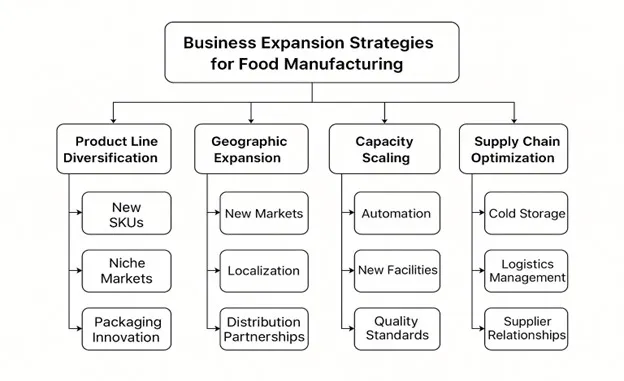
A. Product Line Diversification
| Strategy | Description |
| New Product Variants | Launching new flavors, sizes, or health-oriented options. |
| Functional Foods | Adding value through nutrition (e.g., probiotics, protein-rich). |
| Packaging Innovation | Convenience-oriented (microwavable, resealable, eco-friendly). |
B. Geographic Expansion
Business Expansion Strategies for Food Manufacturing often include tapping into emerging markets to boost sales.
| Strategy | Description |
| Regional Distribution | Expansion to underserved areas within current country. |
| International Entry | Exporting or setting up manufacturing units abroad. |
| Franchising / Licensing | Low-risk entry into new territories. |
Understanding the nuances of Business Expansion Strategies for Food Manufacturing can lead to substantial growth.
Adopting innovative Business Expansion Strategies for Food Manufacturing can drive efficiency and profitability.
Evaluating potential Business Expansion Strategies for Food Manufacturing is crucial before implementation.
C. Capacity Scaling
Successful Business Expansion Strategies for Food Manufacturing require comprehensive market research.
| Strategy | Description |
| Facility Expansion | Establishing new plants or increasing the size of current ones. |
| Process Automation | Use of machines and robotics for consistency and efficiency. |
| Workforce Development | Training for new tech and quality management systems. |
D. Supply Chain Optimization
| Strategy | Description |
| Vendor Consolidation | Partnering with fewer, reliable suppliers for quality control. |
| Cold Chain Development | Essential for perishable goods to reduce spoilage. |
| Digital Inventory Systems | Real-time stock updates to reduce waste and overproduction. |
Technology-Driven Expansion
Utilising data-driven insights can enhance Business Expansion Strategies for Food Manufacturing.
Digital Tools and Automatiaon
- IoT-enabled machinery for real-time performance tracking.
- ERP systems for integrated production, finance, HR, and logistics.
- AI-powered forecasting to match production with demand trends.
Data Analytics
- Customer behavior analysis to inform product development.
- Predictive maintenance of machinery to reduce downtime.
Financial Planning for Expansion
| Area | Key Considerations |
| Capital Expenditure (CAPEX) | Machinery, land, building, automation setup. |
| Operating Expenditure (OPEX) | Hiring, training, raw materials, logistics. |
| Funding Options | Business loans, private equity, government subsidies. |
| Break-Even Analysis | Evaluating profitability timelines. |
Legal and Regulatory Compliance
- FSSAI: For food safety in India.
- ISO 22000: International food safety management standard.
- FDA / Codex Alimentarius: For international exports.
- Environmental Regulations: For sustainable operations and packaging.
Sustainability and CSR in Expansion
Risk assessment is an integral part of Business Expansion Strategies for Food Manufacturing.
- Use of biodegradable packaging materials.
- Investment in water and energy-efficient technology.
- Sourcing from local farmers to reduce carbon footprint and promote rural development.
Many Food Manufacturing companies rely on Business Expansion Strategies for Food Manufacturing to capture new customer bases.
Human Resource Strategy
| Area | Strategic Focus |
| Recruitment | Skilled labor for automated systems and quality assurance. |
| Training Programs | Hygiene, safety, machinery operations. |
| Leadership Development | For plant heads, production managers, and quality officers. |
Risk Management in Expansion
Integrating sustainability into Business Expansion Strategies for Food Manufacturing can enhance brand loyalty.
| Risk Type | Mitigation Strategies |
| Market Risk | Pilot testing in new regions before full-scale entry. |
| Supply Chain Disruptions | Multi-vendor policy, local sourcing alternatives. |
| Operational Inefficiencies | Continuous process improvement (Kaizen, Lean Manufacturing). |
| Compliance Issues | Regular audits, staff training, third-party certification. |
Implementation
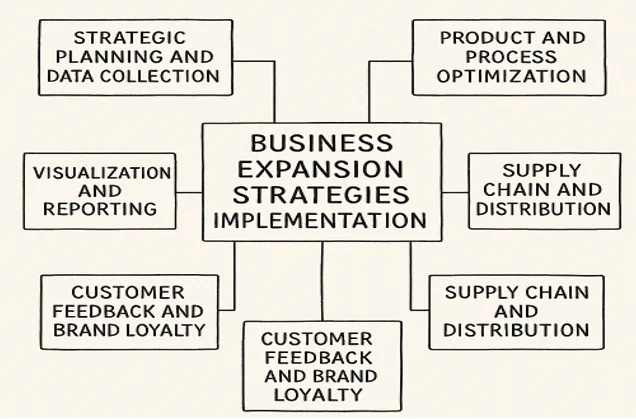
1. Strategic Planning and Data Collection
- Define business expansion goals (new market, product line, capacity increase).
- Conduct SWOT and PESTLE analyses to assess internal and external environments.
- Identify relevant KPIs (sales, profit margin, product return rate, etc.).
- Collect data from:
- Internal sources: CRM, ERP, sales records.
- External sources: market surveys, government reports, industry publications.
Adopting global standards in Business Expansion Strategies for Food Manufacturing can streamline operations.
Effective communication is key in Business Expansion Strategies for Food Manufacturing.
To succeed, Business Expansion Strategies for Food Manufacturing must align with market demands.
2. Market and Consumer Analysis
- Use Descriptive Statistics to summarize customer demand and preferences.
- Perform Cluster Analysis to segment customers (e.g., by geography, age, income).
- Apply Conjoint Analysis to identify product features that customers prioritize.
- Use Time Series Analysis to understand demand trends and seasonality.
- Apply Cross-tabulation to compare preferences by demographics or regions.
3. Product and Process Optimization
- Monitor quality using Control Charts (SPC) to detect defects or variations.
- Use Design of Experiments (DOE) to test different processing conditions.
- Apply Regression Analysis to forecast production needs based on variables like labor hours, material costs, etc.
- Conduct ABC Analysis to classify inventory and focus on high-impact items.
4. Financial and Risk Evaluation
- Perform Break-even Analysis to identify the minimum sales required to cover costs.
- Conduct Scenario Analysis to model risks under various business conditions.
- Use Sensitivity Analysis to see how small changes in input affect outcomes (profit, cost).
- Run Cost-Benefit Analysis to evaluate the return on investment (ROI) of expansion activities.
5. Supply Chain and Distribution
- Optimize transport and warehouse logistics using Linear Programming.
- Conduct Monte Carlo Simulation to model uncertainties in supply chain (e.g., fuel price, delivery delays).
- Evaluate vendor performance using control charts or trend analysis.
- Forecast demand and inventory using predictive analytics.
6. Customer Feedback and Brand Loyalty
- Collect feedback via surveys (using Likert scale, Net Promoter Score – NPS).
- Analyze customer sentiment from reviews and comments using sentiment analysis (manual if AI-free).
- Correlate customer satisfaction with KPIs using correlation and regression.
- Monitor brand engagement and feedback over time using statistical tracking.
7. Visualization and Reporting
- Use tools like Excel, Power BI, or Tableau to:
- Build real-time dashboards.
- Visualize trends in sales, customer behavior, production efficiency.
- Generate clean reports for stakeholders and investors.
Statistical & Analytical Techniques for Business Expansion in Food Manufacturing
1. Descriptive Statistics
Used to summarize and understand current data from production, sales, or customer feedback.
- Mean, Median, Mode – To understand average production, demand, or sales figures.
- Standard Deviation & Variance – To measure consistency in sales, production time, or costs.
- Frequency Distribution – To identify which products or markets are performing best.
2. Market Segmentation & Cluster Analysis
Helps identify customer groups or geographic segments that behave similarly.
- K-Means Clustering – Groups similar markets or customer preferences.
- Hierarchical Clustering – Breaks down regional preferences for targeted marketing or product planning.
3. Forecasting Techniques
Used to predict future demand, sales, and raw material needs—crucial for capacity planning.
- Time Series Analysis (ARIMA, Exponential Smoothing) – Predicts future sales based on past patterns.
- Moving Averages – Simple method to smoothen out sales data for short-term forecasts.
- Seasonal Decomposition – Identifies and separates seasonal trends in sales (e.g., festival spikes).
4. Regression Analysis
Used to examine relationships between variables—ideal for pricing, promotions, and production cost modeling.
- Linear Regression – To see how pricing or marketing spend affects sales.
- Multiple Regression – To analyze how several factors together impact demand or profit.
- Logistic Regression – To predict binary outcomes (e.g., success/failure of a new product launch).
Companies should continuously refine their Business Expansion Strategies for Food Manufacturing.
5. Control Charts & Quality Tools
Used in manufacturing to ensure process consistency and detect issues early.
- X-bar & R charts – Monitor consistency in production batches.
- Pareto Analysis – Identify the most common causes of defects or delays.
- Cause-and-Effect (Fishbone) Diagrams – Root cause analysis for quality or supply issues.
Understanding consumer behaviour enhances Business Expansion Strategies for Food Manufacturing.
6. Decision Tree Analysis
Helps in choosing between multiple expansion options by comparing costs, benefits, and probabilities of success.
- Useful for deciding between building a new plant, outsourcing, or entering a new market.
7. Survey Analysis for Consumer Feedback
When launching new products or entering new markets:
- Use Likert Scale Analysis to measure customer preferences.
- Perform Cross-tabulations to compare feedback across different customer groups.
- Run Chi-square Tests to find if preferences significantly differ between regions or demographics.
Recommended Software for Statistical Analysis
Feedback loops are crucial in refining Business Expansion Strategies for Food Manufacturing.
SPSS
For market research, factor analysis, regression
Stata
Market trends should inform Business Expansion Strategies for Food Manufacturing decisions.
For Time series, panel data, advanced econometrics
R/Python
For Custom modelling, machine learning, simulations
Excel
For Basic descriptive statistics, forecasting
Minitab
For Quality control, Six Sigma
Role of Simbi Labs in Supporting Expansion
Simbi Labs provides strategic, data-driven, and technical support for food manufacturers planning expansion:
- Feasibility Studies: Market entry research and cost-benefit analysis.
- Data Analytics Consulting: For demand forecasting, customer segmentation, and pricing.
- Process Optimization: Suggesting best practices in production, quality control, and supply chain.
- Training Services: Technical and regulatory training for factory staff and managers.
- Customized ERP/Tech Solutions: For real-time operations management.
Conclusion
Successful business expansion in the food manufacturing sector relies on a combination of strategic planning, market insight, compliance, and operational efficiency. By adopting the right mix of product, geographic, technological, and supply chain strategies, food manufacturers can scale sustainably and competitively.
Ready to Expand Your Food Business with Effective Business Expansion Strategies for Food Manufacturing?
Let’s talk about how you can improve operations, reach new customers, and grow without unnecessary stress. Our team at Simbi Labs offers a free 30-minute consultation to understand your goals and share practical ways to move forward.
Book a free consultation for appointment
Email us at : grow@simbi.in
For an in-depth understanding, please refer to our book, “Academic Research Fundamentals: Research Writing and Data Analysis”. It is available as an eBook here, or you may purchase the hardcopy here .
Investing in technology can support Business Expansion Strategies for Food Manufacturing.
Simbi Labs can guide your Business Expansion Strategies for Food Manufacturing effectively.
The right partners can enhance your Business Expansion Strategies for Food Manufacturing.
Leveraging local partnerships is vital for successful Business Expansion Strategies for Food Manufacturing.
Customer insights drive effective Business Expansion Strategies for Food Manufacturing.
In conclusion, successful Business Expansion Strategies for Food Manufacturing are complex yet achievable.