
Data Cleaning and Validation in Survey Research: Why It Matters for Accurate Insights
Data Cleaning and Validation in Survey Research is crucial for ensuring the quality and accuracy of insights derived from survey data.
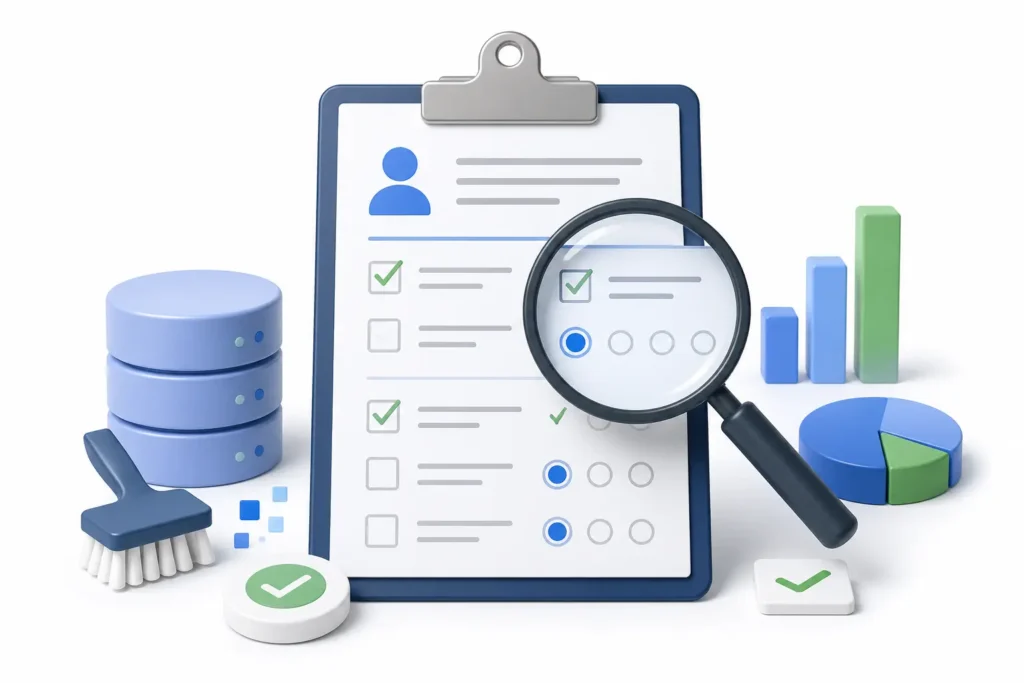
Why Collected Data Is Not Always Ready for Analysis
In most research projects data collection is viewed as the last step to follow however, in reality, it is the only initial step to the analytical journey. Raw survey data are usually characterised by inconsistencies, missing values and errors, which can greatly impact the accuracy of results when they are not tackled. It is here that data cleaning is critical as it will help to convert unstructured and imperfect data into a suitable basis to build analysis.
To researchers, businesses and academic professionals, effective data cleaning is essential in ensuring that the insights are accurate and operational.
Understanding the Role of Data Cleaning in Surveys
The systematic process of recognizing, rectifying, and tabulating data in a manner that renders it acceptable to the meaningful analysis, is what is referred to as data cleaning. It is not a one-step process but rather a continuous process that enhances the overall quality and usability of the data.
It is not only to eliminate errors but also to promote consistency, completeness, and logical correctness of all responses, which is the main purpose of data cleaning. In the absence of this process, even well crafted surveys are likely to give distorted results which will undermine the quality of the research.
Why Data Validation Is Equally Important
Although data cleaning is aimed at correcting the problems, data validation is intended to ensure that the data is obtained according to the predefined requirements and standards. Collectively, the processes result in a robust quality management system, which increases reliability.
The validation methods can be used to ensure that responses are logically consistent, within the range of expectations, and in line with the design of the survey. Working in cooperation, data cleaning and validation provide a high level of reliability of the results and a decreased risk of the wrong analysis.
Common Data Issues That Affect Survey Quality
It is not uncommon to encounter recurring issues when working with survey datasets, and which have to be dealt with by means of subjecting the data to an appropriate data cleaning process:
• Missing Responses: Incomplete responses that decrease the reliability of the data set.
• Duplicate Entries: Two or more records of a single respondent.
• Ineffective Formats: Differences in data recording.
• Outliers: There are extreme figures that can be used to skew analysis.
• Invalid Inputs: Unreasonable or arbitrary answers.
The earlier detection of these issues simplifies and makes the data cleaning process more efficient and effective.
A Structured Approach to Data Cleaning
Initial Data Inspection
The first one is to have a full evaluation of the data to be able to notice apparent mistakes,
inconsistencies and strange patterns.
Handling Missing Values
Researchers can either discard incomplete responses, or with statistical techniques, make
estimates about missing data.
Removing Duplicates
Researchers can either erase unfinished responses or they can use Repeated entries are identified
and eliminated to make sure that each and every response is unique and valid.
Standardizing Data
Dates, categories and numerical values are uniformly applied to achieve consistency.
Detecting Outliers
Extreme values are examined to get the answer whether they are valid responses or errors.
Preparing Data for Analysis
Lastly, the data is organized in a manner that facilitates effective and efficient analysis.
This step-by-step method of data cleaning makes sure that the data is correct and fit to be interpreted.
Key Validation Techniques for Reliable Data
Good validation reinforces the results of data cleaning by making sure that all the entries correspond to the necessary standards:
- Checks within a Range: Check to ensure that the value is within the acceptable range.
- Consistency Checks: Check logical relationships among responses.
- Format validation: validate the proper use of data formats.
- Cross-Verification: Compare related answers to check their accuracy.
- Real-Time Validation: Check the accuracy of data at the point of data collection using digital tools.
These methods are used in order to keep the dataset data intact.
Best Practices to Improve Data Quality
In order to get high-quality results, data cleaning needs to be covered by robust practices:
• Specify the validation rules prior to commencing data collection.
• Automated tools can be used to minimize manual errors.
• Ensure that there is proper documentation of all changes.
• Do frequent quality checks during the process.
• Integrate human inspection and automatic validation software.
The practices are consistent and reliably long-term.
Mistakes That Can Reduce Data Reliability
Despite having correct systems in place, some of the errors may undermine the data cleaning efficiency:
• Not taking into consideration any missing or incomplete data.
• Losing valuable information and removing too much data.
• Not recording any changes that were done during cleaning.
• Using manual processes alone.
• Omitting validation procedures altogether.
To ensure that the data is accurate, it is necessary to avoid these issues.
Tools That Support Efficient Data Cleaning
Modern tools make data cleaning faster and more effective by automating repetitive tasks and
improving accuracy:
• Spreadsheet tools for basic cleaning
• Programming languages for advanced processing
• Statistical software for structured analysis
• Data visualization platforms for quality checks
• Digital survey platforms with built-in validation
These tools enhance both efficiency and scalability.
Strengthening Data Through Quality Control
To guarantee the high level of quality control, professional data processes are characterized by the number of measures to guarantee the high level of quality control:
• Real-time monitoring systems
• Field data tracking of GPS and timestamps.
• Back checks and verifications.
• Automated validation rules
• Checks of consistency between datasets.
Professional expertise in Data Cleaning and Validation in Survey Research lends significant value to data analysis efforts.
In conclusion, Data Cleaning and Validation in Survey Research are pivotal to achieving meaningful and actionable findings.
Our services include comprehensive Data Cleaning and Validation in Survey Research to ensure your data is trustworthy.
Engaging with experts in Data Cleaning and Validation in Survey Research ensures the highest standards of data quality.
These systems enhance the success of data cleaning and validation.
Why Professional Expertise Enhances Data Cleaning
The work with large and complex data sets demands not only technical competencies, but also organised procedures. Professional teams contribute to knowledge of advanced methods of data validation, efficient workflow, and error minimization strategies, so that the data cleaning is both accurate and timely.
Experience mixed with technology will result in more dependable knowledge and enhanced research findings.
Final Insight
Data cleaning is not merely an instrument of technology–it is the basis of sound research. In its absence, even the best-gathered data may cause wrong inferences. The implementation of systematic approaches, employing the latest tools, and having high standards of validation can help researchers to be sure that their information is both useful and factual.
Effective data cleaning will finally result in superior decision and more believable results.
Looking for Clean and Reliable Data?
We offer to offer professional data cleaning, validation, and analysis services with the help of advanced tools and research-based techniques.
Connect with us so that your data is correct, consistent, and is ready to generate meaningful insights.
Book a free consultation for appointment
Email us at : grow@simbi.in