
Mobile-Based Survey Data Collection in India: Transforming Field Research in India
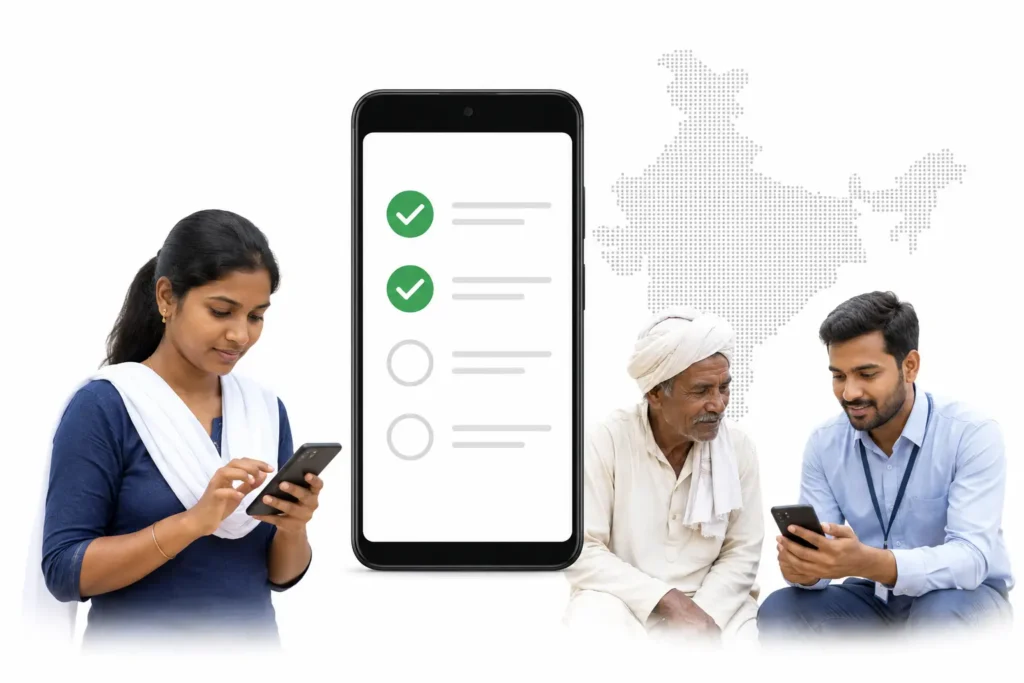
The Move from Paper to Smart Data Collection
Adjust the Basemap transparency, which is optional. Sometimes when you are styling your own data, the basemaps may feel too strong or too dark to adjust the transparency. Right-click the basemap, select the properties, go to transparency, reduce the opacity to around 70-80% if you want a softer background. This small tip can make your thematic maps look more professional, especially in projects related to Mobile-Based Survey Data Collection in India.
The rise of Mobile-Based Survey Data Collection in India has revolutionised how researchers engage with data in real-time.
This change is not merely an issue to do with convenience but reflects a larger need to have accuracy, speed, and scalability within the contemporary research setting where judgments are significantly reliant on real-time information.
What Makes Mobile Surveys Different
Mobile surveys are described as using smartphones or tablets to obtain responses via special applications, thus having direct access to respondents whilst allowing the structured gathering of data. This approach, often referred to as Mobile-Based Survey Data Collection in India, incorporates various functionalities like validation, storage, and synchronization in one system unlike the traditional methods.
The important features that characterize mobile surveys are the ability to work offline, real-time syncing, GPS positioning and multimedia input capabilities such as the ability to capture photos and audio. These characteristics enable them to be very flexible in various research environments in India.
How Mobile Surveys Operate in Practice
The process of conducting mobile surveys follows a streamlined workflow that improves both efficiency and control over data quality.
- Designing the Questionnaire: Digital forms are created using survey platforms with built-in logic and validation rules.
- Deploying to Devices: Surveys are uploaded to mobile devices used by field investigators.
- Collecting Data: Responses are recorded in real time or offline, depending on connectivity.
- Synchronizing Data: Once internet access is available, data is automatically uploaded to centralized servers.
- Monitoring Progress: Supervisors track field activity and validate incoming data continuously.
This structured flow ensures that mobile surveys remain consistent and reliable from start to finish.
Why Mobile Surveys Are Gaining Rapid Adoption
The increasing popularity of mobile surveys can be explained by their capacity to address the major problems that are inherent to the traditional data collection methods.
They not only eliminate manual data entry, but also reduce the possibility of human error, and enable the researcher to track the progress in real time. Moreover, they save a lot of costs of running an operation since there is no need to print or handle data physically.
In such a country as India where field research usually involves remote and varied areas, mobile surveys offer the flexibility and efficiency to effectively conduct a large-scale study.
Key Advantages of Mobile Surveys
- Higher Accuracy: Automated validation ensures that incorrect or incomplete responses are minimised.
- Real-Time Access: Data becomes instantly available for analysis and reporting.
- Cost Efficiency: Digital collection removes printing and manual processing expenses.
- Faster Turnaround: Results can be processed and delivered much more quickly.
- Improved Data Quality: Standardized formats ensure consistency across responses.
These benefits highlight why mobile surveys have become a preferred method across industries.
Choosing the Right Features for Mobile Surveys
When making the best out of mobile survey, it is important to consider the tools that will provide the necessary features like offline applications, easy-to-use interfaces, high level of data protection, and the capability to integrate with analytical systems.
The other features such as GPS tracking, customizable forms, and built-in validation rules further improve the reliability of the data collected and make mobile surveys more robust and scalable.
Best Practices for Effective Implementation
The success of mobile surveys depends not only on the tools used but also on how they are implemented in the field.
- Design clear and concise questionnaires to avoid confusion
- Train field investigators to ensure consistent data collection
- Use validation rules to reduce errors at the entry stage
- Monitor incoming data regularly to detect issues early
- Conduct pilot testing before full deployment
Following these practices helps maintain both efficiency and accuracy.
Challenges in Mobile Surveys and How to Manage Them
Despite their advantages, mobile surveys come with certain challenges that need careful handling.
- Technical issues with devices can disrupt data collection if backups are not in place
- Connectivity problems in remote areas require strong offline capabilities
- Data security risks must be addressed through secure platforms and encryption
- Inadequate training can reduce the effectiveness of field operations
Addressing these challenges ensures smoother execution and better results.
Technology Driving the Future of Mobile Surveys
The technology is constantly improving mobile surveys and turning them into smarter and more efficient. AI-based validation, cloud storage, real-time dashboards, and automated reporting systems now are the standard features, which enhance the quality and usability of the data.
These inventions are assisting researchers to shift to a more predictive and data-driven decision-making process.
Why Expertise Still Plays a Key Role
Mobile survey is an easy way of gathering data, but professional expertise is needed to make sure that the process is well designed and implemented. The teams who are experienced assist in choosing the correct tools, designing surveys in the most effective way, and ensuring that the quality of the data remains high throughout the project, especially for Mobile-Based Survey Data Collection in India.
Such a mix of technology and expertise results in more credible and valuable insights.
Final Perspective
Mobile surveys are no longer merely an alternative to traditional methods, but now have become the cornerstone of modern field research. They bring about faster, more accurate, and scalable data collection to enable organizations to gather high-quality data and make more informed decisions through Mobile-Based Survey Data Collection in India
The use of mobile survey is the way forward to the researchers and businesses in India to keep pace with the changing research standards.
Need End-to-End Mobile Survey Solutions?
We offer end-to-end digital data collection, mobile survey execution, advanced analytics, and research-inspired insights.
Get in touch with us and develop effective and quality data collection systems that suit you.
Book a free consultation for appointment
Email us at : grow@simbi.in
For an in-depth understanding, please refer to our book, “Academic Research Fundamentals: Research Writing and Data Analysis”. It is available as an eBook here, or you may purchase the hardcopy here .