
Data Collection for PhD Research in India: A Complete Guide for Scholars
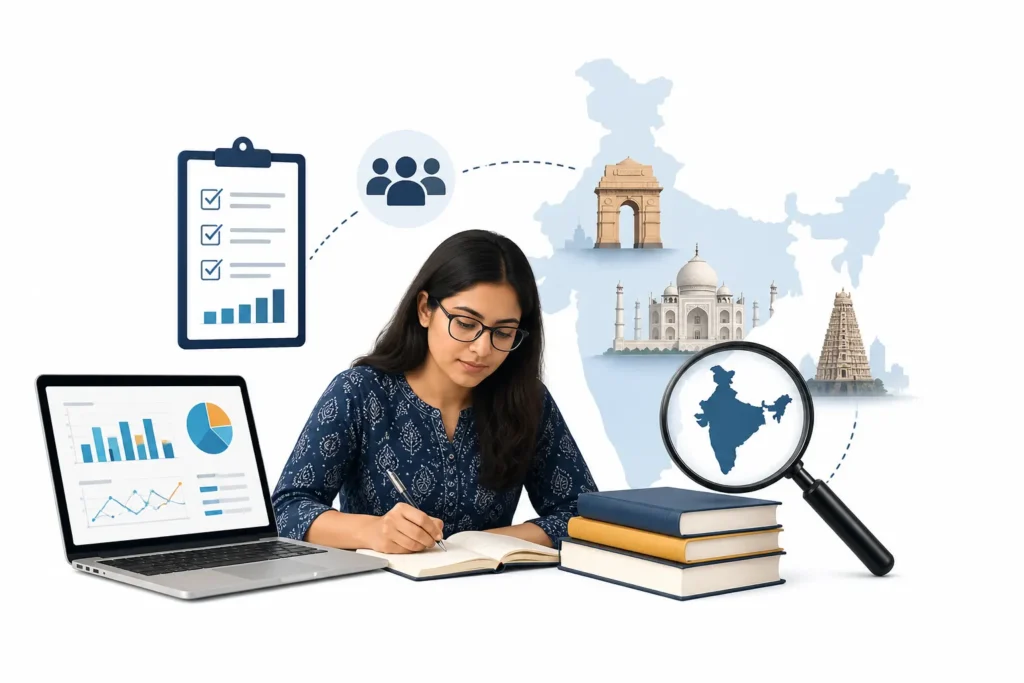
One of the most crucial steps in a doctoral research process is Data Collection in PhD Research in India and Data Collection for PhD Research in India. It entails gathering credible primary or secondary data to answer research questions, test hypotheses, and support academic findings. In the case of PhD scholars, data collection is not merely a technical activity but it directly influences the quality, credibility and acceptability of the entire thesis. The respondents, regions, languages, institutions and field conditions are highly varied in India, and proper planning and professional implementation is required.
What Is Data Collection for PhD Research?
Data Collection of PhD Research in India is defined as a systematic method of collecting data that is needed to conduct a research on PhD level. It can be in the form of surveys, interviews, focus group discussions, observation, case studies, institutional data, field visits or document analysis.
In some fields, the data collection of PhD might be quantitative, qualitative, or mixed-method. As an example, management scholars can run surveys of customers, social science researchers may run surveys of communities and healthcare researchers may run surveys of patients or institutions.
The primary aim is to gather valid, ethical, and research-relevant data that will uphold the study aims.
Why Data Collection Is Important for PhD Scholars
Evidence is vital to a PhD thesis. Although the research topic may be good, lack of proper data may spoil the results. Correct data will assist scholars to develop valid arguments, find patterns, support, and contribute to knowledge in academia.
In India, Data Collection for PhD Research in India is particularly significant since research settings are usually heterogenous. A research can take the form of urban and rural respondents, different education levels, different languages, different social or professional backgrounds.
Quality of data collection enhances the quality of scholarship and aids scholars in avoiding mistakes in the process of analyzing, interpreting and defending the thesis.
How PhD Data Collection Services Work
Professional research data collection services follow a structured process to support scholars while maintaining ethical research standards.
1. Understanding the Research Topic
The collection of data in professional research data collection services is structured in such a way that it aids the scholar in addition to upholding the ethical standards of research.
2. Supporting Research Methodology
The first one is to possess the knowledge of the research title, objectives, research questions, hypotheses and target population. This will help in deciding which type of data needs to be collected and the manner in which the data needs to be collected.
3. Questionnaire or Interview Guide Preparation
It is necessary to have a clear research methodology. This includes how to determine the sample size, sampling method, who will be targeted, how the data will be collected, geographical area to be covered and time.
The services of professionals help the scholars to align data collection and the university policies and research design.
4. Field Survey and Respondent Coordination
When dealing with survey based research, a questionnaire ought to be succinct, unbiased and properly structured. Where qualitative studies are concerned, the interview guides should encourage in-depth and detailed answers. A well-designed questionnaires enhance the quality of the responses and minimize confusion among the respondents.
The online surveys, offline field surveys, telephonic interviews, institutional visits, or face- to- face interactions can be used to collect the data. Field surveys are frequent in India where the respondents are not at ease with online surveys.
5. Data Cleaning and Data validation.
The responses are then checked against missing values, the same response and the different responses to the same question as well as incomplete responses. This enhances the accuracy of the data and readies the data to be analyzed.
6. Final Data Delivery
The data that has been cleaned can be shared in either Excel, Google sheets, SPSS-ready format or any other analysis-ready format depending on the requirement of the scholar.
Common Challenges in Data Collection for PhD Research in India
Most researchers have practical challenges in the process of data gathering.
Difficulty in Finding Respondents
It may prove difficult to find the right respondents, particularly when dealing with a niche research topic, industry-focused research, healthcare research, or institutional survey.
Low Response Rate
Most individuals fail to answer the surveys and more so online questionnaires. In most cases, follow-ups are necessary to ensure that sufficient valid responses are obtained.
Language and Regional Barriers
There are various languages and cultural contexts in India. A questionnaire that is written in English alone might not be effective as far as all target groups are concerned.
Time Limitations
PhD students usually juggle between research, teaching, work or family. Fieldwork management may turn out to be challenging when one handles it himself/herself.
Data Quality Issues
Thesis can be influenced by incomplete forms, random answers, duplicate responses and incorrect choice of respondents.
This is the reason why PhD Research in India, which requires professional Data Collection, can assist scholars in conducting fieldwork in a more systematic manner.
Key Features of Professional PhD Data Collection Support
Structured and ethical support should be offered by a reliable data collection partner for Data Collection for PhD Research in India. It has such features as questionnaire support, screening of respondents, online and offline survey implementation, field investigator assistance, multilinguality, data cleaning, and quality control.
Professional services are not supposed to forge, manipulate or produce false responses. Ethical data collection refers to the collection of actual reactions of actual respondents with due consent and confidentiality.
Benefits for PhD Scholars
Professional Data Collection for PhD Research in India saves time on research and enhances research reliability. Literature review, analysis, interpretation and thesis writing can be performed by scholars, meanwhile field execution is handled by trained teams.
These advantages are high-quality response, broader reach to respondents, increased speed in data collection, less field errors, and clean datasets to analyze.
Professional help may simplify and streamline the process of conducting the research to a scholar who works on large sample sizes or a multi-location study.
Tools and Technologies Used
The tools used in the process of data collection include Google Forms, Microsoft Forms, KoboToolbox, SurveyMonkey, Excel, SPSS-ready templates, mobile survey apps, and online interview platforms.
In the case of field-based research, GPS tagging, photo evidence, supervisor verification, and digital entry tools can also be employed. The technologies enhance transparency and minimise manual error.
Industry and Academic Use Cases
Data Collection for PhD Research in India is practical in most of the fields. Customer satisfaction, employee behavior, leadership, or marketing strategy are all possible subjects of study among management scholars. Researchers in healthcare can take surveys of patients or can do awareness studies. Education researchers can gather data of students, teachers or schools.
Researchers in the social sciences might use community survey, interview, or field research relating to policies. Scholars of commerce and economics can research the subject of business performance, financial behavior, or consumer decision-making.
Common Mistakes to Avoid
Researchers must not embark on data gathering without a definite methodology. The second type of error is the use of inept questionnaires which are not related to the research objectives.
Other errors that may occur include; selecting the wrong sample, collecting fewer valid responses than necessary, ignoring consent, using leading questions, and not validating the data before analyzing.
Proper planning and quality control can assist a professional service provider in minimizing these risks.
How to Choose the Right Data Collection Partner
In selecting a partner, you should consider their academic research experience, research methodology, strength of their field team, data privacy policies and their capacity to deal with your target respondents.
The provider must be open regarding process, timelines, sample collection, quality checks and data format. Above all, they ought to abide by sound research ethics and assist in only the true data collection.
Future Trends in PhD Data Collection
PhD data collection will involve the following aspects in the future: hybrid research approaches, mobile surveys, AI-enhanced data cleaning, real-time dashboards, online interview tools, and stricter data privacy regulations.
Nevertheless, field-based data collection will still be relevant in India since most studies will need personal interaction, regional comprehension, and direct participation of the respondents.
Conclusion
The PhD Research in India involves a careful planning of data collection, ethical collection, reliable collection of data and appropriate handling of data. Questions design and field surveys, validation and preparation of final dataset are all the steps that influence the strength of the final thesis, making Data Collection for PhD Research in India an essential part of successful academic research.
To academics, professional assistance may make the process easier and enhance the quality of data and the validity of the research.
Need a trustworthy and ethical guidance on your PhD data collection? Collaborate with an expert research data collection team in India to obtain real answers, confirm your research, and add confidence to your doctoral research.
Book a free consultation for appointment
Email us at : grow@simbi.in