
Outsourcing Data Collection: How It Reduces Cost and Improves Research Efficiency
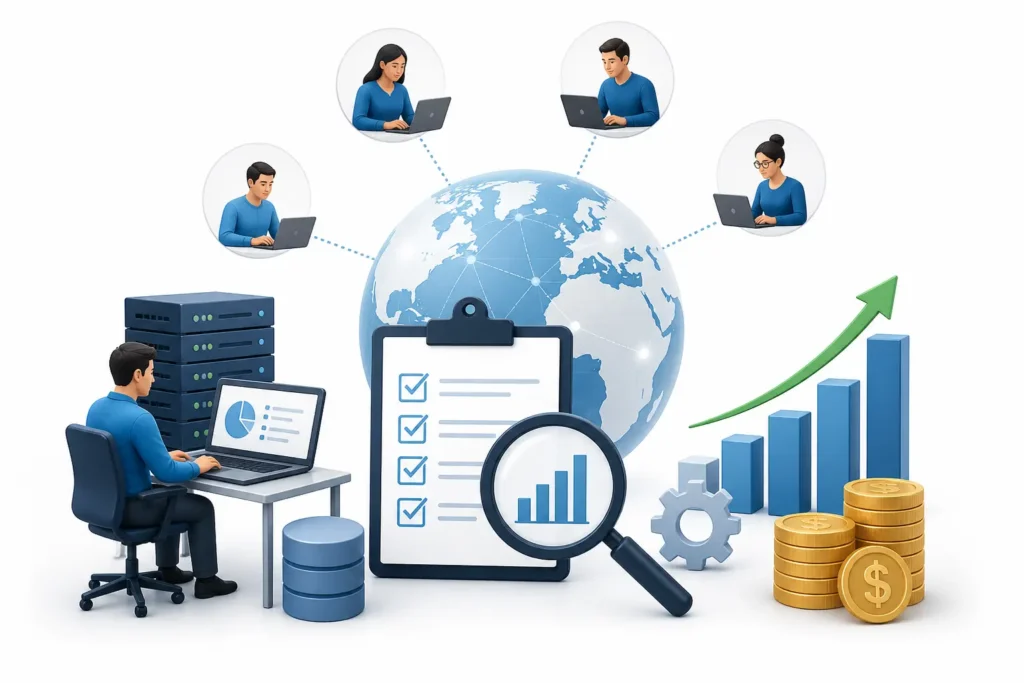
Outsourcing Data Collection is becoming a smart choice for businesses, researchers, institutions, NGOs, and students who need accurate data without managing the entire fieldwork process themselves. It means hiring a professional data collection agency to handle surveys, interviews, field visits, online forms, respondent coordination, data validation, and reporting. In India, where markets are diverse and field conditions can be complex, outsourcing helps save time, reduce cost, improve data quality, and make research projects more efficient.
What Is Outsourcing Data Collection?
Outsourcing Data Collection means assigning the data collection process to an external professional team instead of doing it internally. The service provider manages survey planning, field team deployment, respondent communication, data entry, quality checks, and final data delivery.
This may include online surveys, offline field surveys, telephonic interviews, customer feedback studies, household surveys, retailer surveys, B2B interviews, healthcare surveys, academic research, and market research projects.
For companies and researchers, outsourcing is useful because it allows them to focus on analysis, strategy, and decision-making while trained teams handle ground-level execution.
Why Outsourcing Data Collection Is Important in India
India has a wide range of languages, cultures, income groups, regions, and consumer behaviors. Conducting research across cities, towns, and rural areas requires planning, local understanding, trained field investigators, and proper supervision.
If a company tries to manage everything internally, it may need to hire temporary staff, train surveyors, arrange travel, monitor fieldwork, check data quality, and manage reporting. This can take significant time and increase hidden costs.
Outsourcing Data Collection helps businesses avoid these operational challenges. A professional agency already has the field network, tools, processes, and experience required to complete research projects efficiently.
How Outsourcing Data Collection Works
A professional data collection company follows a structured process to ensure reliable results.
1. Understanding the Research Requirement
The agency first studies the research objective, target audience, sample size, geography, timeline, and expected output. This helps create a practical execution plan.
2. Designing the Survey Methodology
The service provider helps decide whether the project needs online surveys, offline field visits, telephonic interviews, or a hybrid model. The methodology also includes respondent profile, location coverage, and sample distribution.
3. Preparing the Questionnaire
A clear questionnaire is prepared based on the research objective. Questions are designed to avoid confusion, bias, and repetition.
4. Deploying the Field Team
Trained field investigators, callers, or online survey coordinators collect responses from the target audience. For Indian markets, local language support can improve respondent participation.
5. Monitoring and Quality Control
Supervisors track survey progress, verify responses, check incomplete entries, remove duplicates, and ensure that the data meets quality standards.
6. Final Data Delivery
The cleaned data is shared in Excel, Google Sheets, dashboards, SPSS-ready format, or report format as required by the client.
Key Features of Professional Data Collection Outsourcing
Reliable Outsourcing Data Collection services include more than basic response collection. A professional agency provides planning, trained manpower, digital tools, supervision, validation, and reporting.
Key features include:
- Trained field survey teams
- Online and offline data collection support
- Multilingual respondent communication
- GPS tagging and photo verification where required
- Call-back checks and supervisor monitoring
- Data cleaning and structured reporting
- Confidential handling of respondent data
These features help ensure that the final data is accurate, usable, and research-ready.
How Outsourcing Saves Time
Time is one of the biggest benefits of Outsourcing Data Collection. Managing fieldwork internally requires recruitment, training, travel planning, respondent coordination, monitoring, and data checking.
A professional data collection company already has systems in place. This reduces setup time and speeds up execution.
For example, if a business needs 1,000 customer responses across multiple Indian cities, an agency can deploy teams faster than an internal team starting from scratch. This helps complete research within deadlines without disturbing regular business operations.
How Outsourcing Reduces Cost
Many organizations assume that doing data collection internally is cheaper. However, hidden costs can make internal execution expensive. These costs may include staff time, training, travel, supervision, software tools, data entry, error correction, and project delays.
Outsourcing Data Collection converts these scattered expenses into a planned service cost. The agency manages manpower, field logistics, quality checks, and reporting under one structured process.
It also reduces the cost of mistakes. Poor data can lead to wrong decisions, repeated surveys, and wasted budgets. Professional execution helps avoid these risks.
Benefits of Outsourcing Data Collection
The major benefits include faster execution, better data accuracy, reduced operational burden, wider respondent reach, and improved quality control.
Businesses can use outsourced data for market research, customer satisfaction studies, product testing, competitor analysis, and expansion planning. Researchers and students can use it for dissertations, thesis work, academic projects, and social research.
Outsourcing Data Collection also improves scalability. Whether the project needs 100 responses or 10,000 responses, a professional agency can plan resources according to the requirement.
Industry Use Cases in India
Market Research
Companies use outsourced data collection to study consumer behavior, brand awareness, pricing expectations, and product demand.
Healthcare and Pharmaceutical Research
Healthcare organisations collect data from patients, doctors, hospitals, pharmacists, and communities to understand awareness, treatment behavior, and service gaps.
Retail and FMCG
Retail audits, shopkeeper interviews, dealer surveys, and product availability checks help brands understand market performance.
Academic and PhD Research
Students, scholars, and institutions use professional support for surveys, interviews, fieldwork, and data validation.
Social and Development Studies
NGOs and policy organisations use field surveys to study communities, public services, awareness levels, and program impact.
Tools and Technologies Used
Modern agencies use tools such as Google Forms, Microsoft Forms, KoboToolbox, SurveyMonkey, mobile survey apps, GPS tagging, Excel dashboards, CRM systems, and data validation software.
These tools help track field progress, reduce manual errors, organize responses, and improve transparency. However, trained human teams remain important for respondent interaction, local language support, and field judgment.
Common Mistakes to Avoid
One common mistake is outsourcing only to the lowest-cost provider. Cheap services may result in fake responses, incomplete data, poor supervision, and weak reporting.
Another mistake is not defining the research objective clearly. Without proper instructions, even a professional team may collect data that does not match the study requirement.
Businesses should also avoid unclear questionnaires, unrealistic timelines, poor sampling plans, and lack of validation.
How to Choose the Right Data Collection Partner
Before choosing a provider, check their experience, field team strength, geographic coverage, technology use, quality-control process, and reporting format.
A reliable partner for Outsourcing Data Collection should understand research methodology, respondent handling, data privacy, and Indian field conditions. They should also be transparent about pricing, timelines, deliverables, and validation methods.
Future Trends in Outsourced Data Collection
The future of outsourced data collection in India will include hybrid online-offline surveys, AI-supported data cleaning, real-time dashboards, GPS-enabled monitoring, and mobile-based fieldwork.
Technology will make research faster and more transparent, but human field expertise will continue to matter for healthcare studies, rural surveys, retail audits, B2B interviews, and community research.
Conclusion
Outsourcing Data Collection saves time and cost by giving businesses and researchers access to trained teams, structured processes, digital tools, and quality-control systems. Instead of managing fieldwork internally, organizations can focus on using insights for better decisions.
For Indian businesses, researchers, and institutions, outsourcing is not just a cost-saving method; it is a practical way to improve research quality, speed, and reliability.
Looking for professional data collection support in India? Partner with an experienced field research team to collect accurate data, reduce project costs, save time, and turn real responses into actionable insights.
Book a free consultation for appointment
Email us at : grow@simbi.in