
Questionnaire Design Process: Step-by-Step Guide to Better Survey Questions
Good research begins with good questions. A questionnaire is not simply a collection of questions placed one after another; it is a measurement instrument that determines how respondents understand a topic, choose their answers, and provide information.
Poor wording, unsuitable response options, or an illogical sequence can introduce response bias, measurement error, and incomplete data. Even advanced statistical analysis cannot fully correct information that was poorly collected in the first place.
A structured questionnaire design process helps researchers develop questions that are relevant, understandable, measurable, and suitable for later analysis.
READ THIS ALSO: Market Research Methods: Techniques and Emerging Tech
Start With the Research Objective
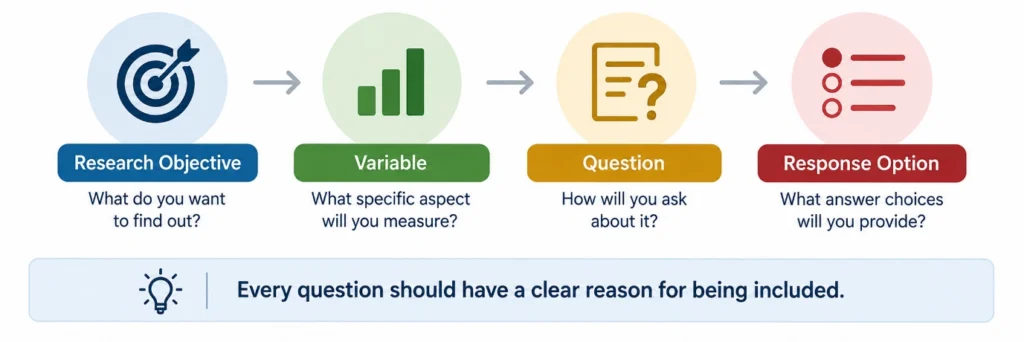
The first step is not writing questions. It is deciding exactly what the study needs to measure.
Suppose a researcher wants to study employee satisfaction with remote working. The research may focus on flexibility, communication, technology, productivity, and managerial support.
Instead of asking a broad question such as:
“Are you satisfied with remote work?”
a more focused question could be:
“How satisfied are you with the flexibility provided by your current remote working arrangement?”
The second question measures a specific aspect of the research objective and can therefore produce more useful data. A useful rule is simple:
Match the Questionnaire to the Respondent
The same subject may need different wording for different populations.
A questionnaire designed for medical professionals can use terminology familiar to healthcare practitioners. A survey intended for the general public should avoid unnecessary technical language.
For example:
Professional audience:
“How frequently do you use electronic health records during clinical practice?”
General population:
“How often do you use a digital system to access your health records?”
The underlying topic remains similar, but the language is adapted to the respondent’s knowledge and experience. This is an important part of survey questionnaire design best practices because respondents should not need specialist knowledge simply to understand what a question is asking.
Select the Right Question Format
Different research objectives require different question types.
| Question Type | Purpose | Example |
| Closed-ended | Collect predefined responses | “How often do you shop online?” |
| Open-ended | Capture detailed opinions | “What would you improve about our service?” |
| Likert scale | Measure attitudes or agreement | “I am satisfied with the product.” |
| Rating scale | Measure perceived performance | “Rate our service from 1–10.” |
| Ranking | Identify priorities | “Rank these features by importance.” |
Closed-ended questions are generally easier to quantify, while open-ended questions can provide explanations that predefined categories may miss. Combining both can be useful when a study requires measurable results as well as respondent perspectives.
Build a Logical Questionnaire Structure
Even well-written questions can perform poorly when they appear in the wrong order.
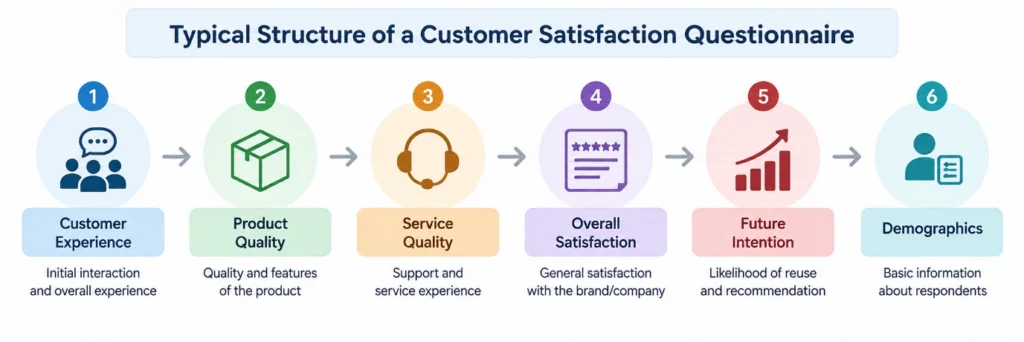
A customer satisfaction questionnaire, for example, might move through:
This creates a natural progression from the respondent’s experience toward broader evaluation.
Skip logic can make the structure more efficient. If a respondent has never used a company’s mobile application, there is little value in asking detailed questions about its usability.
Check for Ambiguity Before Data Collection
A question may appear clear to the researcher but be interpreted differently by respondents.
For example:
“How often do you exercise regularly?”
The word regularly is unclear because respondents may interpret it differently.
A more measurable version is:
“On how many days per week do you usually exercise?”
Specific wording reduces unnecessary interpretation and produces responses that are easier to compare. This is one of the most practical best practices in questionnaire design: whenever possible, replace vague concepts with defined time periods, behaviours, or measurable categories.
Keep the Questionnaire Focused
Longer does not necessarily mean better. A questionnaire containing 50 questions may collect less useful information than a carefully designed 15-question instrument if many of those 50 questions are repetitive or unrelated to the research objective.
Excessive length can contribute to respondent fatigue, incomplete responses, and less careful answering.
Before retaining a question, ask:
Does this question measure a required variable or provide information necessary for the research objective?
If the answer is no, the question may not need to be included.
Pilot Test Before Full Deployment
Pilot testing is one of the most important stages in the process of questionnaire design.
A small group of respondents can reveal problems that may not be obvious during drafting. They may identify unclear wording, missing response options, confusing instructions, excessive length, or technical difficulties.
A useful sequence is:
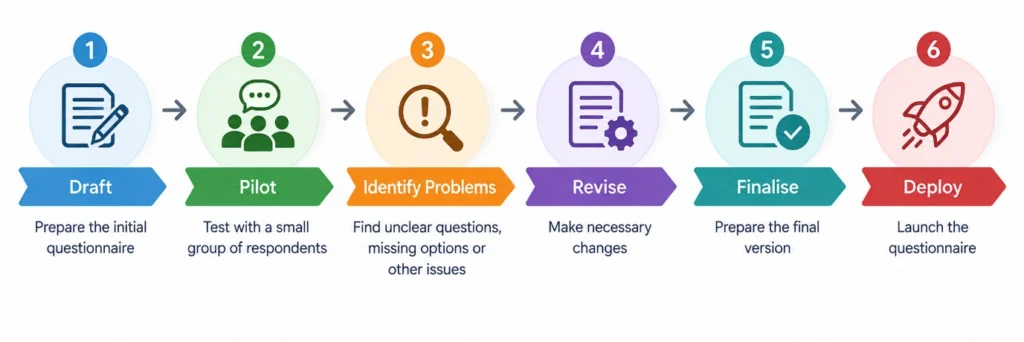
The objective of a pilot test is not simply to check whether the survey works technically. It is to determine whether respondents understand and can answer the questions as intended.
Review the Questionnaire Before Launch
A final review should examine the instrument as a complete measurement tool.
Check whether the questionnaire has:
- clear research objectives;
- appropriate respondent language;
- logically ordered questions;
- suitable question types;
- neutral wording;
- balanced response options;
- no unnecessary double-barrelled questions;
- manageable length;
- appropriate skip logic; and
- a mobile-friendly structure for online surveys.
These elements collectively strengthen the quality of the collected data.
Common Questionnaire Design Errors
Some problems occur repeatedly across research surveys.
| Problem | Example | Better Approach |
| Leading question | “How satisfied are you with our excellent service?” | Remove persuasive wording |
| Double-barrelled question | “How satisfied are you with price and quality?” | Ask about each separately |
| Ambiguous wording | “Do you exercise regularly?” | Specify frequency |
| Unnecessary questions | Asking information unrelated to objectives | Remove or justify the item |
| Excessive length | Repetitive 50-question survey | Retain essential questions |
| Incomplete options | No suitable response for some respondents | Add appropriate alternatives |
Questionnaire Design for Modern Research
Today’s questionnaires are increasingly delivered through online platforms and mobile devices. Features such as automated skip logic, digital data collection, and real-time monitoring can make survey administration more efficient.
For example, an online healthcare survey can automatically bypass detailed treatment questions when a respondent indicates that they have never received the treatment being studied.
Technology, however, should support—not replace—sound questionnaire methodology. Automated logic cannot correct a poorly worded question, inappropriate response scale, or irrelevant variable.
Different Research, Different Questionnaires
The questionnaire design process should always reflect the purpose of the study.
| Research Area | Typical Focus | Example |
| Market research | Preferences and behaviour | Factors influencing product choice |
| Customer research | Satisfaction and loyalty | Likelihood of recommending a service |
| Healthcare research | Experience and perception | Satisfaction with healthcare received |
| Academic research | Attitudes and knowledge | Perceived effect of an intervention |
| Employee research | Engagement and workplace experience | Managerial support |
A questionnaire designed for academic research may require validated measurement scales, while a customer survey may prioritise short, direct questions. The instrument should therefore be built around the research design rather than copied from another context.
Final Takeaway
The best questionnaire design practices are not about making a survey longer or adding more sophisticated question formats. They are about ensuring that every question has a clear purpose, is understood consistently, and contributes reliable information to the research objective.
A well-designed questionnaire therefore provides the foundation for better data collection, stronger statistical analysis, and more credible research conclusions.
Frequently Asked Questions
1. What is the questionnaire design process?
The questionnaire design process involves defining the research objective, identifying variables, developing questions and response options, organising the questionnaire, pilot testing it, revising it, and preparing the final instrument for data collection.
2. What are the best practices in questionnaire design?
Key questionnaire design best practices include using clear and neutral language, avoiding leading and double-barrelled questions, providing appropriate response options, maintaining a logical sequence, keeping the questionnaire focused, and conducting a pilot test before deployment.
3. Why is pilot testing important for a questionnaire?
Pilot testing helps identify unclear questions, missing response options, confusing instructions, excessive length, and technical problems before the main survey. The questionnaire can then be revised to improve its clarity and usability.
4. How does questionnaire design affect research data?
Questionnaire design directly affects the quality of collected data. Poor wording, ambiguous questions, or unsuitable response options can introduce measurement problems and make statistical analysis more difficult. A well-designed questionnaire produces more consistent and useful data.
5. What should be checked before deploying a questionnaire?
Researchers should check the research objectives, variable coverage, question wording, response options, question sequence, skip logic, questionnaire length, and technical functionality. A final pilot test can help confirm that respondents understand and can complete the questionnaire as intended.