
Descriptive vs Inferential Statistics: When to Use What in Research and Data Analysis
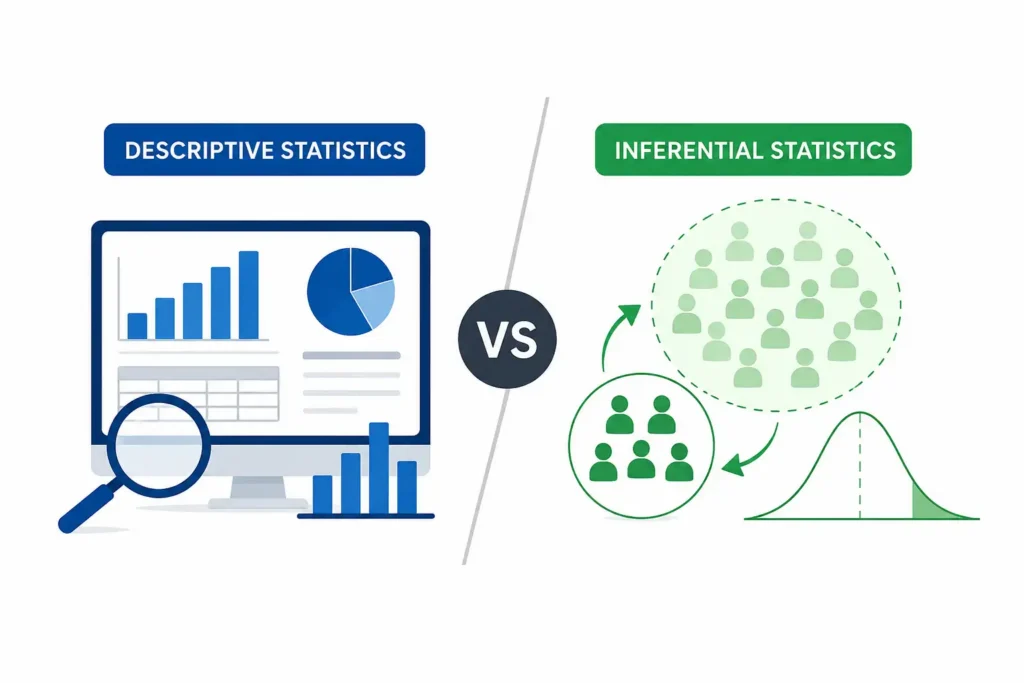
In today’s data-driven world, organizations, researchers, and decision-makers rely heavily on statistical analysis to transform raw data into meaningful insights. Whether you’re conducting academic research, evaluating business performance, or analyzing customer behavior, understanding the difference between descriptive statistics vs inferential statistics is essential.
While both approaches play a vital role in data analysis, they serve different purposes. This article explores the key differences between descriptive and inferential statistics, their applications, and how to determine which method is appropriate for your research objectives.
What is Descriptive Statistics?
Descriptive statistics refers to methods used to summarize, organize, and present data in a meaningful way. The primary goal is to describe the characteristics of a dataset without drawing conclusions beyond the data collected.
Descriptive statistics help researchers answer questions such as:
- What is the average value?
- How spread out is the data?
- What patterns or trends exist in the dataset?
Common Descriptive Statistical Measures
Measures of Central Tendency
- Mean (Average)
- Median
- Mode
Measures of Dispersion
- Range
- Variance
- Standard Deviation
Data Visualization Techniques
- Tables
- Bar Charts
- Pie Charts
- Histograms
- Frequency Distributions
Example of Descriptive Statistics
Suppose a university collects the examination scores of 500 students. By calculating the average score, identifying the highest and lowest marks, and creating a performance distribution chart, the institution is using descriptive statistics.
The analysis describes the dataset but does not make predictions about students who were not included in the study.
What is Inferential Statistics?
Inferential statistics goes beyond describing data. It uses sample data to make predictions, estimates, or generalizations about a larger population.
Since collecting data from an entire population is often expensive and time-consuming, researchers typically analyze a sample and use inferential statistical techniques to draw conclusions about the broader population.
Inferential statistics helps answer questions such as:
- Can the results from a sample be generalized to the population?
- Is there a significant relationship between variables?
- Are observed differences statistically meaningful?
Common Inferential Statistical Techniques
Hypothesis Testing
- t-test
- z-test
- Chi-square test
- ANOVA
Relationship Analysis
- Correlation Analysis
- Regression Analysis
Population Estimation
- Confidence Intervals
- Margin of Error
Example of Inferential Statistics
Imagine a company surveys 1,000 customers from a customer base of 100,000 individuals. Based on the sample responses, the company estimates overall customer satisfaction levels for the entire customer population.
In this case, inferential statistics allows researchers to make conclusions about a larger group using sample data.
Key Differences Between Descriptive VS Inferential Statistics
| Aspect | Descriptive Statistics | Inferential Statistics |
| Purpose | Summarizes and describes data | Draws conclusions and makes predictions |
| Data Scope | Works with collected data only | Generalizes from sample to population |
| Outcome | Provides insights into existing data | Supports decision-making and forecasting |
| Methods | Mean, Median, Mode, Standard Deviation | Hypothesis Tests, Regression, ANOVA |
| Complexity | Relatively simple | More advanced and analytical |
When Should You Use Descriptive Statistics?
Descriptive statistics should be used when your objective is to summarize and understand the characteristics of a dataset.
Common applications include:
- Survey result summaries
- Market research reports
- Customer demographic analysis
- Employee performance evaluations
- Academic data reporting
Descriptive statistics is typically the first step in any data analysis project because it provides an overview of the data before deeper investigation begins.
When Should You Use Inferential Statistics?
Inferential statistics is appropriate when you need to make decisions, test theories, or predict outcomes beyond the collected data.
Typical use cases include:
- Testing research hypotheses
- Evaluating the effectiveness of interventions
- Forecasting market trends
- Identifying relationships between variables
- Generalizing findings from sample studies
Researchers in fields such as healthcare, social sciences, finance, and business frequently use inferential statistical methods to support evidence-based decision-making.
Why Both Types of Statistics Matter
descriptive vs inferential statistics are not competing approaches; rather, they complement one another.
A typical research project often begins with descriptive analysis to understand the dataset’s structure and characteristics. Researchers then apply inferential techniques to test hypotheses, identify relationships, and draw broader conclusions.
For example, a business may first calculate average customer satisfaction scores (descriptive statistics) and then determine whether customer satisfaction significantly affects customer retention rates (inferential statistics).
Together, these methods provide a comprehensive framework for data analysis and decision-making.
Conclusion
Understanding the distinction between descriptive vs inferential statistics is fundamental for effective research and data analysis. Descriptive statistics helps summarize and present data clearly, while inferential statistics enables researchers to make predictions and draw conclusions about larger populations.
Choosing the right statistical approach depends on your research objectives. If your goal is to describe data, descriptive statistics is sufficient. If you need to test hypotheses, make predictions, or generalize findings, inferential statistics is the preferred method.
By applying both techniques appropriately, researchers and organizations can unlock valuable insights, improve decision-making, and maximize the value of their data.
Book a free consultation for appointment
Email us at : grow@simbi.in