
The Hidden Costs of Common Manufacturing Mistakes — A Lean Six Sigma Perspective

Introduction
In Lean Six Sigma, eliminating waste and reducing variation are essential for achieving operational excellence, yet many organizations fail to recognize the hidden costs of manufacturing mistakes embedded within their processes. These costs often remain invisible in standard reports but significantly impact profitability, productivity, and customer satisfaction over time. Issues like rework, downtime, quality failures, and inefficient resource utilization gradually accumulate, reducing overall efficiency. Identifying and addressing these hidden factors enables manufacturers to improve process reliability, minimize losses, and sustain long-term competitive advantage.
Read Also : Reducing Textile Waste with Lean Manufacturing Principles
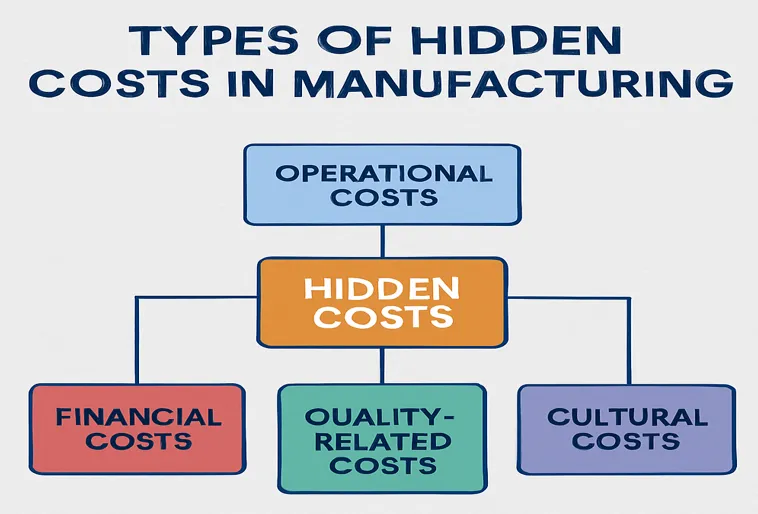
Types of Hidden Costs in Manufacturing
Break down hidden costs into categories like:
1. Operational Costs (e.g., unplanned downtime): These arise when machines or processes stop unexpectedly, leading to lost production time and higher maintenance expenses.
2. Quality-Related Costs (e.g., warranty claims): Expenses linked to defective products, returns, or replacements that damage customer trust and increase after-sales costs.
3. Financial Costs (e.g., inventory holding): Costs of storing excess stock, including warehousing, insurance, and tied-up capital that could be used elsewhere.
4. Cultural Costs (e.g., employee disengagement): Hidden costs from low morale or lack of motivation, which reduce productivity, innovation, and long-term business performance.
This article dives into how Lean Six Sigma helps identify and reduce these hidden costs across manufacturing operations.
1. Rework and Scrap – A Sign of Poor Process Capability
Lean Six Sigma View:
Defects are a form of waste (DPMO) and indicate high process variation.
Hidden Costs:
i. Wasted raw materials and time.
ii. Additional labor and energy consumption.
iii. Delayed delivery due to reprocessing.
Solution:
i. Apply DMAIC to identify defect sources.
ii. Improve Cp, Cpk values through Root Cause Analysis (RCA).
iii. Implement Poka-Yoke (mistake-proofing) systems.
2. Unplanned Downtime – A Hit to Equipment Reliability
Lean Six Sigma View:
Downtime is part of Six Big Losses in Overall Equipment Effectiveness (OEE).
Hidden Costs:
i. Idle workers and missed throughput.
ii. Emergency repair costs.
iii. Poor asset utilization.
Solution:
i. Implement TPM (Total Productive Maintenance).
ii. Monitor with control charts for early warnings.
iii. Conduct Failure Modes and Effects Analysis (FMEA) to prevent breakdowns.
3. Overproduction – A Lean Waste That’s Often Justified Poorly
Lean Six Sigma View:
Overproduction is the most costly of the 7 wastes (Muda).
Hidden Costs:
i. Extra storage space.
ii. Risk of damage, expiry, or obsolescence.
iii. Inventory management overhead.
Solution:
i. Use Takt Time to align production with demand.
ii. Apply Kanban and Just-in-Time (JIT) principles.
iii. Conduct Value Stream Mapping to streamline flow.
4. Undertrained Workforce – A Risk to Quality and Consistency
Lean Six Sigma View:
Skill variation leads to process inconsistency and hidden variation waste.
Hidden Costs:
i. More defects and rework.
ii. Unsafe work environments.
iii. Increased supervision and slower output.
Solution:
i. Develop Standard Work Instructions (SWI).
ii. Use Training Within Industry (TWI).
iii. Include employees in Kaizen events and improvement projects.
5. Inefficient Layouts and Workflow – Wasted Motion and Time
Lean Six Sigma View:
Poor layout increases motion, transport, and waiting—all classified as waste.
Hidden Costs:
i. Longer cycle time.
ii. Employee fatigue.
iii. Material handling issues.
Solution:
i. Apply 5S for workplace organization.
ii. Redesign layout based on Spaghetti Diagrams.
iii. Balance workloads using Takt Time and line balancing.
6. Inaccurate Data – Decisions Based on Bad Inputs
Lean Six Sigma View:
Poor data equals poor decisions and leads to invisible losses.
Hidden Costs:
i. Wrong inventory levels.
ii. Poor forecasting.
iii. Incorrect process settings.
Solution:
i. Validate systems using Measurement System Analysis (MSA).
ii. Use Statistical Process Control (SPC) for real-time tracking.
iii. Establish a data integrity protocol.
7. Neglecting Preventive Maintenance – Delaying Disaster
Lean Six Sigma View:
Ignoring maintenance increases Mean Time Between Failure (MTBF) variation and reduces equipment availability.
Hidden Costs:
i. Emergency repairs.
ii. Compromised product quality.
iii. Higher total cost of ownership.
Solution:
i. Build control plans that include PM schedules.
ii. Use Condition-Based Monitoring (CBM).
iii. Conduct periodic gemba walks to spot early issues.
Role of Data in Quantifying Hidden Costs
Discuss how clean and accurate data plays a critical role:
1. Why Measurement System Analysis (MSA) is essential
2. Importance of real-time dashboards
3. Risks of poor data integrity
Statistical Techniques Used in Lean Six Sigma to Tackle Hidden Manufacturing
| Technique | Purpose | Applied To |
| Statistical Process Control (SPC) | Monitors real-time variation and process behavior over time | Detecting early signs of downtime, defects, or unstable production |
| Control Charts (X-bar, R, P Charts) | Track process averages and ranges; spot out-of-control situations | Process stability during rework, defect generation, or scrap rates |
| Pareto Analysis (80/20 Rule) | Prioritize the most frequent or costly problems | Identifying which defects or failures cause most hidden costs |
| Measurement System Analysis (MSA) | Ensure accuracy and precision of measurement tools | Avoiding false data that leads to hidden errors or rework |
| Process Capability Analysis (Cp, Cpk) | Check if a process meets specifications consistently | Evaluating how often a process produces within tolerance |
| Root Cause Analysis (5 Whys, Fishbone) | Identify core reasons behind repeated issues | Reducing recurring rework or delays |
| Regression Analysis | Explore relationship between variables (e.g., machine speed vs defect rate) | Predicting how input changes impact cost-related outputs |
| ANOVA (Analysis of Variance) | Compare outputs across different machines, shifts, or materials | Finding hidden performance differences in equipment or teams |
| Design of Experiments (DoE) | Test multiple variables to optimize outcomes | Reducing energy usage, cycle time, or rework rates |
| Histogram | Visualize data distribution and spread | Identifying outliers and variation in scrap dimensions or delivery times |
Lean Six Sigma Implementation
1. Define
i) Identify high-cost issues like rework, downtime, or overproduction.
ii) Use tools like SIPOC and VOC to scope the problem.
2. Measure
i) Collect data on defects, delays, or waste.
ii) Use Control Charts, Pareto Analysis, and MSA to verify accuracy.
3. Analyze
i) Find root causes using Fishbone, 5 Whys, ANOVA, and Regression.
ii) Identify where variation or waste is coming from.
4. Improve
i) Test solutions using DoE.
ii) Apply Lean tools like 5S, Poka-Yoke, and JIT to remove waste.
iii) Standardize best practices.
5. Control
i) Set up SPC charts, audits, and SOPs.
ii) Train staff to sustain improvements and monitor key metrics.
Read Also : How SMED Reduces Loom Downtime in Textile Plants
Conclusion
Lean Six Sigma goes beyond fixing what’s visible—it finds the hidden costs embedded in routine errors and overlooked inefficiencies. While traditional management may look at bottom-line defects, Lean Six Sigma looks at the entire system: waste, variation, bottlenecks, delays, and unused talent.
If these hidden costs aren’t exposed and addressed, they quietly drain margins and competitiveness. By applying Lean tools like DMAIC, 5S, SPC, and TPM, organizations can build smarter, leaner, and more cost-effective operations.
Book a free consultation for appointment
Email us at : grow@simbi.in
To learn more about our consulting approach, tools, and industry expertise, explore our Lean Six Sigma Consulting Services and discover how structured process improvement can transform operational performance.