
Interaction and Benefit in Clinical Research: Understanding Their Interdependence
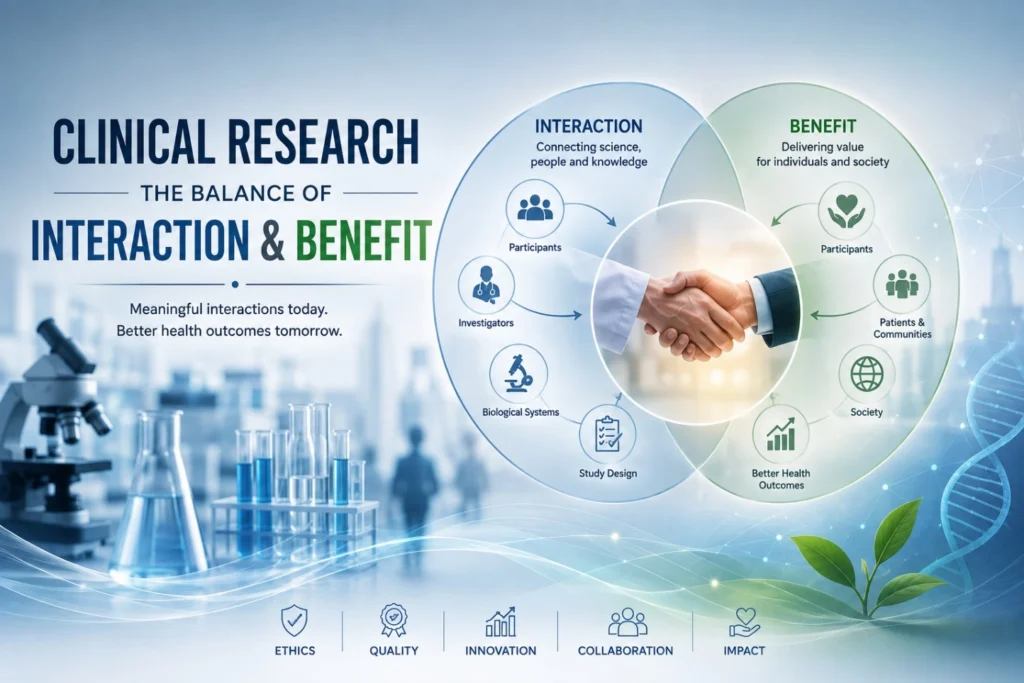
Clinical research aims to generate reliable scientific evidence while protecting participant safety and well-being. Interaction describes how treatments, participants, biological systems, study variables, and healthcare systems influence one another. Benefit refers to the clinical, scientific, and societal value generated through research. Understanding the relationship between interaction and benefit is essential for designing ethical, scientifically valid, and clinically meaningful studies.
Clinical research is more than testing a treatment and measuring its outcome. It involves complex interactions between an intervention and the biological system, participants and investigators, and different variables within a study. These interactions can influence both the safety and effectiveness of an intervention.
Understanding these relationships helps researchers identify potential risks, interpret treatment effects accurately, and determine the conditions under which a treatment may provide meaningful benefit. This makes interaction and benefit closely connected throughout the clinical research process.
READ THIS : Clinical Trial Process
Understanding Interaction in Clinical Research
Interaction can occur at several levels:
Biological and Pharmacological Interaction
Biological interaction describes how an intervention interacts with physiological processes, cellular pathways, organs, or disease mechanisms.
Pharmacological interactions may include:
Drug-drug interactions
Drug-food interactions
Drug-disease interactions
Drug-gene interactions
Drug-organ function interactions
For example, a patient’s liver or kidney function may affect how a drug is metabolized or eliminated. Similarly, the use of another medication may alter drug concentrations and potentially change efficacy or safety.
Understanding these interactions is particularly important during early clinical development, when researchers are establishing appropriate doses, evaluating pharmacokinetics and pharmacodynamics, and identifying potential safety concerns.
Statistical Interaction
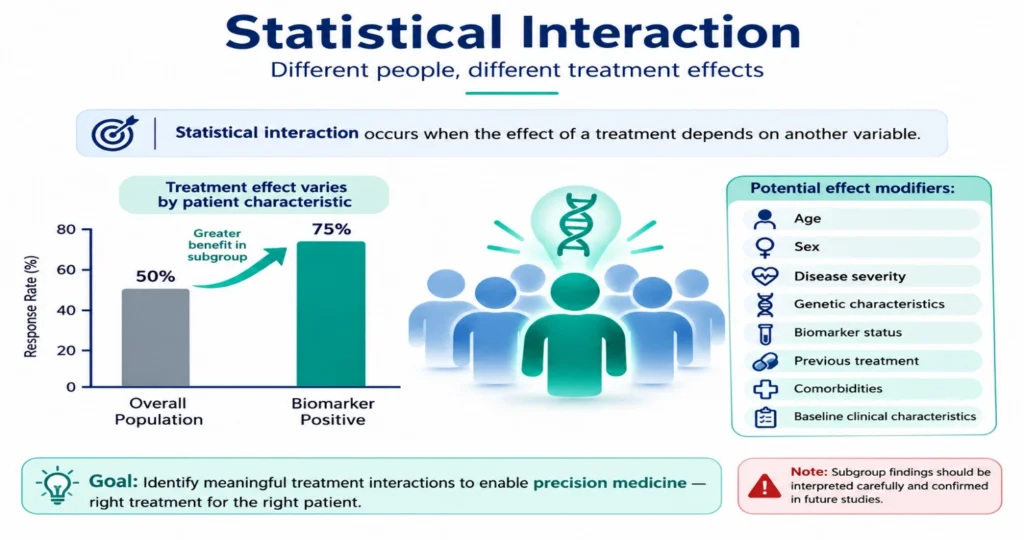
In clinical research, statistical interaction occurs when the effect of one variable depends on another variable.
For example, suppose a treatment is effective in the overall study population. Further analysis may show that its effect is greater in patients with a particular biomarker or disease characteristic.
Potential effect modifiers may include:
Age
Sex
Disease severity
Genetic characteristics
Biomarker status
Previous treatment
Comorbidities
Baseline clinical characteristics
Identifying meaningful treatment interactions can contribute to precision medicine, where treatment decisions are increasingly informed by individual patient characteristics.
However, subgroup and interaction findings should be interpreted carefully. Analyses that are not pre-specified or are based on small sample sizes may produce findings that require confirmation in future studies.
Participant-Investigator Interaction
The relationship between participants and investigators is another important form of interaction.
Clinical research depends on participants understanding the study, following study procedures, reporting symptoms or adverse events, and attending required visits. Investigators and study teams must therefore communicate clearly and respectfully throughout the study.
Effective participant-investigator interaction can support:
Informed consent
Treatment adherence
Participant retention
Accurate safety reporting
Protocol compliance
Data quality
Participant trust
Importantly, good communication should not be viewed as a method for influencing participants to remain in a study. Instead, it should support informed decision-making and respect the participant’s right to continue or withdraw from research.
Interaction Between Study Variables
Clinical trials involve numerous variables that can influence outcomes.
These may include:
Treatment dose
Treatment duration
Baseline disease characteristics
Concomitant medications
Adherence
Study site
Patient demographics
Outcome measurement methods
For example, differences between study sites may influence recruitment, protocol implementation, data collection, or participant follow-up. Recognizing such sources of variability can help researchers distinguish true treatment effects from factors related to study conduct.
System-Level Interaction
Clinical research also operates within larger systems.
Regulatory requirements, healthcare infrastructure, technology, funding, reimbursement, clinical practice, and patient access can all influence how research is conducted and how its findings are ultimately used.
A clinically effective treatment may have limited population-level impact if it is difficult to manufacture, unaffordable, unavailable in certain regions, or difficult to integrate into routine healthcare.
Therefore, the value of clinical research depends not only on what happens inside the trial but also on what happens after the evidence is generated.
Understanding Benefit in Clinical Research
Benefit is a multidimensional concept. It should not be limited to whether a participant experiences an immediate improvement in symptoms.
Benefit should be considered from multiple perspectives:
Direct Clinical Benefit
Direct benefit refers to a positive health outcome experienced by a research participant as a result of the intervention.
Examples may include:
Reduction in disease symptoms
Improved disease control
Delayed disease progression
Reduced complications
Improved functional status
Improved quality of life
However, direct benefit is not guaranteed in clinical research. Particularly in early-phase studies, the primary purpose may be to evaluate safety, tolerability, pharmacokinetics, or an appropriate dose rather than to provide therapeutic benefit.
Scientific Benefit
Even when an individual participant does not experience direct therapeutic improvement, a study can generate valuable scientific knowledge.
Research findings may help scientists:
Understand disease mechanisms
Identify potential therapeutic targets
Determine appropriate treatment doses
Understand treatment response
Identify safety signals
Design future clinical trials
This knowledge contributes to the broader evidence base and can support the development of future interventions.
Patient-Centered Benefit
Traditional clinical trials often focus on objective endpoints such as laboratory values, imaging findings, hospitalization rates, or survival.
However, these outcomes may not fully capture how patients experience a treatment.
Patient-centered measures can include:
Quality of life
Pain or symptom severity
Physical functioning
Treatment burden
Patient satisfaction
Treatment preferences
Patient-reported outcomes
Including these measures can provide a more complete understanding of whether an intervention delivers meaningful benefit from the patient’s perspective.
Societal and Public Health Benefit
Successful clinical research can contribute to broader public health improvements.
Research may lead to:
More effective treatments
Improved prevention strategies
Earlier diagnosis
Better disease management
Reduced disease burden
Improved healthcare outcomes
New scientific knowledge
The societal value of research is particularly important when findings can be translated into improved standards of care or population-level health strategies.
Health-System and Economic Benefit
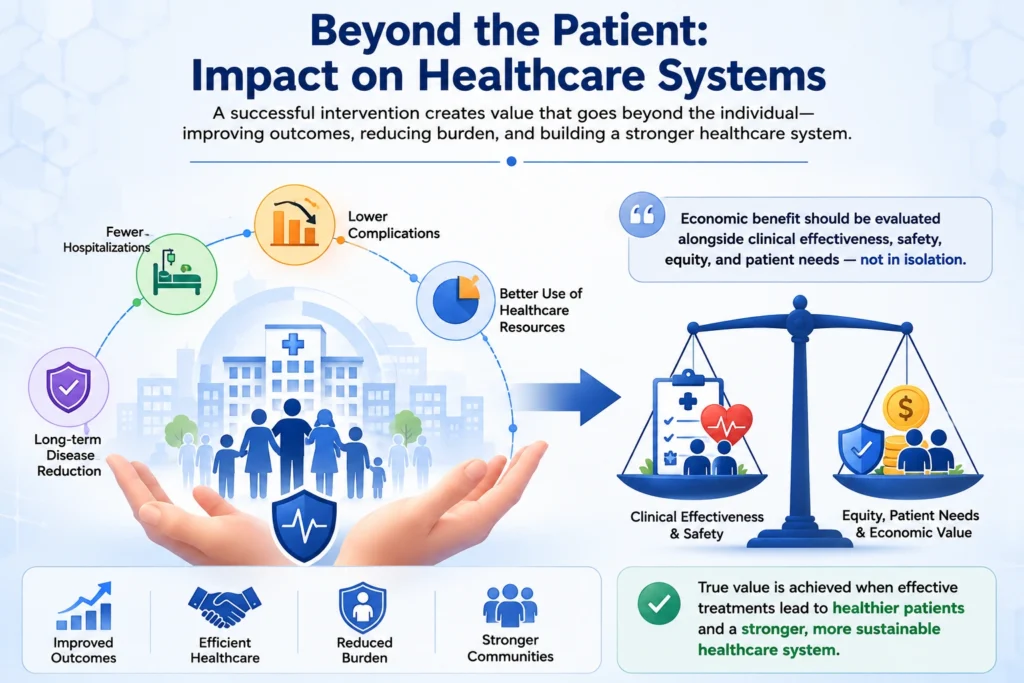
The impact of a successful intervention may also extend to healthcare systems.
For example, an effective treatment that reduces hospitalizations or complications may decrease healthcare resource utilization. Similarly, preventive interventions may reduce the long-term burden associated with chronic diseases.
However, economic benefit should be evaluated alongside clinical effectiveness, safety, equity, and patient needs rather than considered independently.
Where Interaction and Benefit Converge
Interaction and benefit are closely connected throughout the research process.
Interaction Influences the Risk-Benefit Assessment
The potential benefit of an intervention cannot be evaluated without considering the factors that influence its risks and effectiveness.
For example, a treatment may provide significant benefit to a particular patient group but present greater risk in individuals with:
Severe renal impairment
Hepatic dysfunction
Multiple concomitant medications
Specific genetic characteristics
Certain comorbidities
Understanding these interactions allows researchers and ethics committees to make more informed assessments of whether the expected benefits justify the potential risks.
Interactions Can Explain Differences in Treatment Response
Average treatment effects can sometimes hide important differences between individuals.
For example, two patients receiving the same intervention may have different outcomes because of differences in:
Genetics
Age
Disease biology
Baseline risk
Immune response
Drug metabolism
Treatment adherence
Identifying these differences can help researchers understand who benefits most, who may benefit less, and who may be at greater risk.
This is an important foundation for personalized and precision medicine.
Participant Interaction Influences Research Quality
Participant engagement can have a direct effect on study execution.
Participants who clearly understand study procedures may be better able to follow treatment instructions, report adverse events, attend visits, and complete questionnaires accurately.
At the same time, researchers must avoid creating unrealistic expectations about potential benefits. Clear communication should accurately explain both the potential benefits and limitations of participation.
System Interactions Determine Real-World Benefit
Demonstrating efficacy in a controlled clinical trial is only one step in achieving meaningful health benefit.
The ultimate impact of a treatment may depend on:
Clinical evidence → Regulatory approval → Availability → Affordability → Healthcare access → Appropriate use → Patient outcomes
If barriers occur at any stage, the benefit demonstrated in research may not translate fully into real-world healthcare.
This highlights the importance of considering implementation and access alongside clinical development.
Methodological Considerations
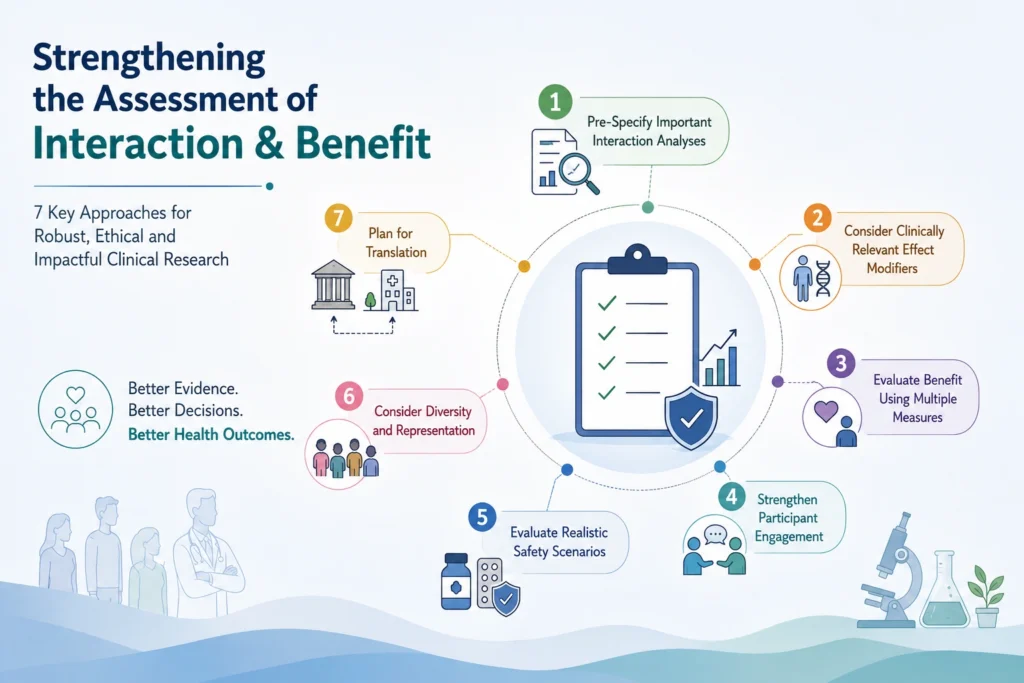
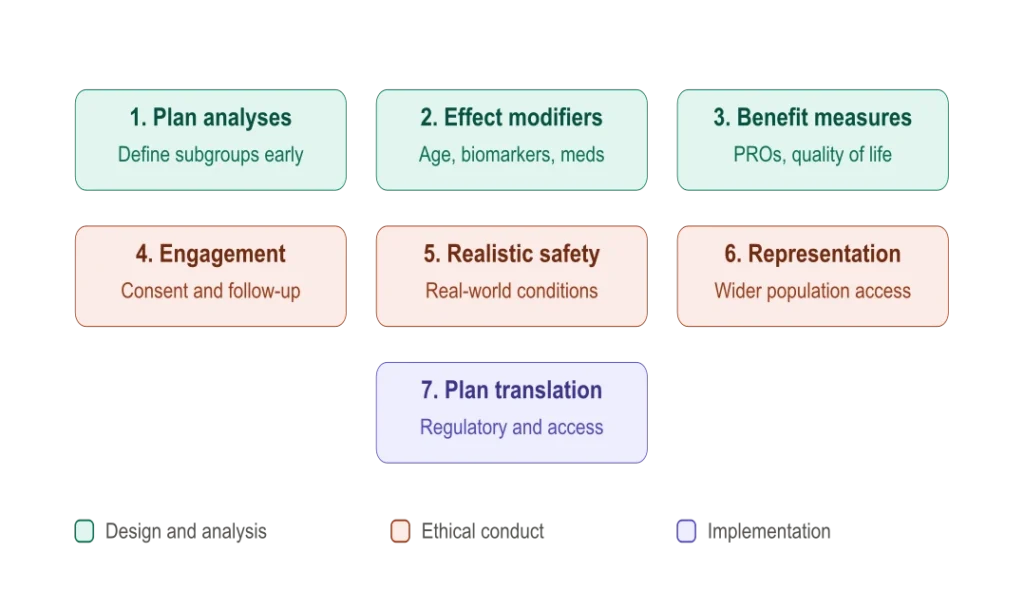
1. Pre-Specify Important Interaction Analyses
Relevant subgroup and interaction analyses should be defined in advance where scientifically justified. This reduces the risk of overinterpreting chance findings.
2. Consider Clinically Relevant Effect Modifiers
Study design and analysis should consider characteristics that may meaningfully modify treatment response, such as disease severity, biomarkers, age, comorbidities, or concomitant medications.
3. Evaluate Benefit Using Multiple Measures
Clinical endpoints should be complemented, where appropriate, by patient-reported outcomes, quality-of-life measures, functional outcomes, and other meaningful indicators.
4. Strengthen Participant Engagement
Clear informed consent, ongoing communication, appropriate follow-up, and transparent reporting of new information support ethical research and high-quality data.
5. Evaluate Realistic Safety Scenarios
Safety assessment should consider real-world conditions, including polypharmacy, comorbidities, organ impairment, and potential drug interactions.
6. Consider Diversity and Representation
A treatment may not provide the same benefit across all populations. Appropriate representation in clinical research helps improve the generalizability of findings and supports more equitable healthcare.
7. Plan for Translation
Researchers and sponsors should consider how study findings may be translated into clinical practice, including regulatory requirements, healthcare infrastructure, affordability, accessibility, and implementation challenges.
Why This Relationship Matters for Modern Clinical Research
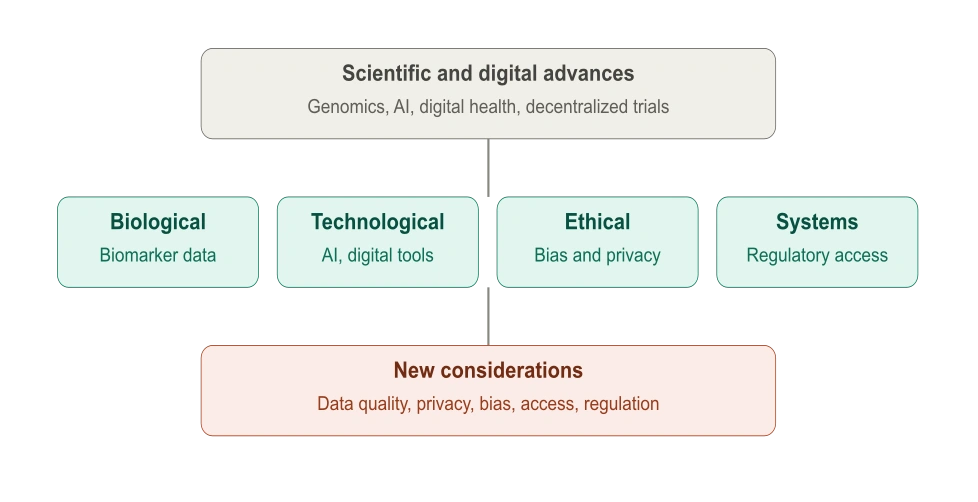
Modern clinical research is increasingly moving toward patient-centered, data-driven, and precision-based approaches.
Advances in genomics, biomarkers, artificial intelligence, digital health technologies, real-world data, and decentralized clinical trial methods are creating new types of interaction.
For example, digital monitoring may provide more continuous information about patient health, while biomarker-based approaches may help identify individuals most likely to respond to a treatment.
At the same time, these advances introduce new considerations related to data quality, privacy, algorithmic bias, accessibility, and regulatory oversight.
Therefore, understanding interaction is becoming increasingly important not only at the biological level but also across technological, ethical, and healthcare systems.
Conclusion
Interaction and benefit are closely connected in clinical research. Treatments interact with biological systems, patient characteristics, medications, study variables, and healthcare environments, influencing safety, effectiveness, and study outcomes.
Benefit should be assessed through clinical outcomes, patient experience, scientific knowledge, and public health impact. Effective research therefore asks not only whether a treatment works, but who benefits, under what conditions, and with what risks.
Understanding these relationships helps researchers design robust studies, protect participants, and generate evidence that supports safer, more effective, and equitable healthcare.
References
International Council for Harmonisation (ICH). E6(R2): Good Clinical Practice. ICH; 2016.
International Council for Harmonisation (ICH). E9: Statistical Principles for Clinical Trials. ICH; 1998.
World Medical Association. World Medical Association Declaration of Helsinki: Ethical Principles for Medical Research Involving Human Subjects. JAMA. 2013;310(20):2191–2194.
Council for International Organizations of Medical Sciences (CIOMS). International Ethical Guidelines for Health-Related Research Involving Humans. 4th ed. Geneva: CIOMS; 2016.
U.S. Food and Drug Administration (FDA). Drug Development and Drug Interactions: Table of Substrates, Inhibitors and Inducers. FDA.