
Mystery Shopping: Turning Customer Experience into Actionable Business Intelligence
Mystery shopping is a structured research methodology in which trained individuals act as ordinary customers while evaluating specific aspects of a business. Businesses often have access to sales reports, customer feedback, and operational data. Yet one important question can remain unanswered:
What actually happens when a customer interacts with the business?
This is where mystery shopping provides value. It offers an independent view of the customer journey by evaluating real interactions against predefined criteria. When findings are analysed properly, mystery shopping services can provide useful insights into customer experience, employee performance, branch consistency, and business opportunities.
The Gap Between Internal Data and Customer Experience
Sales figures show results. Operational audits show whether processes exist. Customer complaints highlight reported problems. But customers do not always complain.
A customer may experience poor service, receive an irrelevant recommendation, or wait too long and simply decide not to return. Mystery shopping research helps identify these gaps by examining the business from the customer’s perspective.
The findings can answer questions such as:
“Are service standards delivered consistently? Are employees understanding customer needs? Are different branches creating different customer experiences?”
From Observation to Business Intelligence
A mystery-shopping visit is only the starting point. Its real value follows this process:
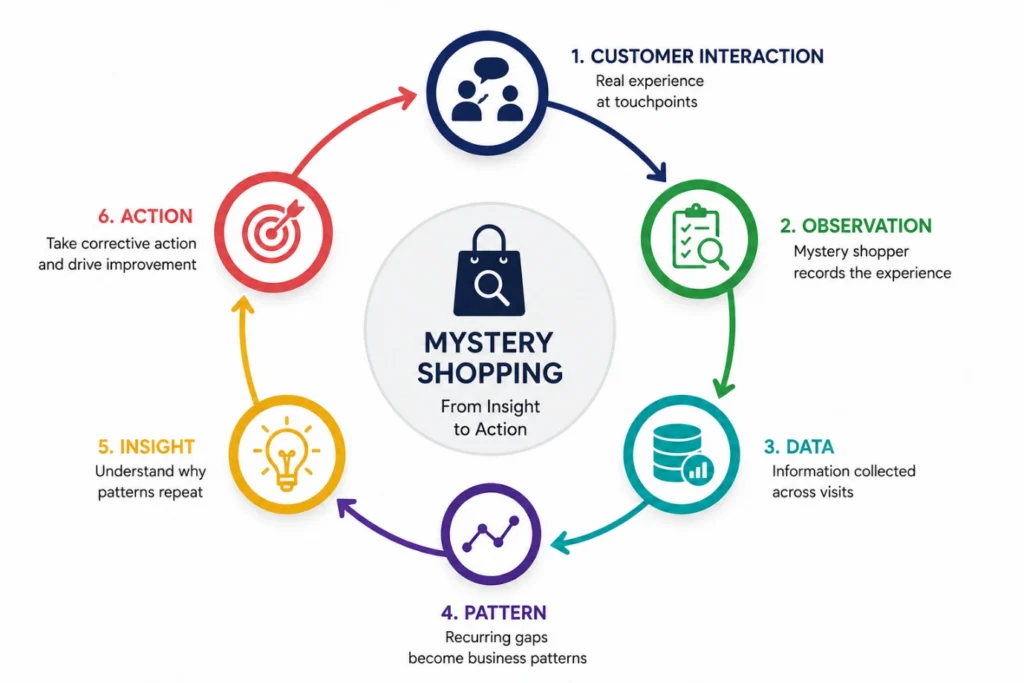
One poor interaction may be an individual issue. However, if the same gap appears repeatedly across branches or customer touchpoints, it becomes a business pattern.
| Stage | What Happens | Example | Business Value |
| Customer Interaction | A customer interacts with the business | A customer visits a retail store | Shows the real customer journey |
| Observation | The mystery shopper records the experience | Employee does not ask about customer needs | Identifies a potential service gap |
| Data | Observations are collected across visits | The same issue appears in several evaluations | Creates measurable evidence |
| Pattern | Recurring issues are identified | Poor needs assessment occurs across multiple branches | Reveals a wider business problem |
| Action | The business responds to the finding | Targeted training is introduced | Supports measurable improvement |
For example, employees may consistently receive positive scores for greeting customers but lower scores for understanding their needs. The problem is no longer simply poor service. It may indicate a weakness in training, communication, or the sales process. This is how mystery shopping for business becomes actionable business intelligence.
READ THIS ALSO : Data Collection Services
What Can Mystery Shopping Reveal?
| Area | Business Insight |
| Customer experience | Whether service standards are actually delivered |
| Employees | Knowledge, communication, and customer engagement |
| Branches | Differences in performance across locations |
| Processes | Whether SOPs work during real interactions |
| Sales | Missed recommendations and conversion opportunities |
| Competition | How customer experience compares with competitors |
The most useful programmes do not measure everything. They focus on the questions the business genuinely needs to answer.
A Practical Example
Consider a retail chain with weak sales growth in several branches. The stores are operating normally, employees are present, and there are no major customer complaints. So, what is causing the problem?
Mystery shoppers visit multiple locations using the same customer scenario. They discover that employees greet customers and provide basic information, but many do not ask enough questions to understand the customer’s actual requirements.
The result:
Greeting → Limited Needs Assessment → Generic Recommendation → Missed Sales Opportunity
Management now has a clear direction. Instead of providing general training, it can focus on customer discovery and relevant product recommendations.A later mystery-shopping evaluation can measure whether the training has improved real interactions.
This is the practical value of mystery shopping research: it helps move from a vague problem to a specific action.
Beyond the Checklist
A common mistake is relying too heavily on simple questions:
“Did the employee greet the customer? Yes.”
But that does not explain whether the interaction was useful. A customer may be greeted promptly but still receive poor advice. Another employee may ask relevant questions, understand the customer’s requirements, and recommend an appropriate solution.
Both interactions may meet a basic checklist requirement. Only one creates a stronger customer experience. Effective customer experience evaluation therefore looks beyond whether an action occurred and examines how well it was performed.
Finding Training, Process, and Revenue Gaps
Mystery shopping can reveal where business performance breaks down. A recurring gap in product knowledge may indicate a training requirement. Poor implementation of service procedures may reveal a process problem. Missed recommendations may point towards lost sales opportunities.
The advantage is specificity. Instead of concluding that an entire branch needs improvement, the findings can identify the particular part of the customer interaction that requires attention.
Better diagnosis leads to more focused action.
Branch Comparison Can Also Identify Best Practices
Mystery shopping is not only useful for finding problems. When one branch consistently performs better, the business can investigate what is working. Perhaps employees receive stronger training, use a better sales approach, or manage customer interactions more effectively.
This allows successful practices to be shared across other locations.
In this way, branch comparison becomes more than a ranking exercise. It becomes a method of learning from internal performance differences.
Mystery Shopping and Competitive Intelligence
Customers compare experiences across businesses. Mystery shopping can help organisations understand how competitors approach service, communication, product presentation, and customer engagement. The purpose is not simply to identify who performs better.
The more useful question is:
“What can the business learn from the difference?
A competitor may respond faster, explain products more clearly, or create a more effective sales interaction. These observations can identify opportunities to improve the organisation’s own customer experience.
READ THIS ALSO: Market Research Services
Turning Findings into Improvement
A mystery-shopping report should lead somewhere.
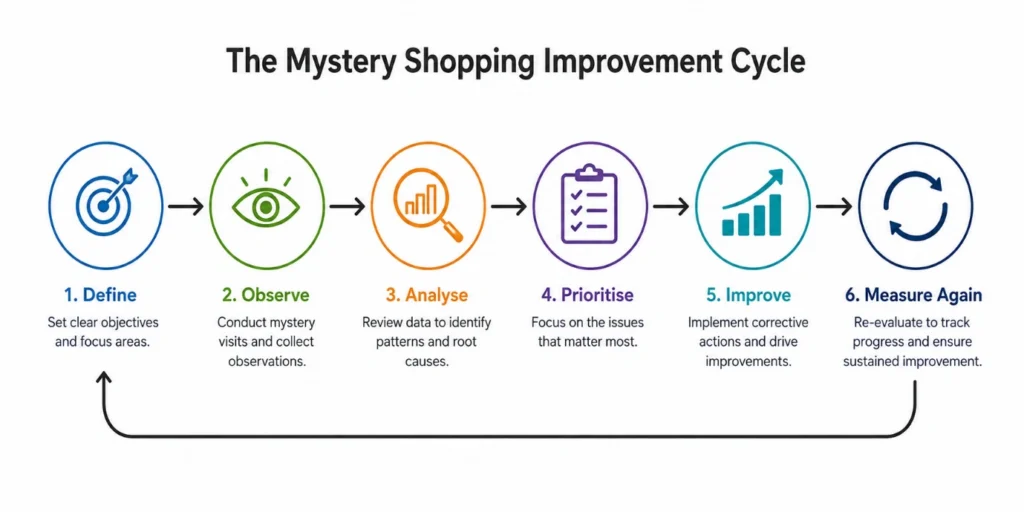
For example, a business may identify inconsistent product recommendations, introduce targeted training, and conduct a follow-up evaluation.
The next round of data then shows whether the improvement worked. This continuous approach gives mystery shopping services greater long-term value. Instead of simply producing scores, the process supports measurable improvement.
The Real Strategic Value
Mystery shopping can be applied across retail, banking, hospitality, healthcare, automotive, restaurants, telecommunications, real estate, and other customer-facing sectors.
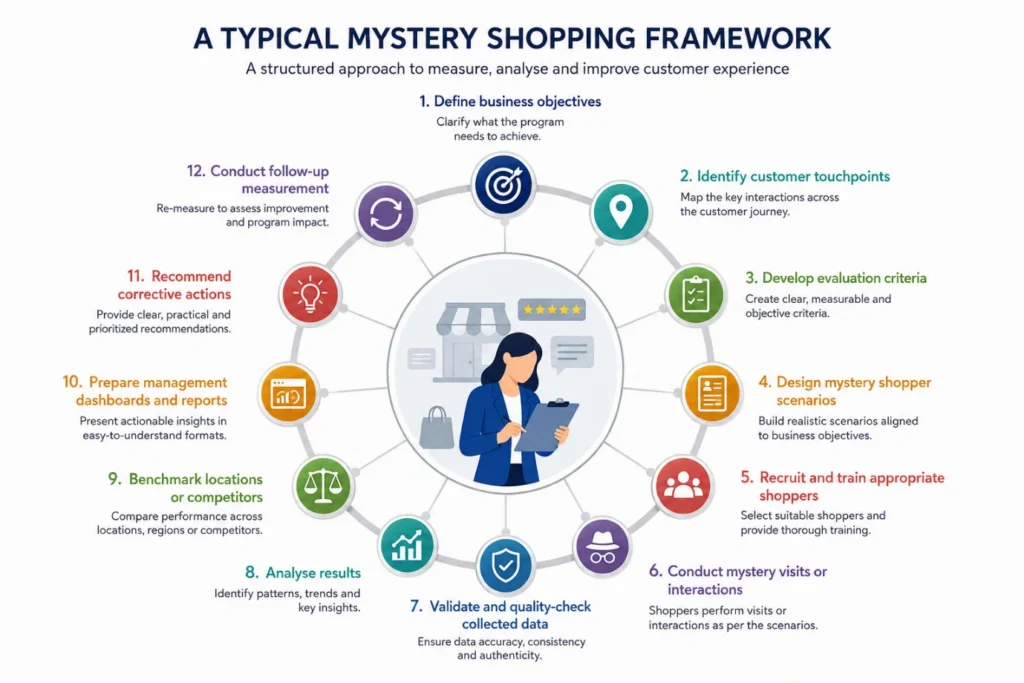
It can also evaluate different touchpoints, including physical visits, telephone enquiries, digital interactions, product purchases, and complaint handling. However, the most important outcome is not the final score.
The real value lies in understanding:
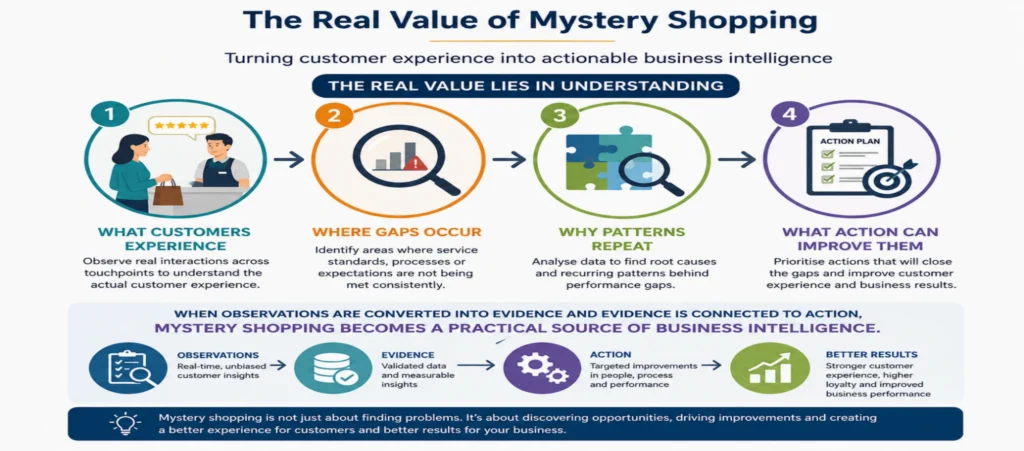
When observations are converted into evidence and evidence is connected to action, mystery shopping becomes a practical source of business intelligence.
Conclusion
Mystery shopping should not be viewed simply as a method for checking employees. It provides an independent view of real customer interactions and can reveal gaps that internal reports may not show.
A well-designed programme helps businesses identify recurring service issues, training requirements, process gaps, branch differences, and missed opportunities. Ultimately, the most useful question is not:
“What score did we receive?”
It is:
“What did the customer experience tell us to improve?”
Book a free consultation for appointment
Email us at : grow@simbi.in
Frequently Asked Questions
How does mystery shopping help businesses?
Mystery shopping provides an independent assessment of real customer interactions. It can identify gaps in service quality, employee knowledge, communication, process execution, and sales practices. When findings from multiple evaluations are analysed together, businesses can identify recurring patterns and make targeted improvements.
What is the difference between mystery shopping and customer feedback?
Customer feedback reflects the experience or opinion voluntarily shared by customers. Mystery shopping uses trained evaluators who follow predefined scenarios and assessment criteria. This provides more structured and comparable information about specific stages of the customer journey.
How can mystery shopping services improve employee performance?
Mystery shopping services can identify specific weaknesses, such as poor product knowledge, weak needs assessment, inconsistent communication, or missed recommendations. This allows businesses to provide targeted training and later measure whether the intervention improved actual customer interactions.
Can mystery shopping be used to evaluate competitors?
Yes. Mystery shopping can compare relevant aspects of competitor customer experiences, including response time, communication, product presentation, and sales approach. These findings can support competitive intelligence and identify practical opportunities for improvement.
How often should a business conduct mystery shopping?
The frequency depends on the business objective. A one-time study can identify current gaps, while regular evaluations are more useful for monitoring consistency and measuring improvement. Follow-up mystery shopping is particularly valuable after major training or process interventions.