
Factor Analysis: Meaning, Types, Process, Model and Applications
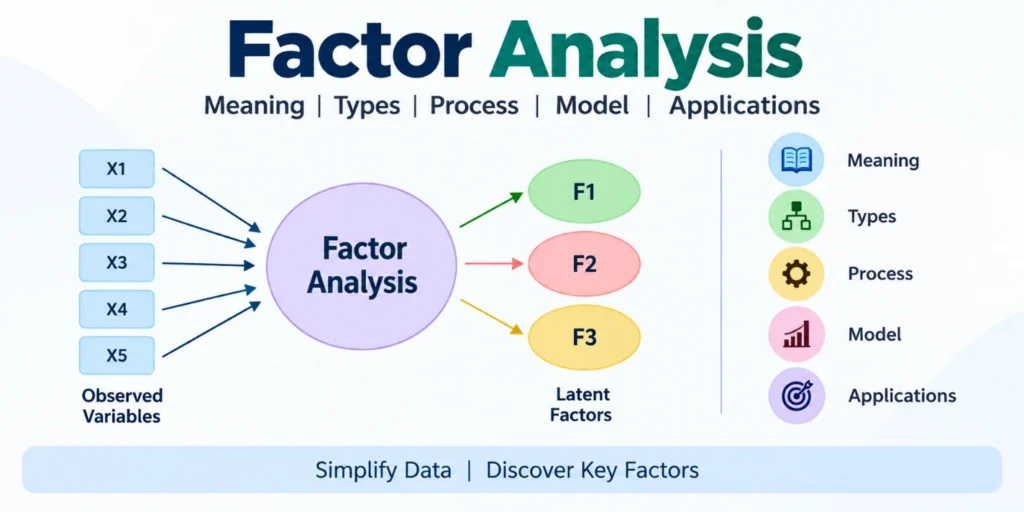
Researchers often collect multiple variables to study concepts such as customer satisfaction, motivation, financial behaviour, or employee engagement. When these variables are related, factor analysis helps identify underlying patterns and group them into meaningful factors.
This explains what is factor analysis, the types of factor analysis, how does factor analysis work, and the factor analysis model, along with its applications and difference from Principal Component Analysis.
READ MORE: Factor Analysis Services in India
What Is Factor Analysis?
Factor analysis is a statistical method used to identify hidden or latent factors that explain the relationships among several observed variables. Instead of analysing every variable separately, related variables are grouped according to their correlations and common variation.
For example, a customer satisfaction survey may contain questions about product quality, price, service, delivery, and support. Factor analysis may show that these observed variables can be represented by broader factors such as Product Experience, Service Quality, and Value Perception.
The technique can reduce a large set of correlated variables into a smaller and more interpretable structure while retaining important information from the dataset.
Why Is Factor Analysis Used?
Factor analysis is commonly used for:
- Reducing a large number of variables
- Identifying underlying dimensions or constructs
- Developing and validating questionnaires
- Grouping correlated survey items
- Identifying latent variables
- Examining relationships among observed variables
- Supporting scale development and construct validation
- Preparing variables for further statistical analysis
How Does Factor Analysis Work?
Understanding how does factor analysis work requires looking at the relationship between observed variables and latent factors.
The basic idea is:
Observed Variables = Common Factors + Unique/Error Components
A simplified factor model can be expressed as:
X = ΛF + ε
Where:
X = observed variables
Λ = factor loading matrix
F = latent factors
ε = unique or error components
Factor loadings indicate how strongly an observed variable is associated with a particular factor. Higher absolute loadings generally indicate a stronger relationship between the variable and factor.
For example, if several survey questions have high loadings on the same factor, those questions may represent a common underlying construct.
Main Steps in Factor Analysis
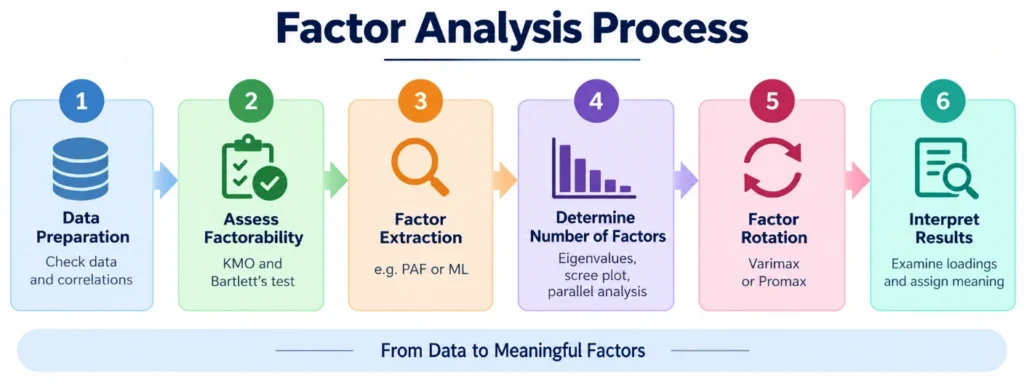
Data Preparation
The dataset is first checked for missing values, unusual observations, measurement scales, and correlations among variables. Adequate sample size and appropriate data characteristics are important for obtaining a stable factor solution.
Assessing Factorability
Researchers commonly examine the Kaiser-Meyer-Olkin (KMO) measure and Bartlett’s Test of Sphericity.
KMO evaluates whether the correlation patterns are suitable for factor analysis. Bartlett’s test examines whether the correlation matrix differs significantly from an identity matrix.
A statistically significant Bartlett’s test and an acceptable KMO value generally support proceeding with factor analysis.
Factor Extraction
Factor extraction identifies the underlying factors that account for common variation among the observed variables.
Common approaches include:
- Maximum Likelihood (ML)
- Principal Axis Factoring (PAF)
The appropriate extraction method depends on the research objective and characteristics of the data.
Determining the Number of Factors
Researchers can use several methods to determine how many factors should be retained, including:
- Eigenvalues
- Scree plot
- Parallel analysis
- Theoretical interpretation
Factor Rotation
Rotation improves the interpretability of factor loadings.
Two broad approaches are:
Orthogonal rotation: Varimax is commonly used when factors are assumed to be uncorrelated.
Oblique rotation: Promax or Oblimin can be used when factors are expected to correlate.
Interpreting Factor Loadings
Researchers examine the loading of each observed variable on the extracted factors. Variables with stronger loadings are generally more closely associated with that factor.
The conceptual meaning of the variables grouped under each factor is then used to assign an appropriate factor name.
Types of Factor Analysis
The two major types of factor analysis used in research are Exploratory Factor Analysis (EFA) and Confirmatory Factor Analysis (CFA).
Exploratory Factor Analysis (EFA)
EFA is used when the underlying factor structure is not clearly established. It explores how observed variables group together and helps researchers identify the possible number and nature of latent factors.
For example, a researcher developing a new employee satisfaction questionnaire may use EFA to determine whether the questions form dimensions such as:
- Work Environment
- Compensation
- Management Support
- Career Development
EFA is commonly used during the early stages of scale development and exploratory research.
Confirmatory Factor Analysis (CFA)
CFA is used when the researcher has an existing theoretical or empirical factor structure that needs to be tested.
For example, if previous research indicates that employee satisfaction consists of four dimensions, CFA can be used to examine whether the proposed four-factor measurement model fits the collected data.
CFA commonly evaluates model-fit measures such as:
- CFI
- TLI
- RMSEA
- SRMR
- Chi-square
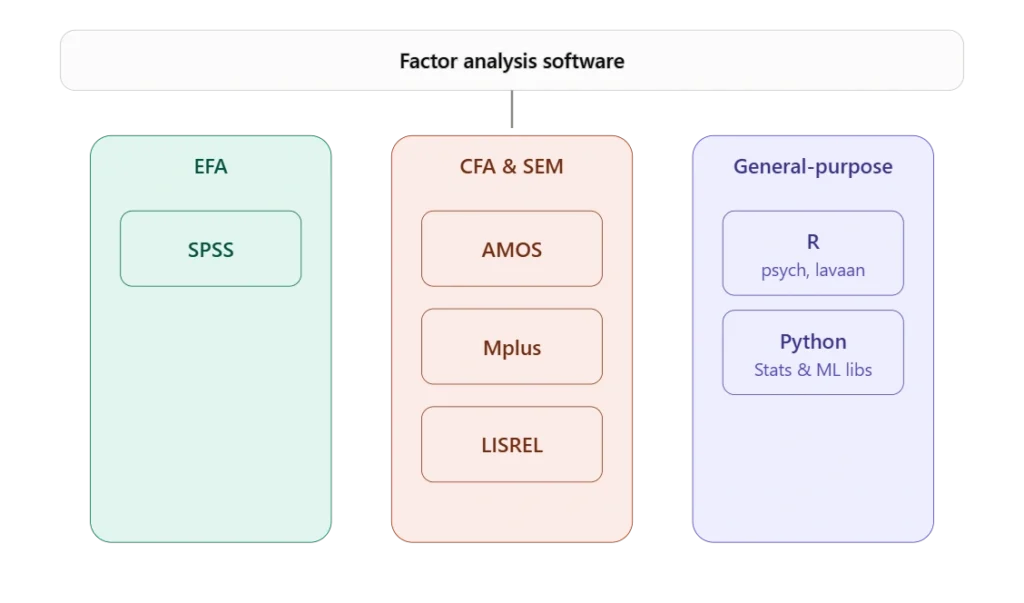
CFA is frequently performed using software such as AMOS, Mplus, LISREL, or R packages such as lavaan.
EFA vs CFA
| Feature | EFA | CFA |
| Main purpose | Explore factor structure | Test a proposed factor structure |
| Factor structure | Not fixed in advance | Specified in advance |
| Approach | Exploratory | Confirmatory |
| Theory requirement | Less restrictive | Usually theory-based |
| Rotation | Commonly used | Not generally used in the same way |
| Typical application | Scale development | Scale validation |
| Common software | SPSS, R, Python | AMOS, Mplus, LISREL, R |
What Is a Factor Analysis Model?
A factor analysis model describes how observed variables are related to underlying latent factors.
A general model can be written as:
Xᵢ = λᵢ₁F₁ + λᵢ₂F₂ + … + λᵢₘFₘ + εᵢ
Where:
- Xᵢ = observed variable
- F₁, F₂ … Fₘ = latent factors
- λ = factor loading
- εᵢ = unique/error component
For example, suppose a questionnaire measures customer experience using 12 observed questions. Factor analysis may indicate that these 12 questions are explained by three underlying factors: Service Quality, Product Quality, and Customer Support.
The factor analysis model helps researchers understand which observed variables contribute to each latent factor and how strongly they are related.
Factor Analysis and Principal Component Analysis
Factor Analysis and Principal Component Analysis (PCA) are often confused because both can reduce dimensionality. They are statistically different techniques.
| Feature | Factor Analysis | PCA |
| Main objective | Identify latent constructs | Reduce dimensionality |
| Variance considered | Common variance | Total variance |
| Measurement error | Modelled separately | Not explicitly modelled |
| Output | Latent factors | Principal components |
| Common use | Construct identification and scale development | Data compression and dimensionality reduction |
Example of Factor Analysis
Suppose a researcher develops a survey containing 15 questions to measure employee satisfaction.
After collecting responses, the researcher finds that several questions are strongly correlated. Factor analysis may reduce the 15 observed questions into three underlying factors:
Factor 1 → Work Environment
Questions related to workplace conditions and facilities.
Factor 2 → Management Support
Questions related to supervision, communication, and leadership.
Factor 3 → Career Development
Questions related to promotion, training, and professional growth.
Instead of analysing 15 individual questions separately, the researcher can interpret the broader three-factor structure.
Advantages of Factor Analysis
Factor analysis can:
- Simplify complex datasets
- Identify hidden structures
- Reduce correlated variables
- Support questionnaire development
- Help validate measurement constructs
- Improve interpretation of large datasets
- Provide inputs for further statistical modelling
Limitations of Factor Analysis
Factor analysis also requires careful methodological decisions. Results can be affected by sample size, variable selection, correlations, extraction method, rotation method, and the criteria used to retain factors.
The interpretation of factors also requires subject knowledge. Statistical output alone does not automatically provide meaningful factor names or theoretical explanations.
Researchers should also distinguish factor analysis from PCA because the two methods have different objectives and statistical foundations.
Conclusion
Factor analysis provides a structured way to understand complex datasets containing multiple related variables. It can reduce variables, identify latent constructs, support questionnaire development, and evaluate measurement structures.
Exploratory Factor Analysis is useful for discovering possible underlying structures, while Confirmatory Factor Analysis is used to test an established measurement model. Understanding the factor analysis model, factor loadings, extraction methods, rotation, and model-fit measures helps researchers apply the technique appropriately.
For research projects involving questionnaire validation, scale development, EFA, CFA, or statistical interpretation, professional statistical support can help ensure that the analysis and reporting are methodologically appropriate.
Book a free consultation for appointment
Call Now : +91 99505 66669
Email : grow@simbi.in
Frequently Asked Questions
1. What is factor analysis in simple terms?
Factor analysis is a statistical technique that groups related observed variables into a smaller number of underlying factors or latent constructs.
2. What are the types of factor analysis?
The two primary types are Exploratory Factor Analysis (EFA) and Confirmatory Factor Analysis (CFA). EFA explores an unknown factor structure, while CFA tests a predefined structure.
3. How does factor analysis work?
Factor analysis examines correlations among observed variables, extracts underlying factors, rotates the factor solution when appropriate, and interprets factor loadings to understand the relationships between variables and latent constructs.
5. What is a factor analysis model?
A factor analysis model represents observed variables as functions of underlying latent factors plus unique or error components. Factor loadings describe the strength of relationships between observed variables and factors.
6. Is factor analysis the same as PCA?
No. Factor analysis focuses on underlying latent constructs and common variance, whereas PCA transforms variables into components based on total variance.