What Are Primary Data Collection Services?
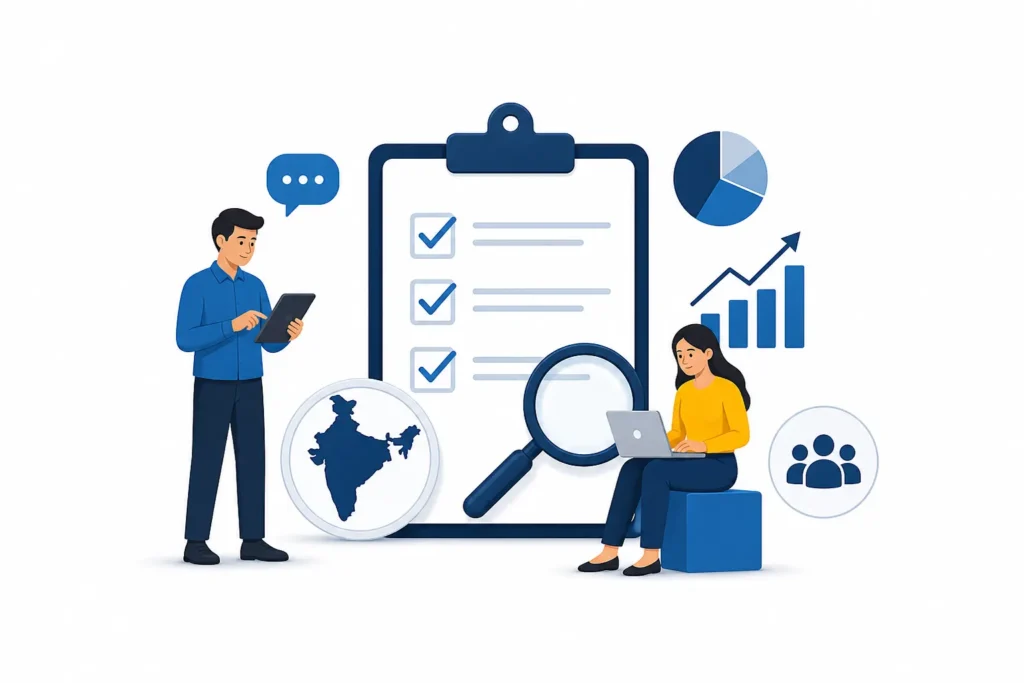
Primary Data Collection Services in India entail scientifically designed techniques to gather original data of respondents of interest. This can comprise surveys, interviewing, questionnaires, focus groups discussions, observations, product feedbacks, retail audit, and field investigations.
The services are believed to be mostly used in market researches, academic researches, medical research, social research, and projects of social policies as well as business viability studies. An Indian data collection company comprised of professionals ensures that the data itself is collected in a systematic, ethical and accurate manner.
Why Primary Data Collection Is Important in India
India is an expanding and a diverse market. What works in a certain city, might not work in the other city. This heralds the primary importance of the data collection in gaining insights into realities on the ground.
Before business launches a product, opens in a new geographical area,modifies prices or even improved services, businesses require good consumer information. In the same way, genuine field information will be required by students and also researchers, to back up the dissertations, research papers and policy studies.
The need to collect primary data in India is on the rise as organizations desire evidence-based decisions as opposed to guesses. It could be customer satisfaction, brand awareness, product demand, competitor analysis, or even user behavior but, through primary research, direct answers are given.
How Primary Data Collection Services Work
With the use of innovative techniques, our Primary Data Collection Services in India make it easier for companies to adapt to market changes.
Professional primary data collection process typically has a structured process.
1. Understanding the Research Objective
The initial approach is to have a clear understanding of what the client wants to know. This can be in the form of market demand, customer response, product taste, service excellence or the social behaviour.
2. Designing the Research Methodology
The second process will be to develop the research methodology. This involves determination of the sample size, target audience, the method of data collection, questionnaire format and the geographical coverage.
3. Questionnaire and Tool Preparation
The questionnaire needs to be designed well to enable it to gather useful information. The type of questions used can be closed-ended, open-ended, rating-based or multiple choice questions based on the purpose of the research.
4. Field Data Collection
The training of field investigators involves the collection of data by using face-to-face survey, telephonic interview, online form or observation. In India, field survey services (offline), continue to play a significant role, as there are significant chances that many target groups are not going to respond appropriately via digital medium.
5. Data Validation and Quality Check
Following the collection, the data is verified to have complete responses, no repetition, incomplete answers and errors. This will enhance the quality and reliability of the data.
6. Data Analysis and Reporting
The final data is arranged, processed and given in a structured report which contains key findings, graphs, key insight and recommendations.
Key Features of Professional Primary Data Collection Services in India
A trusted service provider can provide services that are beyond conducting surveys. The Professional Primary Data collection in India incorporates the following; proper planning, trained field force, computerized data collection instruments, quality checking and reporting in time.
Important features include:
- Tailor-made research design in accordance to the needs of the client.
- Competent field survey teams to various areas.
- Online and offline means of collecting data.
- Multilingual survey service of Indian respondents.
- Photo evidence, real time monitoring where necessary and GPS tracking.
- Data cleaning, validation and reporting services.
Benefits of Primary Data Collection
Primary data collection provides organizations with first hand and pertinent information. The data is gathered towards a given purpose; it is therefore more useful as opposed to general secondary data.
Among the key advantages are making a better decision; having an accurate consumer insight; better planning of a product; stronger market entry strategies as well as less business risk. In the case of academic researchers, it can be used to present original evidence that can be used to support research results.
To companies, Primary Data Collection Services in India are useful in identifying what the customer actually requires, what is the problem facing the customer and how this customer reacts to the product or the service.
Industry Use Cases
Primary data collection would be applicable in a variety of industries in India.
Market Research and Consumer Goods
The primary data collected and used by FMCG companies entails understanding the product usage, purchasing behavior, anticipated prices, as well as perception, of the brand(s).
Healthcare and Pharmaceutical Research
Field surveys and interviews are used by the healthcare organizations to study their patient awareness and behavior, access to healthcare services, and community health requirements.
Education and Academic Research
Primary data are used by students, universities and research institutions to do thesis work, dissertations, surveys and social research projects.
Real Estate and Urban Studies
The outcomes from our Primary Data Collection Services in India directly influence future business strategies and operational practices.
Primary data will be used to conduct research on residential demand, location preference, and infrastructure problems and community responses.
Retail and Competitor Analysis
Retail inspection, customer survey and dealer survey assist businesses to know competition, availability of products in the market and their gaps.
Tools and Technologies Used
In India, Modern Primary Data Collection Services adopt digital and manual means of data collection. The process can be completed using Google Forms, Microsoft Forms, KoboToolbox, SurveyMonkey, mobile data collection apps, GPS tagging and digital dashboards to make the process faster and more accurate.
In case of field project, technology can be used to monitor progress of surveys, locate places, eliminate the occurrence of manual errors, and enhance transparency. Nonetheless, human judgment is still significant particularly in interviews, survey in the rural areas and sensitive issues of a research.
Common Mistakes in Primary Data Collection
Most of the research undertakings fail due to improper planning or even weak implementation. Some of the common errors include vague goals, poorly constructed questionnaires, improper choice of the sample, untrained surveyors, obvious questions, incomplete responses and data validation.
The other fallacy is to merely rely on online surveys because the target audience needs to interact on the field. A mixed approach tends to be more effective in India since the access to internet, language comfort and behaviors of respondents vary significantly.
How to Choose the Right Data Collection Company in India
When deciding on the provider, it is necessary to get the right provider to ensure that one gets the right results. A nice organization must be aware of research methodology, the work of the field, how to handle the respondents and how to control the data quality.
Prior to choosing a service provider, consider his/her experience, industry and field expertise, strength of his/her field team, geographic location, technology usage, reporting format and confidentiality practices. The company will also be in a position to personalize the study as opposed to having a one size fits all solution.
The ethical standards of research, privacy of respondents, and clarity and usability of insights provided should be maintained of a professional provider of Primary Data Collection Services in India.
Future Trends in Primary Data Collection
Digital tools, mobile surveys, AI-driven data cleaning, real-time dashboard, and the fusion of research models will shape the future of primary data collection in India. The field-based human interaction will remain, however, vital in cases of rural markets, healthcare studies, social research and community level projects.
Technology with field trained teams will provide a company with better accuracy, quicker execution, and greater insights.
Conclusion
Primary Data Collection Services in India is vital to business, researchers and institutions which require reliable, original and market specific information. Primary data can be used to transform ground level reactions into significant choices as far as surveying research and field examination to consumer insight and data-processing are concerned.
When you need to select the right data collection partner, you can find your project to be more accurate, professional and result-oriented.
In need of a credible primary data collection assistance in India? Collaborate with a skilled research and field survey team to avert erroneous data, create valuable information and make reliable decisions.
Book a free consultation for appointment
Email us at : grow@simbi.in