
Statistical Data Analysis in Business: Methods, Applications and Real-World Uses
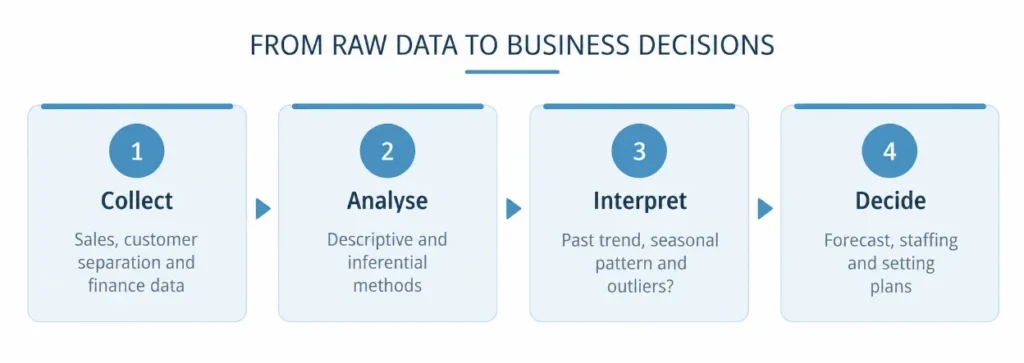
Every business generates data the moment it opens its doors: daily sales, footfall, ad clicks, support tickets, payroll records. None of that becomes useful on its own. Statistical data analysis in business is the discipline that turns this raw exhaust into something a manager can actually act on, a forecast, a pricing decision, a staffing plan. Companies that build this into how they operate consistently outperform those that are still deciding based on gut feel.
This piece covers what statistical business analysis actually involves, where the uses of statistics in business management show up in day-to-day operations, which techniques and tools get used in practice, and how to read the output without a statistics degree.
Defining Statistical Data Analysis in Business
Statistical data analysis in business means collecting numbers from sales, operations, customers or finance, then applying statistical methods to find patterns, test assumptions and produce a result a non-statistician can act on. It is not the same as just looking at a spreadsheet. A sales report that lists last month’s numbers is data. Statistical analysis for business is what happens when you ask whether last month’s jump was a real trend, a seasonal blip or random noise, and you have a method for telling the three apart.
In practice this covers two tracks that usually work together: descriptive analysis, which summarises what already happened, and inferential analysis, which uses a sample to make a defensible statement about the wider customer base, market or population.
READ MORE: Business Analytics vs Data Analytics
Core Uses of Statistics in Business Management
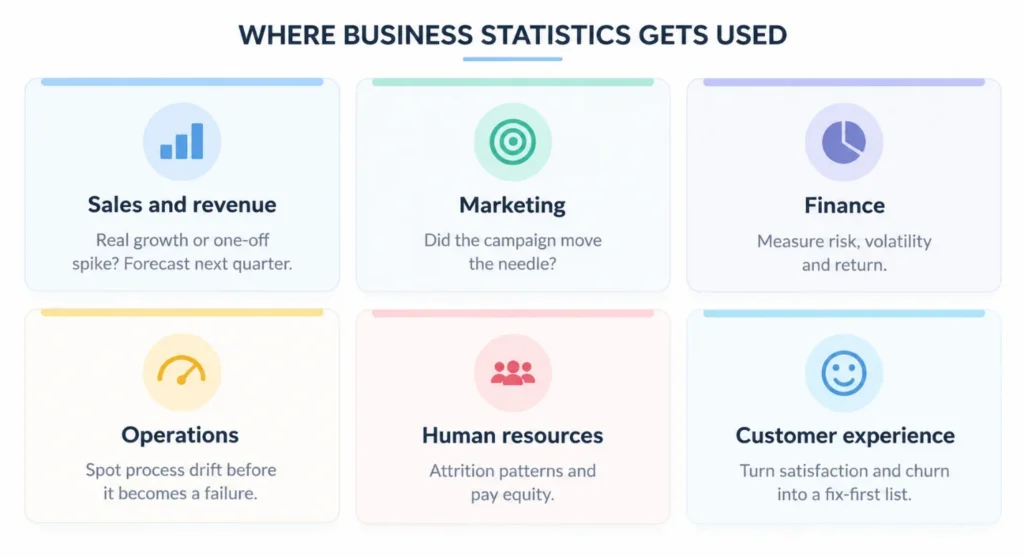
The uses of statistics in business management are not confined to one department. Every function that deals in numbers eventually runs into a question only statistics can answer properly.
- Sales and revenue: spotting real growth trends versus one-off spikes, and forecasting next quarter with a defensible method rather than a guess.
- Marketing: testing whether a campaign actually moved the needle, or whether the lift would have happened anyway.
- Finance: measuring risk, volatility and return, and stress-testing assumptions before they go into a budget.
- Operations and supply chain: flagging when a process has drifted out of normal range before it becomes a visible failure.
- Human resources: tracking attrition patterns and pay equity with numbers that hold up if questioned.
- Customer experience: turning satisfaction scores and churn data into a ranked list of what to fix first.
Running a Statistical Business Analysis Step by Step
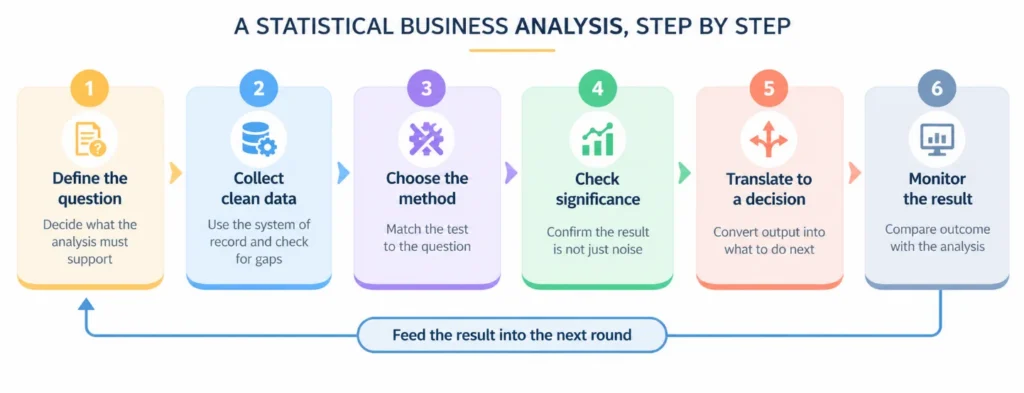
A statistical business analysis follows the same basic sequence regardless of department or tool, only the specific tests change.
- Define the question: decide exactly what decision the analysis needs to support, before touching any data.
- Collect clean data: pull from the system of record rather than a manually maintained copy, and check for gaps before analysing anything.
- Choose the right method: match the technique to the question, a correlation for a relationship, a t-test for comparing two groups, regression for a prediction.
- Run the analysis and check significance: confirm the result isn’t just noise before building a recommendation on top of it.
- Translate the output into a decision: a p-value or coefficient means nothing to a manager unless it’s converted into what to do differently next month.
- Monitor after the decision ships: track whether the real-world result matched the analysis, and feed that back into the next round.
Statistical Methods Used Across Business Functions
Most statistical analysis for business draws from a fairly short list of recurring methods, each suited to a different kind of question.
| Method | What It Answers | Typical Business Use |
| Descriptive statistics | What does the data look like right now | Monthly sales and KPI summaries |
| Correlation analysis | Do two variables move together | Ad spend versus website traffic |
| Regression analysis | What value will a variable likely take | Sales forecasting, pricing models |
| T-test | Is the difference between two groups real | A/B testing two campaign versions |
| Time series analysis | Where is this trend headed next | Demand and revenue forecasting |
| Cluster analysis | Which records naturally group together | Customer segmentation |
| Chi-square test | Are two categories related | Region versus product preference checks |
Software & Forecasting in Business Analysis
- Excel – Used for basic data analysis and descriptive statistics.
- SPSS, R & Python – Used for regression, forecasting, and predictive analysis.
- Power BI & Tableau – Used to create dashboards and visual reports.
- SAS & Stata – Used for advanced and regulatory statistical analysis.
- Retail Forecasting – Sales data, seasonal trends, and advertising spend can be used to predict demand, reduce inventory costs, and prevent stockouts.
Build Statistical Analysis into How Decisions Get Made
Statistical data analysis in business works best when it’s a standing part of how decisions get made, not a one-off report pulled together before a board meeting. Simbi Labs supports organisations with statistical data analysis services covering everything from descriptive reporting to regression modelling and forecasting, so the numbers behind a decision hold up when someone asks how you got there.
Explore Statistical Data Analysis Services
Book a free consultation for appointment
Email us at : grow@simbi.in
Frequently Asked Questions
1. What is statistical data analysis in business?
It is the process of collecting business data and applying statistical methods to find patterns, test assumptions and support decisions with evidence rather than guesswork.
2. What are the main uses of statistics in business management?
Sales forecasting, marketing campaign testing, financial risk measurement, operations monitoring, HR analytics and customer experience tracking are the most common uses across departments.
3. Which statistical methods are used most often in business?
Descriptive statistics, correlation, regression, t-tests, time series analysis and cluster analysis cover the large majority of real business questions.
4. Which tools are used for statistical business analysis?
Excel for everyday summaries, SPSS, R and Python for deeper statistical and predictive work, and Power BI or Tableau for turning results into dashboards non-technical teams can read.
5. Is statistical analysis for business only useful for large companies?
No. Even a small business with a few months of sales and customer data can use basic statistical analysis to spot trends and avoid decisions based purely on assumption.