
Complete Data Workflow Guide: Cleaning, Coding, and Analysis Explained Step-by-Step
Introduction
Today, data gathering is just the first step in the data revolution. The true value is in what is done with that data – in how it is processed and analyzed. A well-defined workflow for data cleaning, coding, and analysis guarantees that raw data is converted into valuable information and data that will assist in decision making.
For accurate and reliable results, it is crucial to know how to clean the data coding and analysis workflow whether you are a researcher, student, or business professional. Each of the steps involved in this guide is explained in a simple and practical manner, enabling you to set up an efficient data workflow.
What is a Data Cleaning, Coding, and Analysis Workflow?
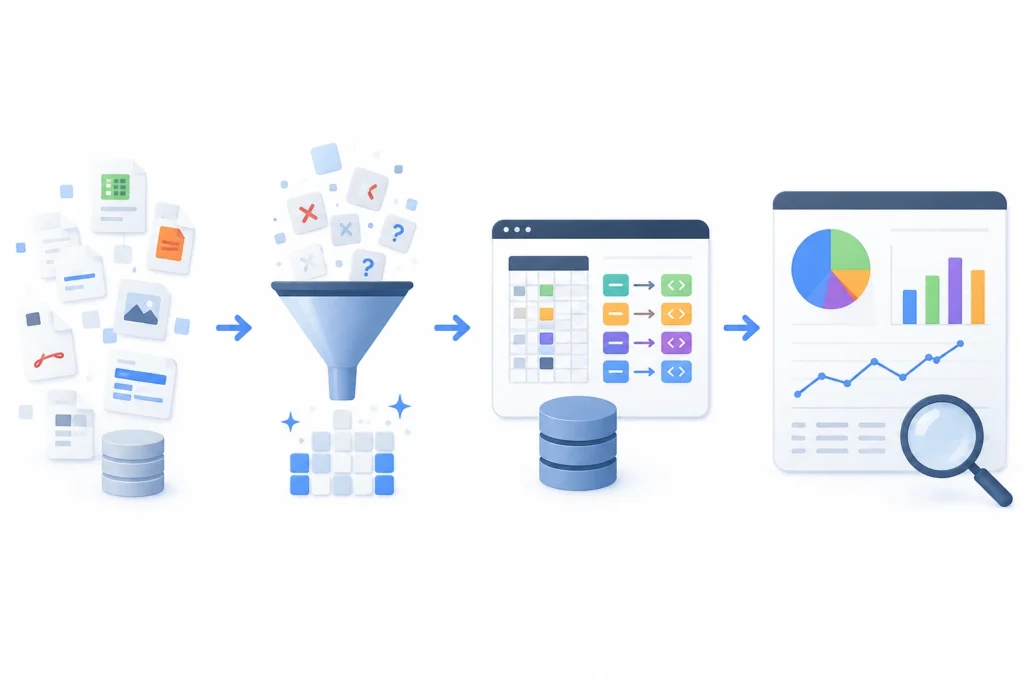
Data cleaning coding and analysis workflow is a structured approach for cleansing raw data, structuring it into usable forms and analyzing it to gain insights. Part of an important stage of the data analysis stage in research and business analysis.
Key Stages:
- Data collection
- Data cleaning and preprocessing
- Data coding
- Data analysis
- Interpretation and reporting
This structured approach ensures consistency and accuracy throughout the analysis.
Step 1: Data Collection
The first step in the data cleaning coding and analysis workflow is gathering relevant data from various sources such as surveys, databases, or online platforms.
Example:
A company collects customer feedback through online surveys to understand satisfaction levels.
Step 2: Data Cleaning and Preprocessing
Raw data often contains errors, missing values, or inconsistencies. Proper data cleaning and preprocessing steps are essential to ensure data quality.
Common Tasks:
- Removing duplicates
- Handling missing values
- Correcting errors
- Standardizing formats
Example:
If a dataset contains missing customer ages, you may replace them with the mean or median value.
These data cleaning and preprocessing steps improve the reliability of the analysis.
Step 3: Data Coding in Research Methodology
Once the data is cleaned, it needs to be structured for analysis. Data coding in research methodology involves converting qualitative or categorical data into numerical formats.
Examples of Data Coding:
- Gender: Male = 1, Female = 2
- Satisfaction Level: Low = 1, Medium = 2, High = 3
This step is crucial in the data cleaning coding and analysis workflow, especially for survey-based research.
Step 4: Data Preparation and Transformation
After coding, the data is further prepared for analysis using various data preparation and analysis techniques.
Techniques Include:
- Data normalization
- Data aggregation
- Feature selection
- Data transformation
Example:
Combining multiple variables to create a new metric, such as total sales per customer.
These data preparation and analysis techniques ensure that the dataset is ready for advanced analysis.
Step 5: Data Analysis Process in Research
The next step in the data cleaning coding and analysis workflow is analyzing the data using statistical methods.
Common Methods:
- Descriptive statistics (mean, median, standard deviation)
- Inferential statistics (t-tests, ANOVA, chi-square)
- Regression analysis
- Correlation analysis
Example:
A researcher uses regression analysis to study the relationship between income and spending habits.
The data analysis process in research helps uncover patterns, trends, and relationships.
Step 6: Data Visualization and Interpretation
After analysis, results must be presented clearly using charts, graphs, and dashboards.
Visualization Tools:
- Bar charts
- Pie charts
- Line graphs
- Dashboards
Example:
A business presents monthly sales trends using a line chart for better understanding.
Visualization is an essential part of the data cleaning coding and analysis workflow, as it simplifies complex data.
Step 7: Reporting and Decision-Making
The final step involves interpreting the results and making data-driven decisions.
Key Activities:
- Writing reports
- Drawing conclusions
- Providing recommendations
Example:
A company uses analysis results to improve customer retention strategies.
This completes the data cleaning coding and analysis workflow and ensures actionable insights.
Business Use Cases of Data Workflow
1. Marketing Analytics
Companies use the data cleaning coding and analysis workflow to analyse customer behavior and optimize campaigns.
2. Healthcare Research
Researchers apply data cleaning and preprocessing steps to ensure accurate patient data analysis.
3. Financial Analysis
Organizations use the data analysis process in research to predict market trends and manage risks.
4. Academic Research
Students rely on data coding in research methodology for survey data analysis in theses and dissertations.
Benefits of a Structured Data Workflow
1. Improved Data Quality
Clean and well-structured data leads to accurate insights.
2. Better Decision-Making
Reliable analysis supports informed decisions.
3. Increased Efficiency
Streamlined processes save time and effort.
4. Enhanced Research Credibility
Proper methodology improves the validity of results.
Common Challenges and Solutions
Challenge 1: Missing Data
Solution: Use imputation techniques or remove incomplete records.
Challenge 2: Data Inconsistency
Solution: Standardize formats during data cleaning and preprocessing steps.
Challenge 3: Complex Data Structures
Solution: Use appropriate data preparation and analysis techniques.
Best Practices for Effective Data Workflow
- Plan your workflow before starting analysis
- Use reliable tools like Excel, SPSS, R, or Python
- Document each step for transparency
- Validate results before reporting
- Continuously improve your process
Following these practices ensures a successful data cleaning coding and analysis workflow.
Conclusion
Finally, structuring the data cleaning coding and analysis process is crucial for converting raw data into valuable information. Various stages, ranging from data cleaning and preprocessing to data coding in research methodology and data analysis in the research, each stage is important in ensuring accuracy and reliability.
Utilizing these data preparation and analysis techniques effectively, businesses and researchers can make informed decisions and reach their objectives. It’s a workflow that is essential for success, whether you’re working on a business project or a piece of academic research.
Call to Action
Looking for a more efficient data pipeline? Collaborate with data experts to establish a comprehensive data cleaning coding and analysis process and maximize the value of your data now.
Book a free consultation for appointment
Email us at : grow@simbi.in