
Role of Clinical Research Coordinators in Regulatory Compliance
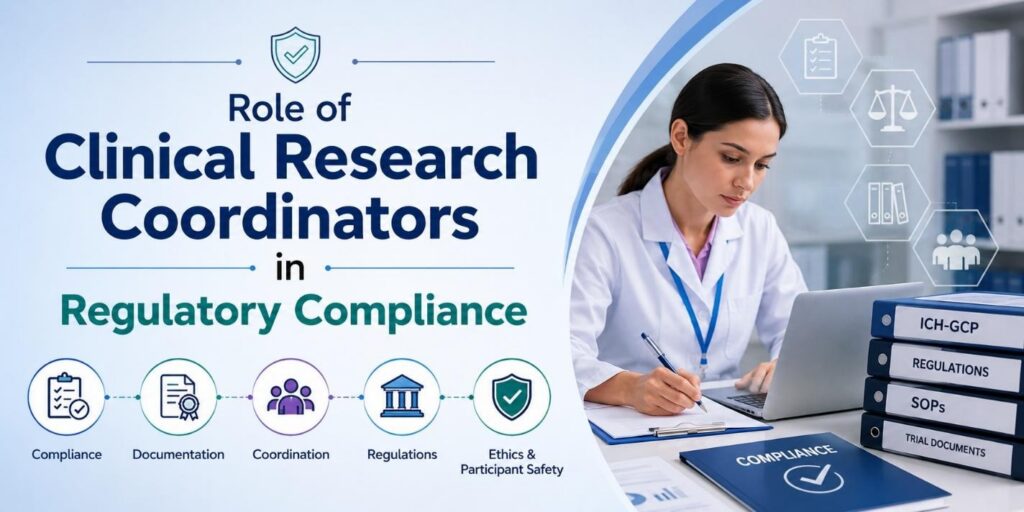
Connecting Clinical Operations with Regulatory Excellence
In clinical trials, the coordination of research activities and requirements is a continuous process that guarantees safety, reliability of data, and ethical conduct of the trials. CRCs provide a link between investigators, sponsors, Ethics Committees and regulatory groups, providing day-to-day support of trial operations to ensure adherence to trial protocols and compliance requirements.
Clinical Trial Documentation, GCP Compliance, Regulatory Support, and Ethics Committee Support are areas where CRCs play a pivotal role in ensuring clinical trial quality, helping to maintain it throughout the clinical trial lifecycle.
Their function is to make sure that the process of operation is compliant with the regulatory standards and to ensure that clinical research is accurate, transparent, and is able to be inspected.
READ THIS ALSO: Hire Dedicated Clinical Research Coordinators
The Clinical Research Coordinator: The Foundation of Clinical Research Compliance
Consistent implementation of regulatory requirements during the life of a study is what provides Clinical Research Compliance. Clinical Research Coordinators make sure that the rules are followed properly on a daily basis while regulations determine what should be done. CRCs are the liaison between investigators, organization sponsors, Contract Research Organizations (CROs), Ethics Committees, laboratories, pharmacists, and regulatory agencies. Their duties involve compliance of study activities with ICH-GCP, national regulations, sponsor protocols and institutional policies.
By anticipating potential problems and taking proactive steps to address them, CRCs are able to prevent issues from impacting participant safety or study integrity, rather than simply reacting to them once they arise.
Driving Regulatory Compliance During Study Startup
A Clinical Research Coordinator’s first job is not completed until the first participant has been enrolled. At the start of the study, CRCs first lay the groundwork for the study by creating regulations that ensure a legal and ethical basis for the trial to get underway.Their responsibilities include:
- Collecting essential regulatory documents
- Preparing site activation packages
- Verifying investigator qualifications
- Maintaining delegation of authority logs
- Organizing investigator training records
- Coordinating laboratory certifications
- Ensuring equipment calibration documentation
- Confirming protocol version control
- Supporting Site Initiation Visits (SIV)
Maintaining GCP Compliance Throughout Every Participant Visit
One of the most critical roles of the Clinical Research Coordinator is to ensure GCP Compliance in participant interaction. All study visits need careful co-ordination to ensure protocol procedures are conducted according to the approved procedures. CRCs schedule visits, make participant files, ensure the protocol is met, organize laboratory assessments and record all procedures completed during the visit.They also ensure:
- Eligibility criteria are verified before enrollment.
- No study procedures begin before informed consent.
- Visit windows are maintained.
- Protocol-required assessments are completed.
- Missed procedures are documented appropriately.
- Participant confidentiality is protected.
- Deviations are identified and reported promptly.
Clinical Trial Documentation: A Core Responsibility of Every CRC
One of the most important tasks that Clinical Research Coordinators do is to keep Clinical Trial Documentation. Clinical trial records are the evidence that all study activities were carried out as per regulatory requirements. Inadequate documentation can affect the integrity of data and result in substantial inspection issues.
Coordinating Ethics Committee Support Throughout the Trial
Ethical oversight is a continuous process that continues beyond the point of first approval of a clinical trial. Clinical Research Coordinators (CRCs) are an important part of the work with the Ethics Committee to offer an ongoing service to ensure that all components of the study are conducted in an ethical and regulatory manner.
Their duties involve the preparation and submission of initial ethics applications, amendments to the ethics application, new informed consent documents, participant recruitment documents, annual continuing review reports, participant safety notifications, Serious Adverse Event (SAE) reports, Investigator Brochure updates, study progress reports and notifications or study closure.
CRCs assist in protecting participant rights, the process of regulatory compliance and adherence to ethical standards from initiation to completion of the clinical trial process.
Acting as the Primary Regulatory Support Professional
Clinical Research Coordinators offer continued Regulatory Support to keep communication between the research site and regulatory parties organized and compliant. Their responsibilities include:
1.Ensuring regulatory documents/reports are submitted within required timeframes.
2.Maintenance of document version control: Keeping the most recent versions of key study documents and retaining previous versions as appropriate.
3.Sponsor requests: Documenting, clarifying and updating sponsors timely in response to a sponsor’s requests.
4.Ensuring regulatory correspondence: Coordinating and archiving all regulatory/sponsor/Ethics Committee correspondence.
5.Coordinating investigator signatures: Collecting necessary signatures for study documents, reports and regulatory forms.
6.Documenting for inspections: Gathering and arranging necessary documentation for audits and regulatory inspections.
7.Current investigator license maintenance: Maintenance of up to date investigator licences and certifications, and keeping investigator professional credentials current.
8.Oversee the process of training certification administration, record and track necessary training records, such as ICH-GCP training and protocol-specific training.
9.Assisting monitors with site visits: Providing access to study records and answering documentation questions during monitors’ visits.
Protecting Participants Through Proper Informed Consent Management
One of the most ethically challenging duties of a Clinical Research Coordinator is the informed consent process. CRCs coordinate consent process making sure the participants:
- Take a copy of the most up-to-date approved consent form.
- Know how to study and any risks to safety
- Know how to respond to any emergency situations that may occur
- Have sufficient opportunity to ask questions Voluntarily take part without being forced or threatened to do so Firmly sign documents prior to the start of study procedures
- Be given signed consent documents
- Are re-consented for changes in important protocol or safety information
Managing Safety Reporting With Regulatory Accuracy
The Clinical Research Coordinator is a key person on the team that ensures participant safety information is reported correctly and on time. They organise documentation and reporting of:
1. Adverse Events (AEs): Documentation, reporting and recording of any unwanted medical events that occur during the study.
2.Serious Adverse Events (SAEs): Quickly documenting adverse events that lead to death, hospitalization, disability, or other serious medical events.
3.Suspected Unexpected Serious Adverse Reactions (SUSARs): Reporting unexpected and serious adverse reactions that could be related to the investigational product within regulatory time limits.
4.Pregnancy Reporting: These involve the recording and reporting of pregnancies during the study and subsequent monitoring and follow-up as outlined in the protocol.
5.Protocol-Related Safety Concerns: Identifying, documenting and communicating any safety or deviations issues that may impact participant safety or integrity of the study.
6.Device Deficiencies: Deficiencies or failures of investigational medical devices that may affect participant safety or study results, whether recorded or reported
Ensuring Data Integrity Through ALCOA+ Principles
Reliable clinical trial data depend on disciplined documentation practices, and Clinical Research Coordinators are responsible for maintaining these standards, CRCs apply the ALCOA+ principles by ensuring data are:
- Attributable to the individual recording them.
- Legible throughout the record retention period.
- Contemporaneous, documented at the time activities occur.
- Original, preserving the first recorded observation.
- Accurate, without unauthorized alterations.
- Complete, capturing all required information.
- Consistent across all study records.
- Enduring, securely retained for regulatory review.
- Available whenever monitors, auditors, or inspectors require access.
Managing Protocol Deviations and CAPA
While clinical studies can sometimes involve deviations from the protocol, their proper management is crucial for ensuring the safety of participants and regulatory compliance.
The Clinical Research Coordinator (CRC) is tasked with identifying and documenting protocol deviations, evaluate the impact of these deviations and execute the required Corrective and Preventive Actions (CAPA).
They also make reports of deviations to the sponsors, inform Ethics Committees as needed, track common deviations, and implement preventive measures to minimize the likelihood of future deviations and maintain the clinical trial’s integrity.
Preparing Research Sites for Regulatory Inspections
Inspection readiness is not an activity performed only before an audit. Clinical Research Coordinators maintain continuous readiness throughout the clinical trial, routine responsibilities include:
- Reviewing regulatory binders
- Updating delegation logs
- Organizing essential documents
- Reconciling investigational product accountability
- Resolving monitor findings
- Tracking outstanding action items
- Ensuring staff training records remain current
- Verifying protocol compliance documentation
Leveraging Digital Systems for Better Compliance Management
Getting the most out of Digital Systems to improve Compliance Management Key electronic systems that are commonly used by Modern Clinical Research Coordinators include:
1.Electronic Data Capture (EDC): Entry, review and management of clinical trial data electronically to ensure accuracy and completeness.
2.Clinical Trial Management Systems (CTMS): Monitoring study activities, participant signups, site engagements and trial progress.
3.Electronic Trial Master File (eTMF): Providing a safe and sound digital repository for organizing and maintaining important study documents.
4.Electronic Regulatory Binder (eReg): Electronic management of regulatory documents, approvals, certifications and compliance records.
5.Interactive Response Technology (IRT): Assisting with subject randomization, investigational product management and drug allocation.
6.Electronic Patient-Reported Outcomes (ePRO): Patient-reported outcomes data collected and monitored digitally.
7.Electronic Source Documentation (eSource): Capture of clinical information in electronic source systems with integrity.
8.Electronic Consent (eConsent): Efficiently obtain informed consent via secure electronic systems and documentation.
9.Risk Based Monitoring (RBM) Dashboards: Review of study quality, identification of potential risks and proactive compliance management using centralized data.
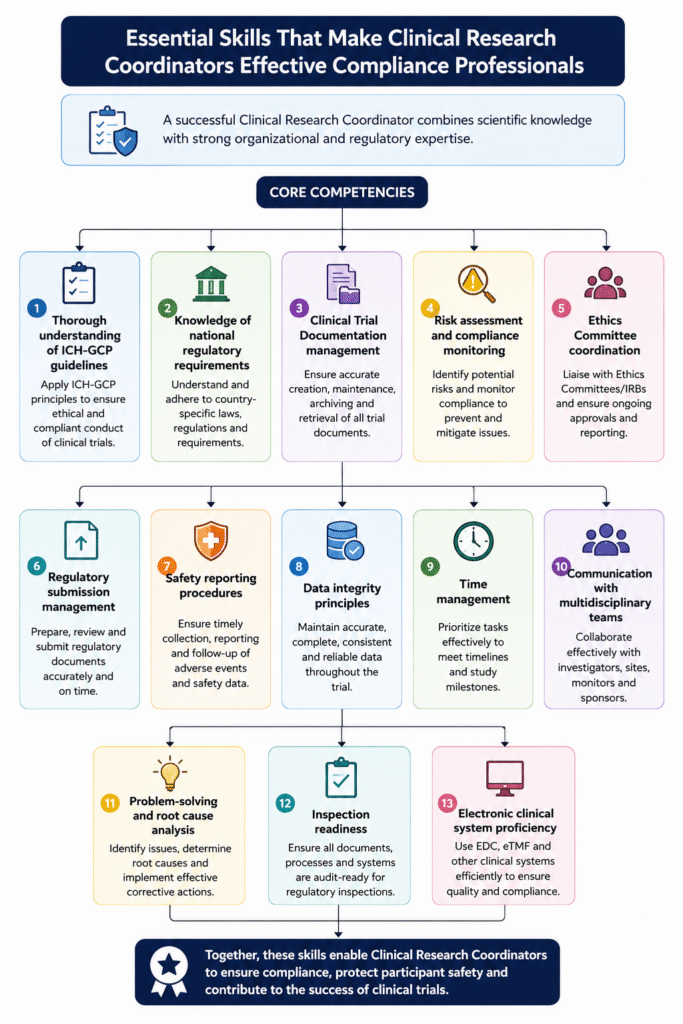
Strengthening the Future of Clinical Trials Through Regulatory Excellence
The successful implementation of regulatory, ethical and operational duties is essential for Clinical Research Compliance and the Clinical Research Coordinator plays a key role in this role.
Their role goes well beyond scheduling visits and ensuring paperwork is completed; they are responsible for ensuring GCP Compliance, Clinical Trial Documentation, Regulatory Support, Ethics Committee Support, participant safety, data integrity, and that every aspect of a trial is inspection-ready. With the evolution of clinical research, new technologies and risk-based quality paradigms are being implemented, which in turn has transformed the role of the Clinical Research Coordinator to a strategic one that cannot be missed in the delivery of compliant, ethical and high quality clinical trials.
Frequently Asked Questions
1. What is the role of Clinical Research Coordinators in regulatory compliance?
2. How do Clinical Research Coordinators support GCP Compliance in clinical trials?
3. Why is Clinical Trial Documentation important for Clinical Research Coordinators?
4. How do CRCs provide Regulatory Support during clinical studies?
5. What is the involvement of CRCs in Ethics Committee Support?
6. How do Clinical Research Coordinators maintain data integrity?
7. How do CRCs contribute to clinical trial inspection readiness?
8. What technical skills are required for Clinical Research Coordinators?
9. How do Clinical Research Coordinators manage protocol deviations?
10. Why are Clinical Research Coordinators important in modern clinical research?
11. How do Clinical Research Coordinators support participant safety compliance?
12. What role do CRCs play in risk-based quality management?
Book a free consultation for appointment
Email us at : grow@simbi.in