
Clinical Trial Staffing Services for CROs and Sponsors
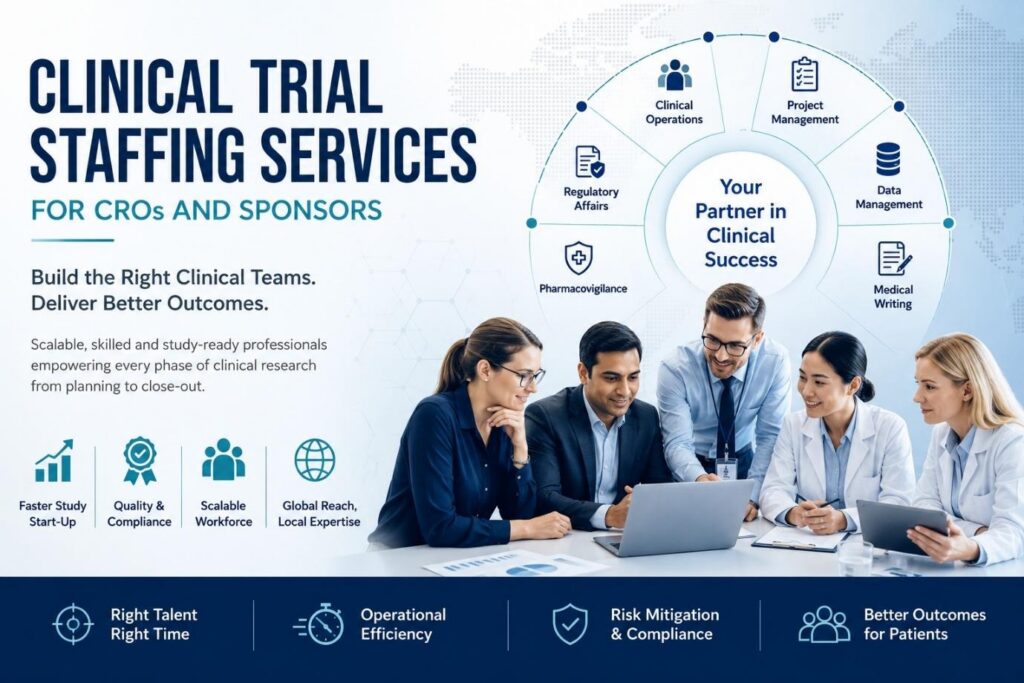
In today’s clinical research landscape, time, accuracy, and scalability are all crucial to achieving successful study execution. Sponsors, as well as Contract Research Organizations (CROs), are navigating a landscape of global study portfolios, decentralized trial models, technology-driven research platforms and ever-evolving regulatory requirements. In addition to a constant demand for scientific innovation to drive clinical development, the capacity to establish and keep a highly skilled workforce is also critical to the timely and budgeted completion of studies.
This shift has transformed Clinical Trial Staffing from a traditional recruitment function into a strategic component of clinical operations. Today’s workforces are not just about filling positions but ensuring specialist professionals are matched with the protocol complexity, therapeutic, patient recruitment objectives, digital technologies and regulatory needs. Workforce planning is a continuous process throughout a clinical trial, as it demands different skills in each phase. Structured clinical staffing can enhance operational efficiency, boost compliance, expedite study timelines, and establish robust research teams that are more adaptable to evolving project requirements.
Clinical Trial Staffing: The Operational Engine Behind Successful Clinical Research
All successful clinical trials are based on coordinated teamwork, not on individual expertise. Study protocols represent scientific goals and regulatory requirements, but they must be followed by the professionals who conduct the research activities in a consistent way at each research site. Clinical Trial Staffing ensures that organizations have the right expertise available throughout the clinical development lifecycle while maintaining flexibility to respond to evolving operational demands.
A comprehensive staffing strategy is more than recruitment, it involves staffing planning in conjunction with study objectives, operational milestones and regulatory expectations. Rather than relying on ad hoc deployments, sponsors anticipate the staffing needs and use teams composed of multidisciplinary staff to provide support to both routine and high complexity clinical programs.
A high-performing clinical trial workforce typically includes:
- Clinical Project Managers
- Clinical Research Associates (CRAs)
- Clinical Research Coordinators (CRCs)
- Clinical Data Managers
- Regulatory Affairs Specialists
- Medical Writers
- Pharmacovigilance Professionals
- Quality Assurance Specialists
- Clinical Trial Assistants
- Site Management Professionals
They are all part of a chain of professions that support each other, making their work contribute to the quality of the study, the safety of the participants, the meeting of regulatory requirements, and timely project delivery. Organizing the staff according to operational requirements leads to better communication, fewer bottlenecks in the workflow, and better clinical trial performance.
Workforce Planning Across the Clinical Trial Lifecycle
A frequently misguided belief is that the need for clinical staffing isn’t constant throughout the study but changes from the beginning to the end. In fact, there is a highly variable demand for workforce across the clinical trial lifecycle. Every operational phase presents a different set of challenges that demands a different mix of skill sets to successfully execute the studies, thus necessitating dynamic workforce planning to efficiently conduct the studies.
In study planning, organizations are concerned with protocol development, regulatory preparation and project governance. Site initiation involves operational teams that can respond to activate research centers, train site staff and prepare for protocols. The process of participant screening and enrolment requires extra coordination efforts during recruitment phases, and monitoring and data review require skilled professionals who can ensure quality and provide rapid solutions to the operational challenges. Finally, the study close-out and database lock rely on the cooperation of documentation specialists, data managers and regulatory professionals to finish the study deliverables.
Increasingly, sponsors use flexible staffing arrangements that change over time as studies progress, instead of having fixed staffing arrangements.
Table 1. Clinical Trial Phase vs Workforce Requirements
| Clinical Trial Phase | Primary Workforce Requirements | Operational Objective |
| Study Planning | Project Managers, Regulatory Specialists | Study strategy and regulatory preparation |
| Site Initiation | Clinical Research Associates, Site Management Teams | Site activation and readiness |
| Participant Recruitment | Clinical Research Coordinators, Recruitment Specialists | Enrollment and participant engagement |
| Study Conduct | CRAs, CRCs, Data Managers | Protocol execution and operational oversight |
| Monitoring & Quality Review | Clinical Monitors, QA Professionals | Compliance and quality assurance |
| Database Lock | Data Management Teams | Data validation and database completion |
| Study Close-Out | Regulatory & Documentation Specialists | Final reporting and regulatory closure |
This lifecycle-based approach enables organizations to allocate resources where they create the greatest operational value while minimizing periods of workforce underutilization.
Characteristics of a High-Performing Clinical Trial Staffing Strategy
The number of professionals assigned to a study is not the only factor that makes for successful workforce planning. Instead, it requires the ability to structure expertise, operation and organizational goals into a scalable staffing plan that can support a range of clinical research initiatives.
An effective Clinical Trial Staffing strategy should deliver:
- Scalability to support changing study workloads
- Therapeutic expertise aligned with protocol complexity
- Rapid workforce deployment for accelerated study timelines
- Regulatory readiness across all participating sites
- Cross-functional collaboration between operational teams
- Technology-enabled workforce management
- Consistent quality standards throughout study execution
- Resource optimization across multiple concurrent trials
Organizations that integrate these principles into workforce planning improve operational resilience while maintaining the flexibility required for modern clinical development.
Designing Scalable Workforce Models for CROs and Sponsors
Clinical research portfolios rarely remain static. Typically, sponsors conduct several studies in parallel for various therapeutic categories and in different geographic regions and stages of development. The complexity demands staffing configurations that can scale up and down without impacting study performance.
The first step in workforce planning is to accurately anticipate future resource needs. Prior to assigning professionals to specific studies, organizations assess the complexity of the protocol, number of participants needed for the study, expected growth of the study site, and special skills required. On-going tracking of workforce utilization also allows sponsors to shift resources effectively as needs change and priorities shift.
To avoid having to hire only permanent personnel, many employers have an internal staffing team, but also use temporary staffing to get the necessary expertise when the need arises, for example during busy periods at work. This helps to enhance all-round resource efficiency, and operational continuity.
Workforce Intelligence and Digital Resource Planning
As clinical research becomes increasingly complex, workforce planning is data-driven. The traditional staffing models that depended on manual allocation of resources are being replaced by intelligent workforce planning systems that predict, track, and optimise use of resources before they impact study timelines. Digital workforce intelligence gives sponsors and CROs visibility into resource availability, as well as making proactive staffing decisions in multiple clinical programs.
Modern Clinical Trial Staffing strategies integrate technology throughout the workforce lifecycle. Clinical Trial Management Systems (CTMS) support the coordination of study activities and the tracking of staffing needs at various research locations while workforce analytics platforms analyze productivity, utilization, and resource allocation. AI is also starting to assist in predictive workforce planning, forecast the need for staff based on the complexity of the protocols, predicted enrollment, and historical project performance.
These technologies do not exist in isolation as software applications, but form an ecosystem that operationalizes workforce planning as a continuous strategic practice instead of an ad hoc recruitment effort.
Table 2. Digital Technologies Supporting Clinical Trial Staffing
| Technology Platform | Workforce Application | Operational Value |
| Clinical Trial Management System (CTMS) | Resource planning and study tracking | Improves workforce visibility |
| Electronic Data Capture (EDC) | Data workflow coordination | Enhances collaboration between operational teams |
| Electronic Trial Master File (eTMF) | Regulatory documentation | Supports inspection readiness |
| Workforce Analytics Platforms | Capacity and utilization monitoring | Optimizes workforce allocation |
| AI-Based Resource Forecasting | Staffing demand prediction | Reduces future resource shortages |
| Collaboration Platforms | Cross-functional communication | Improves operational efficiency |
These technologies enable sponsors to move beyond reactive staffing and adopt predictive workforce management that supports efficient clinical trial execution.
Building Cross-Functional Clinical Teams for Operational Excellence
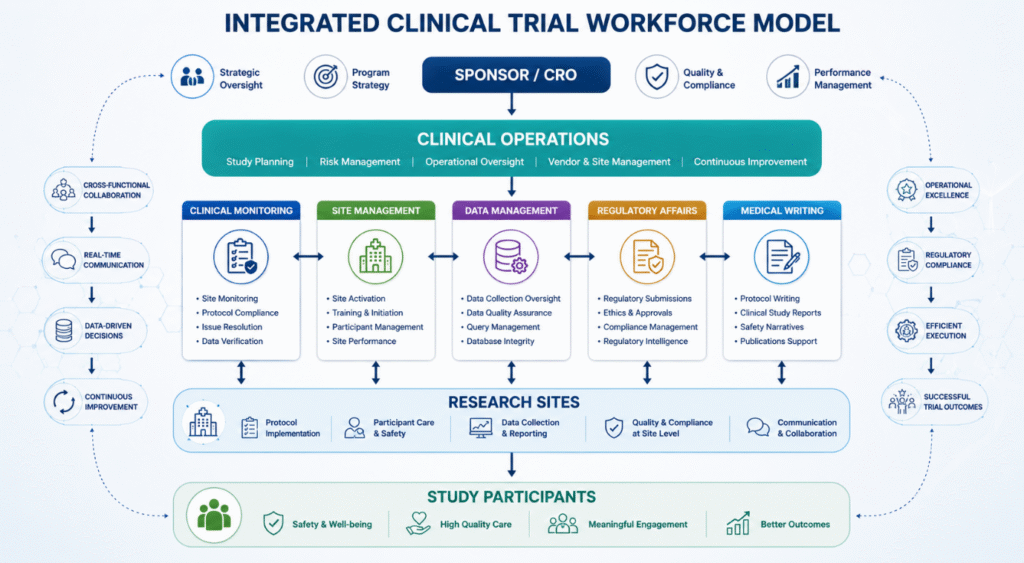
The clinical research field is now more and more interdisciplinary and has need of constant interaction between people with different specific knowledge. Good organizations do not function in silos, but rather have integrated clinical teams that bring operational, regulatory, scientific and quality together to achieve shared project objectives.
An effective workforce model encourages collaboration between:
- Clinical Operations
- Clinical Research Associates (CRAs)
- Clinical Research Coordinators (CRCs)
- Clinical Data Management
- Regulatory Affairs
- Medical Writing
- Pharmacovigilance
- Quality Assurance
- Site Management Teams
Having a cross functional team helps to facilitate communication, speed up problem resolution and helps to guarantee that protocol changes, regulatory updates and operational decisions are applied consistently from each of the participating research sites. Decentralized and global clinical trials are growing and a collaborative working model is becoming critical to ensure the quality of clinical trials while minimizing operational complexity.
Integrated Clinical Trial Workforce Model
The Future of Clinical Trial Staffing
The clinical research workforce is evolving toward a more flexible, technology-driven and world-class model. However, as sponsors look to staffing strategies that can help cover decentralized clinical trials, adaptive study designs and global research programs, they are increasingly seeking operational consistency that is suitable for various research settings.
Future-ready organizations are focusing on workforce strategies that emphasize:
- Predictive resource planning through AI and analytics
- Hybrid staffing models combining permanent and project-based professionals
- Remote collaboration across global study teams
- Functional outsourcing for specialized expertise
- Continuous workforce development and therapeutic specialization
- Performance-driven staffing decisions supported by operational KPIs
As these trends continue to evolve, Clinical Trial Staffing will become an integral component of clinical development strategy rather than a standalone operational activity. Companies with proactive investments in workforce intelligence and scalable staffing models will have a leg up delivering studies faster without compromising on quality, compliance and participant safety.
About Simbi Labs India
Building high-performing clinical research teams requires a combination of specialized talent, operational expertise, and flexible workforce planning. Simbi Labs India partners with pharmaceutical companies, biotechnology organizations, Contract Research Organizations (CROs), hospitals, and research institutions to deliver comprehensive Clinical Trial Staffing solutions that align workforce capabilities with study objectives. By integrating experienced clinical professionals, scalable staffing models, and operational best practices, Simbi Labs India helps organizations strengthen study execution, enhance regulatory compliance, and improve workforce efficiency across every stage of the clinical trial lifecycle.
The success of modern clinical research depends as much on workforce strategy as it does on scientific innovation. As studies become more complex, geographically distributed, and technology-enabled, organizations must move beyond conventional recruitment approaches and embrace strategic Clinical Trial Staffing models that support scalability, cross-functional collaboration, and operational resilience. Sponsors and CROs that invest in intelligent workforce planning, digital resource management, and multidisciplinary clinical teams will be better equipped to accelerate development timelines while consistently delivering high-quality, compliant research outcomes.
Build a High-Performance Clinical Trial Workforce
Whether you’re launching a first-in-human study, expanding a global multi-center trial, or strengthening existing clinical operations, Simbi Labs India provides flexible Clinical Trial Staffing solutions designed to help sponsors and CROs build skilled, scalable, and study-ready clinical teams. Connect with our experts to develop a workforce strategy that supports quality, efficiency, and long-term clinical research success.
Book a free consultation for appointment
Email us at : grow@simbi.in
Frequently Asked Questions
1. What is Clinical Trial Staffing?
Clinical Trial Staffing is the strategic process of planning, deploying, and managing qualified clinical research professionals across every phase of a clinical trial to ensure efficient study execution and regulatory compliance.
2. Why is Clinical Trial Staffing important for sponsors and CROs?
It helps organizations align the right expertise with study requirements, improving operational efficiency, participant management, data quality, and regulatory readiness while supporting timely trial completion.
3. Which professionals are included in Clinical Trial Staffing?
Clinical Trial Staffing typically includes Clinical Project Managers, Clinical Research Associates, Clinical Research Coordinators, Clinical Data Managers, Regulatory Affairs Specialists, Medical Writers, Pharmacovigilance professionals, Quality Assurance teams, and Site Management personnel.
4. How do sponsors determine workforce requirements for a clinical trial?
Sponsors assess study complexity, protocol design, participant enrollment targets, therapeutic expertise, geographic coverage, regulatory requirements, and operational timelines to forecast staffing needs.
5. What technologies support modern Clinical Trial Staffing?
Common technologies include Clinical Trial Management Systems (CTMS), Electronic Data Capture (EDC), Electronic Trial Master Files (eTMF), workforce analytics platforms, AI-based resource forecasting tools, and collaboration software.
6. How can specialized Clinical Trial Staffing partners improve study performance?
Specialized staffing partners provide access to experienced professionals, scalable workforce models, therapeutic expertise, and operational flexibility, enabling sponsors and CROs to improve study quality, optimize resources, and maintain compliance throughout the clinical trial lifecycle.