End to End Clinical Trial Workforce Solutions: Integrating Expertise Across the Clinical Trial Lifecycle
Clinical trials have become very “interdependent” operational programs with each and every activity affecting the subsequent one. Study startup, site activation, participant recruitment, clinical monitoring, data management, regulatory compliance and study close-out are no longer standalone activities. Instead, build an ecosystem that is interdependent and requires collaboration between multidisciplinary teams. However, with clinical development increasingly moving to different countries, decentralized trial models, and more complex therapeutic areas, organizations need a workforce strategy that can bring together expertise at all stages of clinical development.
This transformation has accelerated the adoption of End to End Clinical Trial Workforce Solutions, enabling sponsors and Contract Research Organizations (CROs) to manage the complete clinical workforce through a unified operational framework. Integrated workforce solutions bring together specialized staff and processes, standardized procedures, digital solutions and governance across the clinical trial continuum, rather than just focusing on individual staffing needs. As a result, greater collaboration, better efficiency, better adherence to regulations, and better study quality in protocol development through database lock.
End to end workforce solutions offer a more integrated perspective on the entire clinical research lifecycle, from start to finish, underlining continuity, accountability and synchronized execution, enabling organizations to execute complex studies with greater confidence and operational resilience.
Clinical Trial Workforce Operating Architecture
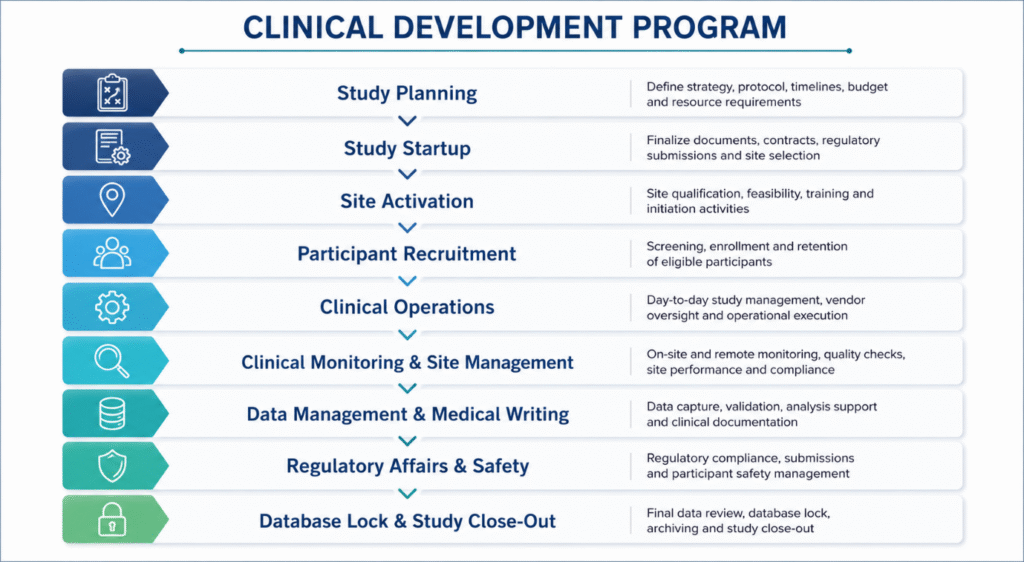
Clinical Trials Function as Connected Operational Ecosystems
Recruiting talented professionals is just one part of the equation when it comes to the success of clinical research. Each department brings in its own expertise, but needs to communicate regularly with other operations departments. Slowness in regulatory paperwork could delay the start of the site, poor monitoring may compromise data quality, and communication among research sites may vary, therefore impacting retention. The relationships are intertwined, each playing a critical role in the others, making workforce integration a necessity for today’s clinical operations.
End to End Clinical Trial Workforce Solutions establish a coordinated operating model where every function contributes toward common clinical objectives rather than working independently.
An integrated workforce typically includes:
- Clinical Operations Teams
- Clinical Project Managers
- Clinical Research Associates (CRAs)
- Clinical Research Coordinators (CRCs)
- Clinical Data Managers
- Regulatory Affairs Specialists
- Medical Writers
- Pharmacovigilance Professionals
- Quality Assurance Specialists
- Biostatisticians
- Site Management Teams
Each function is aligned to a particular stage of operation, and they are linked via common processes, digital platforms and joint governance.
These specialists work together as a clinical delivery network rather than just a collection of independent departments to increase the operational efficiency of the study delivery process.
Clinical Workforce Functions and Their Operational Contribution
| Clinical Function | Operational Contribution | Business Value |
| Clinical Operations | Overall study governance | Operational consistency |
| Project Management | Timeline coordination | Efficient study execution |
| Clinical Monitoring | Site oversight | Regulatory compliance |
| Clinical Research Coordination | Participant management | Improved recruitment and retention |
| Data Management | Clinical database integrity | Accurate study outcomes |
| Regulatory Affairs | Regulatory submissions | Inspection readiness |
| Medical Writing | Clinical documentation | Consistent reporting |
| Pharmacovigilance | Safety surveillance | Participant protection |
Rather than measuring success through staffing numbers alone, organizations increasingly evaluate workforce effectiveness based on collaboration, operational continuity, and study performance.
Eliminating Operational Silos Through Workforce Integration
Functional silos are one of the biggest challenges of operating in a clinical research environment. Departments may have their own goals, lines of communication, and metrics, which can cause delays in decision-making processes and lead to mismatched records. These isolated processes can have dramatic impacts on timelines, compliance and the overall quality of the study, as studies grow in size and become geographically spread.
End-to-End Clinical Trial Workforce Solutions address this challenge by integrating every operational function into a coordinated delivery model. Information is passed on more effectively, task ownership is more clear and cross-functional co-operation is part of the daily routine instead of an exception.
An integrated workforce model helps organizations:
- Improve communication between clinical functions
- Accelerate issue resolution across research sites
- Reduce operational duplication
- Strengthen documentation consistency
- Enhance participant experience
- Improve inspection readiness
- Standardize study execution across multiple locations
The result is a workforce capable of responding collectively to operational changes while maintaining consistency throughout the clinical trial lifecycle.
Workforce Synchronization Across Every Study Milestone
Each stage of a clinical trial requires a unique set of skills. Operational infrastructure is set up by regulatory professionals, project managers and site management teams during the start-up of the study. Clinical Research Coordinators and site staff are recruited for the participants, and monitoring activities are assigned to Clinical Research Associates and quality professionals. In later stages, the need for more interaction between the data management team and the medical writing team, regulatory team and pharmacovigilance team to ensure accurate reporting and completion of the study.
Resource synchronization with each milestone helps organizations to avoid resource bottlenecks and keep productivity high in the project. They do not consider staffing a one-off event, but are constantly monitoring their workforce needs against operational priorities to ensure staff skills are available at the right moment.
Digital Coordination Across Integrated Clinical Teams
Building an integrated workforce isn’t only about skilled workers, it’s also about a group of these skilled workers that can work together in an integrated digital ecosystem. Clinical trials today produce enormous amounts of operational, regulatory and participant information that needs to be shared with multiple teams, with data integrity and compliance kept intact. End-to-end workforce solutions thus depend on digital coordination platforms which allow all stakeholders to operate in a single working environment.
Rather than having separate systems for different departments, sponsors and CROs are increasingly turning to digital infrastructures that are integrated, offering real-time insights into study progress, workforce utilisation, documentation status, and quality metrics. This linked strategy reduces communication gaps, speeds up the decision-making process, and enables uniformity in execution in geographically dispersed research centres.
A digitally integrated workforce environment typically enables:
- Real-time communication between clinical functions
- Centralized documentation management
- Faster issue escalation and resolution
- Improved study milestone tracking
- Greater workforce visibility across projects
- Standardized collaboration between sponsors and research sites
- Better regulatory compliance through synchronized documentation
Digital coordination transforms individual teams into a connected operational network capable of supporting increasingly complex clinical development programs.
Workforce Priorities Across the Clinical Trial Lifecycle
| Clinical Trial Milestone | Workforce Priority | Primary Functional Teams |
| Protocol Development | Strategic planning | Clinical Operations, Project Management |
| Site Activation | Operational readiness | Site Management, Regulatory Affairs |
| Participant Recruitment | Enrollment efficiency | Clinical Research Coordinators, Recruitment Teams |
| Study Conduct | Quality execution | Clinical Research Associates, Clinical Operations |
| Data Review | Data integrity | Data Management, Biostatistics |
| Safety Monitoring | Participant protection | Pharmacovigilance, Medical Monitors |
| Database Lock | Validation and documentation | Data Management, Medical Writing |
| Study Close-Out | Regulatory completion | Regulatory Affairs, Quality Assurance |
Rather than assigning resources independently, integrated workforce solutions align specialist expertise with each milestone, ensuring operational continuity throughout the study lifecycle.
Cross-Functional Clinical Workforce Collaboration Network
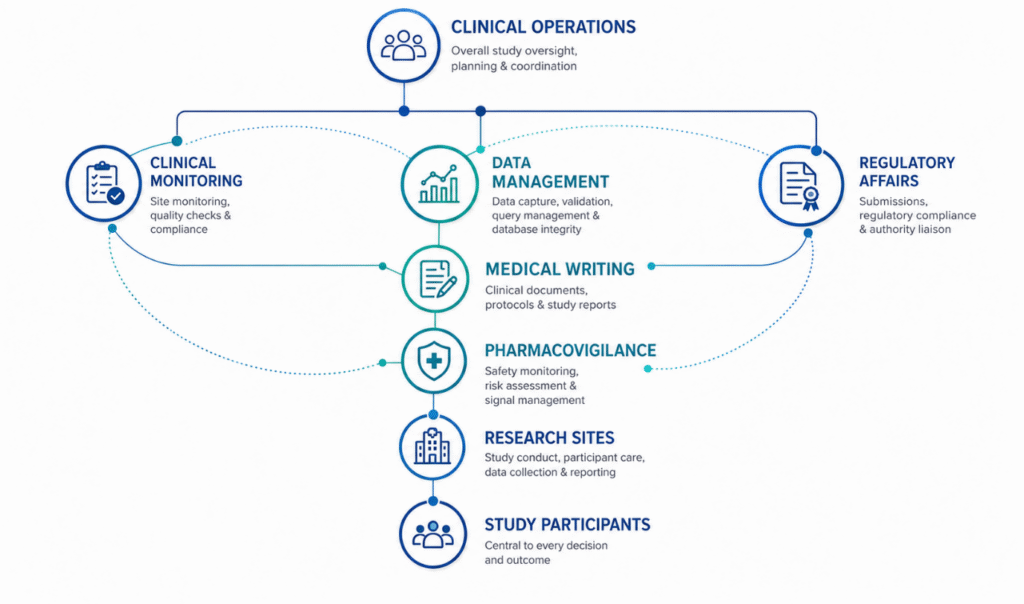
Measuring Workforce Performance Beyond Headcount
Staffing approaches are somewhat traditional, with staffing being judged by the number of staff working on a study. But, in the modern clinical operations, the performance of the workforce is measured by the operational outcome, not the workforce size. Integrated workforce solutions emphasize the effective utilization of multidisciplinary teams in achieving study goals, quality and regulatory requirements.
Key workforce performance indicators include:
- Study startup timelines
- Site activation efficiency
- Participant recruitment performance
- Monitoring cycle completion
- Protocol deviation rates
- Query resolution turnaround time
- Documentation accuracy
- Database lock readiness
- Inspection preparedness
- Cross-functional collaboration effectiveness
Organizations that continuously monitor these indicators gain actionable insights into workforce performance, enabling them to optimize resources while maintaining consistent study quality.
End-to-End Workforce Operating Framework
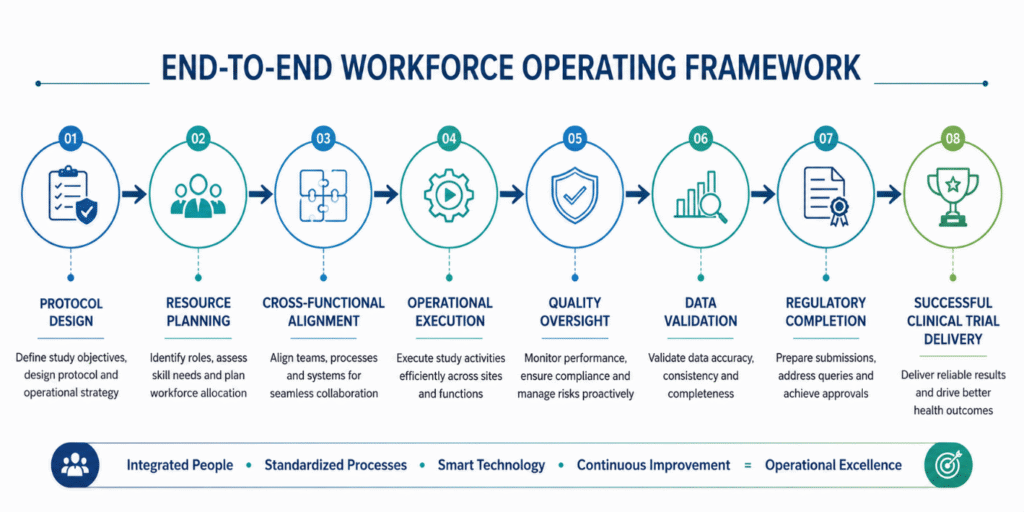
The success of clinical trials is increasingly dependent on the ability to have teams of specialized professionals working together within a “delivery” framework. Simbi Labs India offers End-to-End Clinical Trial Workforce Solutions comprising of a pool of skilled professionals, standardized operational processes and scalable workforce solutions throughout the clinical trial lifecycle for sponsors, CROs, biotechnology firms, hospitals and research institutions. The coordinated approach will allow organizations to enhance the collaboration, run operations more efficiently and ensure the quality from study start to regulatory close-out.
With the continued growth and complexity of clinical research, workforce integration will be a key ingredient in success. By adopting an End-to-End Clinical Trial Workforce Solutions, organizations can enhance collaboration, streamline study delivery, fortify regulatory compliance, and build robust clinical operations that meet future study requirements.
Transform Clinical Operations Through Integrated Workforce Solutions
Every stage of a clinical trial deserves coordinated expertise and seamless collaboration. Simbi Labs India helps sponsors and CROs build integrated workforce models that connect people, processes, and operational excellence across the entire clinical development lifecycle, enabling efficient, compliant, and high-quality clinical trial delivery.
Book a free consultation for appointment
Email us at : grow@simbi.in
Frequently Asked Questions
1. What are End-to-End Clinical Trial Workforce Solutions?
End-to-End Clinical Trial Workforce Solutions provide integrated clinical professionals and coordinated operational support across every phase of the clinical trial lifecycle, from study planning to close-out.
2. Which functional teams are included in an end-to-end workforce model?
These solutions typically include Clinical Operations, Project Management, Clinical Research Associates, Clinical Research Coordinators, Data Management, Regulatory Affairs, Medical Writing, Pharmacovigilance, Quality Assurance, Biostatistics, and Site Management teams.
3. Why are integrated workforce solutions important for clinical trials?
Integrated workforce models improve communication, reduce operational silos, strengthen compliance, optimize resource utilization, and enhance study quality by aligning multidisciplinary teams under a unified operating framework.
4. How do digital platforms support end-to-end workforce coordination?
Digital platforms such as CTMS, EDC, eTMF, collaboration tools, and workforce analytics systems enable real-time communication, centralized documentation, milestone tracking, and operational visibility across all clinical functions.
5. Can End-to-End Clinical Trial Workforce Solutions support global and multi-center studies?
Yes. These solutions are designed to coordinate multidisciplinary teams across multiple sites, countries, and decentralized trial environments while maintaining standardized processes and regulatory compliance.
6. How do integrated workforce solutions improve clinical trial performance?
By aligning expertise, workflows, and technology across the clinical trial lifecycle, integrated workforce solutions help accelerate study execution, improve collaboration, reduce operational risks, enhance data quality, and support successful regulatory outcomes.