
Essential Documentation Required for Clinical Trials: A Complete Guide to Clinical Research Compliance and GCP Compliance
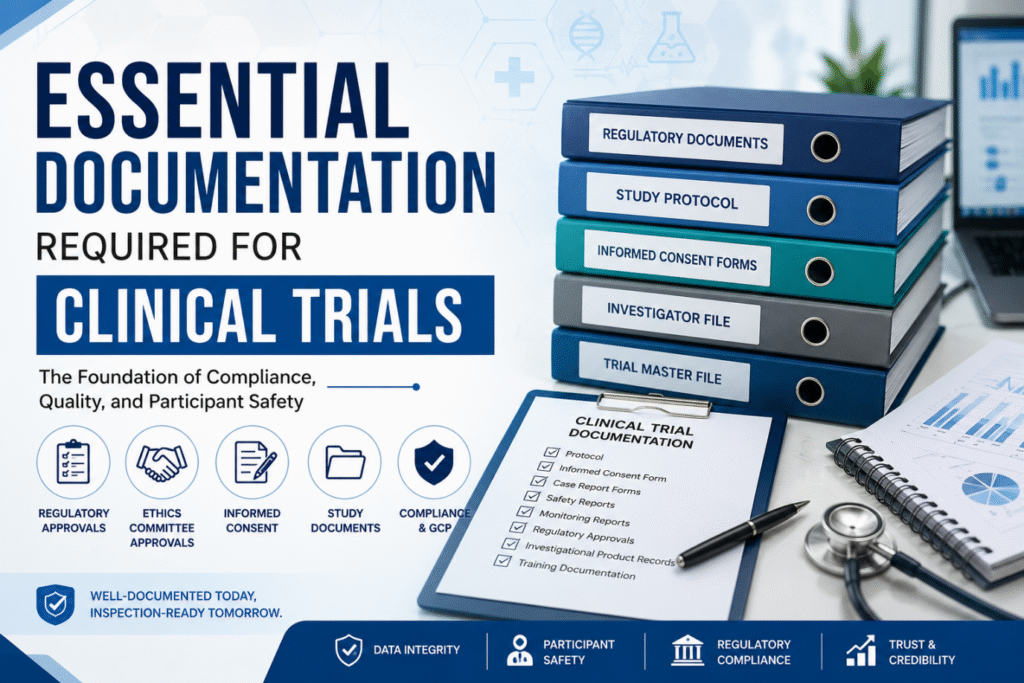
Every Clinical Trial Begins with Reliable Documentation
For every successful clinical trial, there is one thing that is not seen, but is absolutely vital: documentation. Documentation is the key that supports all elements of a clinical trial, whereas the participant, investigator and procedures are taken for granted. It is an legal proof, scientific evidence, and assurance of regulatory research that has been performed ethically and in accordance to approved research standards.
Documentation is not just about keeping records in a clinical research setting. It is used to assess participant safety, compliance with the protocol, data integrity and international standards like Good Clinical Practice (GCP) and regulatory requirements.
Documentation speaks for the entire story of the trial, both when it is being monitored, audited or inspected by regulatory authorities. Each informed consent, laboratory report, monitoring visit, protocol amendment and safety report adds to that story.
This comprehensive document covers every document that’s needed throughout the clinical trial process, explains their significance and the impact that good documentation has on Clinical Research Compliance, GCP Compliance, Regulatory Support and Ethics Committee Support.
READ THIS ALSO: Patient Recruitment Support Services
Documentation: The Foundation of Clinical Research Compliance
Clinical research is tightly regulated—it involves people and is used to produce evidence to approve new medical treatments. The rules and regulations can’t track every activity during a trial, so they depend on the paperwork to ensure that research has been carried out properly. documentation demonstrates that:
- Participant rights were protected.
- Risks were properly managed.
- Study procedures followed the approved protocol.
- Data were collected accurately.
- Investigational products were handled appropriately.
- Ethical principles were maintained.
- Regulatory obligations were fulfilled.
Understanding Essential Documents According to ICH-GCP
According to ICH-GCP E6(R2), Essential Documents are documents that individually and collectively enable the evaluation of:
- The conduct of a clinical trial
- Compliance with GCP
- Data quality
- Investigator performance
- Sponsor oversight
- Protection of study participants
The Documentation Lifecycle in Clinical Trials
Documentation should not be isolated objects, but it’s better to think of it as a process. Documenting the plans for the study.
Phase 1:
Study Planning Documentation : Documentation efforts occur prior to the recruitment of participants and emphasize regulatory preparation, ethical approval and site readiness. This phase provides the legal and scientific basis for the study. Conducting the trial is covered in
Phase 2:
Trial Conduct Documentation. Data are collected throughout the study, and documentation of all clinical activity, all protocol required procedure, all safety assessment, and all data collection event is made. This phase is responsible for the bulk of the clinical trial paperwork.
Phase 3:
Study Close-Out Documentation: Once the final participant has completed the study, documentation becomes more focused on data verification, reporting, regulatory closure and long-term documentation.
Regulatory Documentation: Building the Legal Foundation of a Clinical Trial
Some of the major regulatory documents include: regulatory documentation ensures that a clinical trial is approved for initiation prior to commencing the trial.
1. Clinical Trial Application: This is the application that is submitted to the regulatory authority for authorization to conduct the study. Typical contents include:
- Study protocol
- Investigator’s Brochure
- Investigator qualifications
- Manufacturing information
- Safety information
- Insurance documentation
- Regulatory Approval Letters: These are documents that formally allow the study to begin, they show that the study meets the national regulatory requirements prior to the start of participant recruitment.
- Clinical trials often have protocol changes; Each protocol amendment has to be documented for:
- Scientific justification
- Regulatory approval
- Ethics approval
- Investigator acknowledgment
- Updated participant documents
Ethics Committee Documentation: Protecting Human Participants
Ethics Committees (Institutional Review Boards/Independent Ethics Committees) not only approve clinical trials but also ensure that their main focus is participant welfare, not necessarily research.Key records include:
Ethics Submission Package
Contains:
- Study protocol
- Investigator’s Brochure
- Participant Information Sheet
- Informed Consent Form
- Recruitment materials
- Investigator CVs
- Insurance documents
Continuing Review Documentation:Most ethics committees require this to be done periodically during the study, and it should contain:
- Annual progress reports
- Safety summaries
- Enrollment updates
- Protocol deviations
- Serious adverse event reports
Final Study Closure Reports:At the end of the study, investigators inform the ethics committee with:
- Final participant status
- Overall safety information
- Study completion confirmation
- Final reports
Protocol Documentation: The Blueprint for Clinical Trial Execution
It is the operational manual of clinical trial, all clinical activities carried out in the research site are derived from the protocol.A thorough protocol will include:
- Scientific rationale
- Objectives
- Trial design
- Randomization methods
- Eligibility criteria
- Visit schedule
- Safety monitoring
- Statistical analysis plan
- Quality assurance procedures
Investigator Documentation: Demonstrating Site Competency
Regulators expect investigators to possess appropriate qualifications before conducting research,Required documentation includes:
Curriculum Vitae: Current and signed CV demonstrating relevant experience.
Medical License: Proof of authorization to practice medicine.
GCP Training Certificates: Evidence that investigators understand international clinical research standards.
Delegation of Authority Log: This document identifies:
- Every study team member
- Assigned responsibilities
- Training completion
- Authorization dates
Participant Documentation: Protecting Rights Through Accurate Records
Participant documentation represents one of the most scrutinized areas during inspections.
Important records include:
Informed Consent Forms: Documentation must prove:
- Consent occurred before study procedures.
- Current approved version was used.
- Participant voluntarily agreed.
- Investigator signed appropriately.
- Copies were provided.
Subject Identification Log: Maintains confidential linkage between participant identity and study identification number.
Screening Log: Tracks:
- Screened participants
- Eligibility status
- Screen failures
- Enrollment decisions
Source Documentation: Where Clinical Trial Data Begin:
Source documents are original records that support every data point entered into the study database.
Examples include:
- Medical charts
- Electronic health records
- Physician notes
- Laboratory reports
- Imaging reports
- ECG printouts
- Vital signs records
Source documentation should satisfy the ALCOA+ principles:
- Attributable
- Legible
- Contemporaneous
- Original
- Accurate
- Complete
- Consistent
- Enduring
- Available
Clinical Trial Documentation and Data Integrity
Documentation directly affects data integrity.Poor documentation creates uncertainty regarding:
- Whether procedures occurred
- Whether data were modified
- Whether participants met eligibility criteria
- Whether safety assessments were completed
Modern GCP emphasizes maintaining data that are:
- Complete
- Consistent
- Accurate
- Traceable
- Reliable
Safety Documentation: Recording Risks Throughout the Study
Participant safety documentation extends far beyond reporting adverse events,Essential safety records include:
Adverse Event Documentation: Every adverse event requires:
- Onset date
- Severity
- Outcome
- Relationship assessment
- Treatment provided
Serious Adverse Event Documentation: Requires expedited reporting to:
- Sponsor
- Regulatory Authority
- Ethics Committee
Safety Follow-up Documentation:
Maintains records until event resolution.
Investigational Product Documentation
Study drug accountability is closely monitored.
Required records include:
- Drug shipment logs
- Receipt documentation
- Temperature monitoring
- Storage logs
- Dispensing records
- Return records
- Destruction certificates
Monitoring Documentation: Ensuring Continuous Compliance
Clinical Research Associates evaluate whether studies remain compliant.
Documentation generated during monitoring includes:
- Monitoring Visit Reports
- Follow-up Letters
- Action Item Logs
- Query Resolution Reports
- Source Data Verification Records
Quality Management Documentation
Modern GCP emphasizes proactive quality management.
Key records include:
Risk Assessments: Identify study-specific compliance risks.
Corrective and Preventive Actions (CAPA): Document:
- Root cause analysis
- Corrective measures
- Preventive strategies
- Effectiveness checks
Internal Audit Reports: Verify compliance before regulatory inspections.
Trial Master File (TMF): The Central Repository of Essential Documents
The Trial Master File serves as the official archive of the clinical trial.
A complete TMF includes:
- Regulatory documentation
- Ethics approvals
- Investigator records
- Monitoring reports
- Safety documentation
- Protocol amendments
- Laboratory certifications
- Drug accountability records
- Correspondence
- Training documentation
Common Documentation Deficiencies Identified During Regulatory Inspections
Even if Clinical Research Compliance and GCP Compliance are conducted in a correct manner, regulatory inspections may discover documentation problems that can impact compliance.
Lack of or faulty records will make it difficult to audit the safety of participants, data quality and compliance with the protocol. Typical findings from inspections are signatures and dates missing, document versions not retained, poor version control, informed consent forms not completed, adverse event reporting delayed, filing practices are not good, and training documentation is inadequate.
Documenting these issues with timely and accurate documentation and providing this in a well-organized manner will help ensure inspection readiness and compliance to regulatory requirements.
Digital Transformation of Clinical Trial Documentation
The use of digital technologies is growing in clinical research to enhance efficiency, accuracy and regulatory compliance. Some of the most important electronic systems are: Electronic
1)Trial Master File (eTMF): Digitally stores and manages all the necessary clinical trial documents in a central location.
2) Electronic Consent (eConsent): Provides secure digital platforms for participants to review and give informed consent.
3) Electronic Data Capture (EDC): Provides secure electronic data collection, validation and management of clinical trial data.
4) Remote Monitoring Platforms: Enable virtual monitoring, documentation and collaboration between sponsors and research s
5)Electronic Investigator Site Files (eISF): Make available a digital system to organize and maintain Investigative Site documentation during the study.
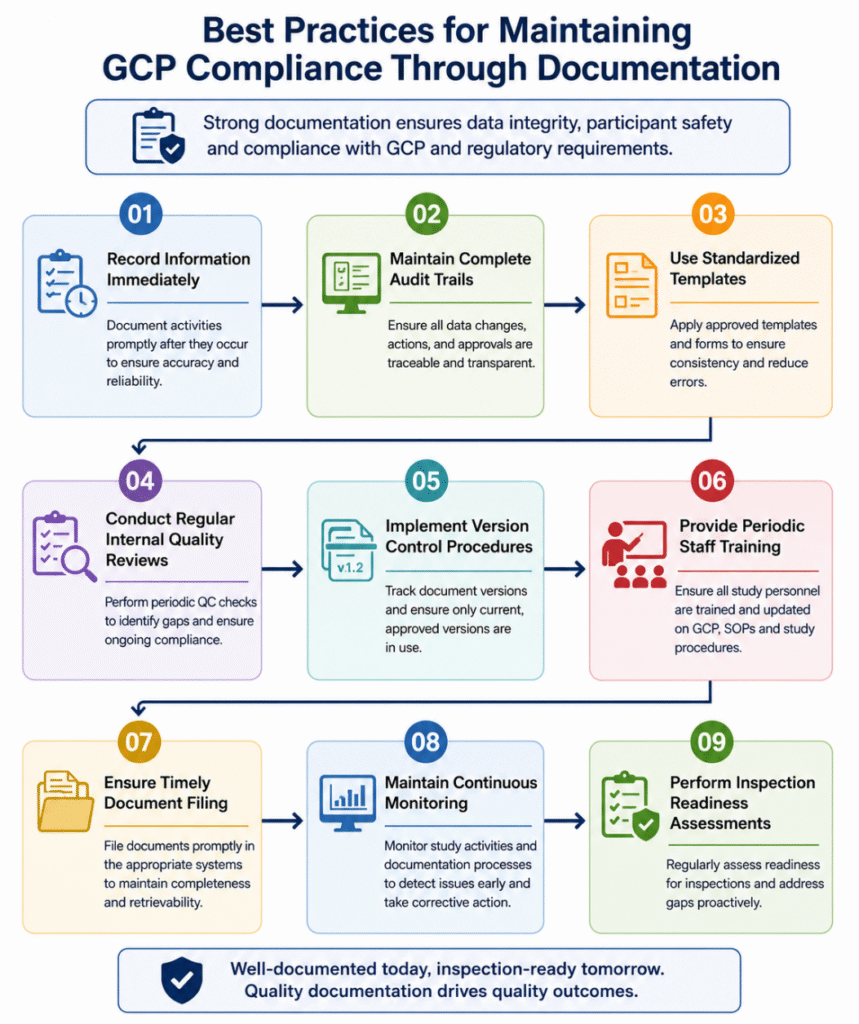
How Regulatory Support and Ethics Committee Support Strengthen Documentation
Strong Regulatory Support ensures timely submissions, amendment management, authority communications, and inspection readiness. Likewise, good Ethics Committee Support ensures that the protection of participants is maintained by appropriate review, ongoing monitoring and record of ethical compliance.
These functions complement each other in the reinforcement of Clinical Research Compliance and in the documentation of scientific quality and in the sense of ethical responsibility.
Ensuring Long-Term Success Through Effective Documentation
Clinical trial documentation is much more than a set of forms; it’s the proof that every aspect of the study is done responsibly, ethically and according to regulations. These documents underscore the rigor and integrity of the research process and ensure the safeguarding of research participants, ranging from protocol development and ethics approval to the final archiving.
Organizations with strong documentation practices with a strong Regulatory Support and Ethics Committee Support are more likely to be able to meet Clinical Research Compliance and GCP Compliance.
With the maturing of clinical research through digital technologies and growing complexity of study designs, there is an increasing need to ensure accurate, complete and inspection-ready documentation which can provide reliable data, keep participants safe and aid in the successful development of new therapies.
FAQs
Why is Clinical Research Compliance important?
What is GCP Compliance in clinical research?
Which documents are of critical importance in a clinical trial?
What is the use of a Trial master file (TMF)?
How does Regulatory Support help clinical trials?
Why is Ethics Committee Support important?
What are some routine errors made in documentation in regulatory inspections?
What are the benefits of electronic systems on the documentation of clinical trials?
What are some ways to keep documentation GCP compliant?
Book a free consultation for appointment
Email us at : grow@s