
Railway Station Crowd Simulation for Safer Passenger Flow
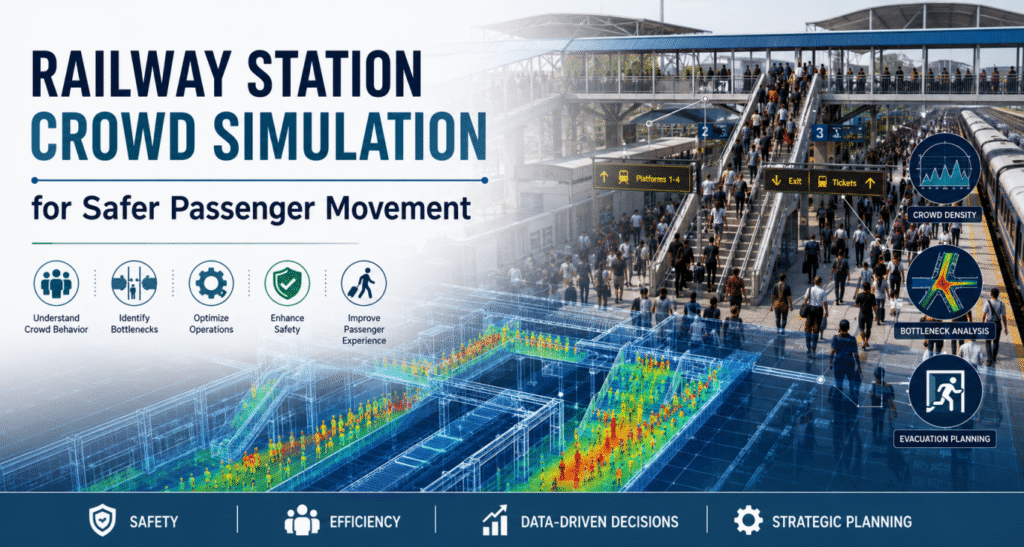
When Passenger Movement Becomes the Biggest Operational Challenge
Passenger movement is as important as train operations at modern railway stations where thousands of passengers travel and move in short time intervals. Platforms, Foot Over Bridges (FOBs), staircases and escalators can quickly become congested during peak hours, festivals or special events when multiple streams of passengers converge.
With regard to passenger behaviours, the numbers are not the only challenge, as the various speeds of walking, walking routes, group walking and sudden stops all contribute to the flow of the crowd.
That is why railway crowd simulation is now a crucial planning tool. It can model passenger flow in a station under various conditions, aiding railway operators in optimizing the management of passenger flow on platforms, identifying congestion points, and data-informed, evidence-based decisions on operational strategies before the start of congestion.
Passenger Movement Is No Longer a Guessing Game
Railway stations are also one of the most complex transportation systems where the flow of passengers is dynamic and fluctuates with the arrival and departure of each train. Passengers do not arrive at airports in a steady stream, but rather in large groups, which leads to rapid surges in the number of people arriving in a short time.
Traditional approaches to planning largely rely on infrastructure capacity, which do not necessarily reflect actual human actions. Different passengers take different paths, people move around at different speeds, groups of people walk together, people stop the station unexpectedly and respond differently to congestion.All of these affect overall station performance as passengers choose different routes, walk at different speeds, walk in groups, stop the station unexpectedly, and react to congestion differently.
Railway crowd simulation models the actual behaviors and helps planners to accurately forecast how passengers will move within a virtual environment, highlighting congestion and allowing planners to make informed decisions to ensure safer and more efficient station operations.
Engineering Passenger Flow with Railway Crowd Simulation
The basic idea behind railway crowd simulation is the simulation of a digital model of a railway station in which each person is a separate decision-making agent.
Advanced simulation software models each individual rather than the crowd as a whole, as a moving mass. Every simulated passenger has characteristics such as:
- Walking speed – sets different velocities for passengers who walk, elderly passengers, children, and passengers traveling with luggage.
- Preferred walking direction – Represents the most natural walking paths taken to the platforms, exits or transfer areas by passengers.
- Personal space requirements – Consideration of the space required by the passengers when they move around or wait.
- Boarding urgency – When passengers adjust their pace and behaviour when boarding and leaving a train.
- Route preferences – guesses how passengers will travel between the shortest, fastest and least congested.
- Reaction to congestion – Models passenger slowing down, rerouting or waiting due to congestion events.
- Platform Concourse Platform Door – Observations of where and how passengers wait at train platforms, concourses and near train doors.
- Group movement pattern – These are groups of people that move together, not separately, whether they be families, friends, or groups of people on a tour.
- Luggage influence – Refers to the effect of the luggage on the walking speed, maneuverability and space occupancy.
- Accessibility requirements – Represents the mobility of a passenger with a wheelchair, mobility aid, stroller or who needs step-free access.
- Decision making during disruption – Forecasts what passengers will do in a delay, platform change, emergency, or when service is announced.Thousands of these virtual passengers interact at the same time, and the complex patterns of the crowds emerge naturally.
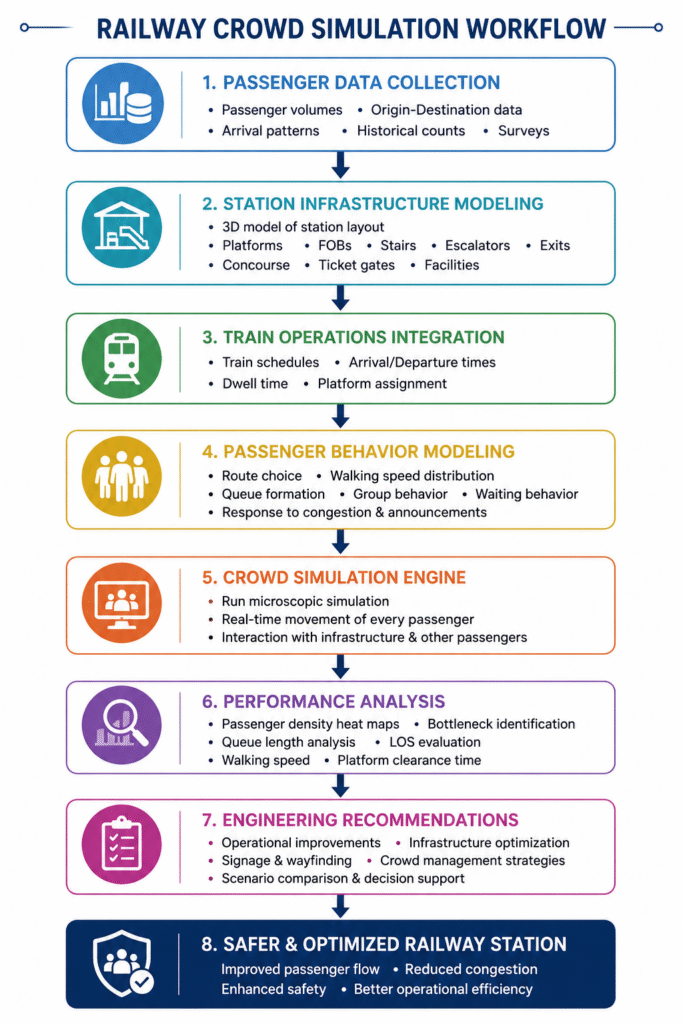
Building a Digital Twin of Passenger Movement
All simulations start with a correct digital model of the station. But contemporary railway crowd simulation can do more than just duplicate architectural drawings. It produces a virtual reality model with infrastructure, operations and passenger behavior in a single analysis environment. The following are the typical components of the model:
Station Geometry
All physical elements which affect the passenger flow are reconstructed in digital model to represent the actual conditions in the station. These include platforms, Foot Over Bridges (FOB), staircases, escalators, elevators, concourse areas, ticketing areas, Automatic Fare Collection (AFC) gates, waiting halls, retail areas, corridors, entry/exit gates, emergency exits, and platform furniture/safety barriers.
The location of pillars, seating areas, ticket vending machines, and information kiosks are just a few examples of seemingly insignificant design considerations that can have a major impact on the flow of pedestrians, and which therefore must be captured in simulations of railway crowds, if they are to be realistic and reliable.
Railway Operations
The movement of passengers is tightly related to the operation of trains and thus an important part of railway crowd simulation is operational data. The simulation includes: Train arrival and departure times, platform assignments, boarding times, train door open positions, train occupancy, dwell times, delayed train services, special services and temporary closures of platforms.
These operational features are coupled with the passenger behaviour to gain a realistic picture of station performance during the day, both under normal and disrupted operating conditions.
Passenger Demand
Demand for passengers depends on the time, the event, and the type of passenger. Railway crowd simulation models for situations like morning/evening peak hours, weekends, festivals, holidays, special events, and holiday seasons, considers various categories of passengers, such as commuters, families, individuals with reduced mobility, people with luggage, interchange passengers, and senior citizens. These variations differ between each group, so accurately modelling these variations helps to predict realistic crowd dynamics and enhance station planning.
Human Behavior
Railway crowd simulation models simulate real passenger behavior when calculating the capacity of a railway system, unlike the traditional capacity calculations. It reflects the way people take routes, avoid overcrowded zones, queue up, walk together, listen to announcements, turn around when they become congested, prefer walking up and down the escalator rather than up and down stairs, and stop unexpectedly.
These behaviors offer a more realistic representation of crowd dynamics, and can be used to predict congestion before it happens.
When Infrastructure Meets Human Behavior
It is possible to have a railway station that can accommodate thousands of people per day, but for the railway to run safely more than the space of the station is required. The station may appear congested, but it’s not necessarily because of its physical size – sometimes passenger behaviour in the station interacts with the infrastructure in an unexpected manner.
For instance, although a staircase may be designed to be wide enough and strong enough for the number of passengers it is expected to carry, there will be a number of factors that would render it less effective in practice, for example, the diversity of people walking, groups going up and down the stairs, passengers carrying luggage, personal space requirements and the reluctance of passengers to make decisions in uncertain situations.
This is where railway crowd simulation software comes in, by modelling the infrastructure design and realistic human behaviour to reveal potential congestion points, allowing planners to optimize passenger flow in advance.
Platforms, FOBs, Stairs, and Escalators—Where Congestion Actually Begins
Crowd congestion does not occur randomly. It grows at certain places where the demand for passengers outstrips the capacity of movement (space). Knowing which areas are critical in platforms is the base of good platform crowd management.
Railway Platforms: Where Passenger Density Changes Every Minute
The most dynamic parts of a station are the railway platforms, where passenger numbers fluctuate with each train coming and going.
Platforms host waiting passengers, boarding and alighting passengers, transfer passengers, passengers with bags, railway personnel, vendors and emergency responders all of which interact in a different manner with regard to their movement priorities.
Such cross-curculiter pedestrian traffic can easily lead to congestion, particularly at train doors and at the platforms edge. Railway crowd simulation is used to simulate the crowd and analyse the characteristics of the platform, including the density of passengers, efficiency of passengers boarding, utilisation of the platform door, passenger queue formation, platform walking paths, platform clearance time, and hotspot overcrowding.
Why Foot Over Bridges Become Critical Crowd Bottlenecks
Foot Over Bridges are often the busiest components of a railway station. They connect multiple platforms while simultaneously accommodating passengers travelling in opposite directions,Their performance depends on more than bridge width.
Simulation evaluates:
- Bidirectional pedestrian flow – Evaluates how passengers moving in opposite directions affect overall movement efficiency.
- Merging behavior from multiple staircases – Analyzes how passenger streams combine at Foot Over Bridges (FOBs) and other junctions.
- Passenger overtaking – Simulates how faster passengers navigate around slower-moving individuals or groups.
- Congestion propagation – Tracks how bottlenecks spread from one station area to another.
- Queue spillback – Identifies when queues extend beyond their intended areas, blocking walkways or platforms.
- Safe occupancy levels – Assesses whether the number of passengers remains within safe capacity limits.
- Walking speed reductions – Measures how crowd density impacts passenger movement and travel time.
- Emergency accessibility – Evaluates whether emergency routes remain clear and accessible during high crowd conditions.
The Hidden Impact of Vertical Circulation on Passenger Safety
The effects of vertical circulation in the area of passengers safety are not so obvious.The influence of vertical circulation on passenger safety is not as apparent. Although they take up a fairly small proportion of space, stairs and escalators can be critical to the capacity of the whole station, and simulation can be used to answer questions like:
What if the speed of the stairs or escalators could be reduced to get people off the platform to decrease queues, or what if the shoes were designed with wheels or rubber treads to reduce the need for staircases?
- Should an escalator run in one direction during rush hour?
- Is an additional staircase required?
- What will the length of the queues be?
- Will the congestion interfere with emergency evacuation?
- Which of the stairs has the greatest passenger demand?
- Are there alternative evacuation routes in case of a failure on one of the escalators?
When Rush Hour Pushes Infrastructure to Its Limits
Railway stations can become quickly saturated during rush hours when there is a surge in the number of passengers. Increased train frequency and higher peak ridership results in reduced walking speeds, longer queues, and platform congestion, Foot over Bridges (FOB) congestion, staircase congestion, escalator congestion and ticket gate congestion.
These are challenges that are caused by the interaction of passenger behaviour, infrastructure design and train operations. Railway crowd simulation allows engineers to create a virtual environment of ‘peak hour’ conditions to determine potential bottlenecks, trial various scenarios and provide appropriate solutions before congestion impacts real-life train services.
Beyond Capacity: Measuring How Stations Actually Perform
The traditional approach to planning is to plan for the maximum number of passengers that a station can possibly handle. But, in terms of operation, safety and efficiency are not a matter of capacity.
Though a station is claimed to be adequately sized on paper, it may be unable to accommodate a sufficient number of passengers due to uneven distribution. Naturally they tend to go to areas they already know in which to enter, or to preferred stairs or escalators or to the train door nearest to an exit from the station.
For this reason, modern railway crowd simulation investigates different performance measures which give a much more reliable picture of the station performance.
| Performance Indicator | Why It Matters |
| Passenger Density | Identifies overcrowded zones and unsafe crowd conditions. |
| Walking Speed | Measures how congestion affects passenger movement. |
| Queue Length | Evaluates waiting conditions at ticket gates, stairs, and escalators. |
| Platform Occupancy | Assesses available space before and after train arrivals. |
| Travel Time | Measures the time passengers need to move between station areas. |
| Foot Over Bridge Utilization | Determines whether bridges can safely handle passenger demand. |
| Staircase Throughput | Evaluates the number of passengers moving safely per minute. |
| Escalator Capacity | Measures vertical circulation efficiency during peak periods. |
| Bottleneck Duration | Identifies how long congestion persists before normal flow resumes. |
| Evacuation Time | Estimates how quickly passengers can exit during emergencies. |
| Level of Service (LOS) | Indicates passenger comfort, safety, and operational efficiency. |
Testing Thousands of Passenger Journeys in a Virtual Environment
The flexibility of railway crowd simulation is one of its best features, allowing engineers to try out various operational strategies without making any changes to the train service and seeing the results, as they would do in real life. Through simulation, questions can be raised like:
- What happens if two trains arrive simultaneously?
- Will adding a new staircase reduce platform congestion?
- How will passenger flow change if one escalator is dedicated to upward movement during peak hours?
- What is the impact of closing one Foot Over Bridge for maintenance?
- Can temporary barriers improve queue organization?
- How will a new retail kiosk affect pedestrian circulation?
- Will wider platform waiting areas improve boarding efficiency?
- Does relocating ticket gates reduce congestion?
Simulation Scenario: Managing Festival Travel Without Expanding Infrastructure
Imagine a major railway station preparing for a week-long festival expected to increase passenger traffic by over 40%. Although additional special trains are introduced, the station infrastructure remains unchanged.
To prepare, engineers perform a railway crowd simulation using projected passenger volumes, train schedules, and station layouts.
The simulation identifies several critical bottlenecks, including:
- Severe congestion on the central Foot Over Bridge (FOB)
- Queue spillback from staircases onto platforms
- Overloaded escalators during peak hours
- High passenger density near train doors
- Reduced walking speeds at ticket gates
- Obstructed emergency access routes
Based on these insights, station authorities implement operational improvements instead of costly infrastructure upgrades, such as:
- One-way movement on selected FOBs
- Additional crowd marshals at busy locations
- Temporary directional signage
- Controlled holding areas before train arrivals
- Optimized passenger announcements
Engineering Insight: A Small Operational Change with a Major Impact
Consider a busy suburban railway station where weekday commuters consistently experience congestion between 8:00 AM and 9:00 AM.
Passenger observations indicate that most commuters prefer a centrally located escalator, while adjacent staircases remain underutilized.
Rather than immediately constructing additional infrastructure, engineers develop a railway crowd simulation model to understand the underlying cause.
The simulation reveals that:
- More than 70% of passengers choose the same escalator because it aligns directly with the preferred platform exit.
- Bidirectional movement reduces effective escalator capacity.
- Staircases have sufficient spare capacity but are poorly integrated into passenger circulation routes.
Several virtual alternatives are tested.
The optimal solution combines operational and behavioral interventions rather than civil construction.
These include:
- Converting one escalator to upward-only movement during morning peak hours.
- Improving directional signage toward adjacent staircases.
- Installing lightweight pedestrian barriers to organize passenger flow.
- Positioning staff near decision points to encourage balanced distribution.
Without modifying the station structure, the simulation predicts:
- Reduced queue lengths.
- Higher vertical circulation efficiency.
- Faster platform clearance.
- Improved passenger comfort.
- Lower crowd density around escalator landings.
Why Leading Railway Authorities Invest in Predictive Crowd Simulation
As railway networks continue to expand, passenger movement has become a strategic engineering challenge rather than a purely operational concern.Simulation is increasingly used throughout the lifecycle of railway infrastructure projects, including:
During Planning: Engineers validate station layouts before construction begins, ensuring platforms, concourses, staircases, and Foot Over Bridges can accommodate projected passenger demand.
During Design: Architects and consultants compare alternative station configurations, optimize circulation paths, and identify bottlenecks before finalizing drawings.
During Operations: Station managers evaluate staffing plans, passenger routing strategies, boarding procedures, and temporary operational changes without disrupting live services.
During Redevelopment: Simulation assesses how proposed modifications affect existing passenger movement and identifies the safest implementation strategy.
During Emergency Preparedness: Safety teams evaluate evacuation procedures, emergency exit capacities, smoke scenarios, and infrastructure resilience under abnormal operating conditions.
Because every recommendation is supported by measurable data, simulation provides confidence that operational decisions are based on engineering evidence rather than assumptions.
Turning Passenger Data into Actionable Engineering Decisions
We build and test cutting-edge railway crowd simulation models in our simulation laboratory, translating complex passenger movements into valuable engineering insights. We integrate transportation engineering, pedestrian behavior analysis and computational models to assess station performance both during normal use and during peak demand periods. Services provided are passenger flow analysis, platform crowd management, Foot Over Bridge capacity assessment, evacuation simulation, infrastructure validation and digital twin development.
The outputs from each study include engineering level results like density heat maps, crowd visualisations, bottlenecks and practical recommendations for stakeholders to make better decisions about infrastructure, optimise operations and improve safety.
The Next Generation of Intelligent Railway Stations
Railway stations are transforming into multi-modal hubs – where people easily switch from rail to metro, bus to taxi and active transport. This complexity demands more than traditional planning and management tools.
New technologies such as Artificial Intelligence, the Internet of Things (IoT) sensors, computer vision, digital twins, and real-time passenger analytics are revolutionizing the ability of railway companies to grasp and manage the ways that people move.
When integrated with railway crowd simulation, these technologies enable:
- Real-time monitoring of passenger density.
- Predictive congestion forecasting.
- Dynamic passenger routing.
- Intelligent wayfinding systems.
- Automated crowd alerts.
- Adaptive platform management.
- Data-driven staffing decisions.
- Continuous operational optimization.
Building Safer Railway Stations Before the First Passenger Arrives
Each station is intended to serve a purpose that is to transport people, but the ultimate test of a railway station’s effectiveness is whether it can do so safely, efficiently and comfortably under all operating conditions. With passenger numbers continuing to rise, it is no longer possible to rely on old planning techniques to deal with the complexities of modern railway contexts.
Predictive, data-driven analysis is essential for understanding the interaction between infrastructure, train operations and people. Railway crowd simulation offers such a feature by allowing engineers and railway planners to simulate passenger flow, stress performance of infrastructure and the flow management of platform crowds, well before the passengers arrive in the station.
From determining a new station design, to assessing redevelopment projects, to planning for festival traffic, or even to bolstering emergency plans, simulation brings engineering intelligence to bear on uncertainty. Our simulation lab can integrate state-of-the-art modelling with practical operational experience to create railway stations that can meet current passenger volume and are fit for the future.
Frequently Asked Questions
1. What is railway crowd simulation?
2. How does platform crowd management improve passenger safety?
3. What data is required to perform a railway crowd simulation study?
4. Can railway crowd simulation support station expansion projects?
5. How is crowd simulation useful during festivals or special events?
6. Why should railway authorities work with a crowd simulation laboratory?
Book a free consultation for appointment
Email us at :grow@simbi.in