
How AI Crowd Monitoring Improves Risk Detection and Safety
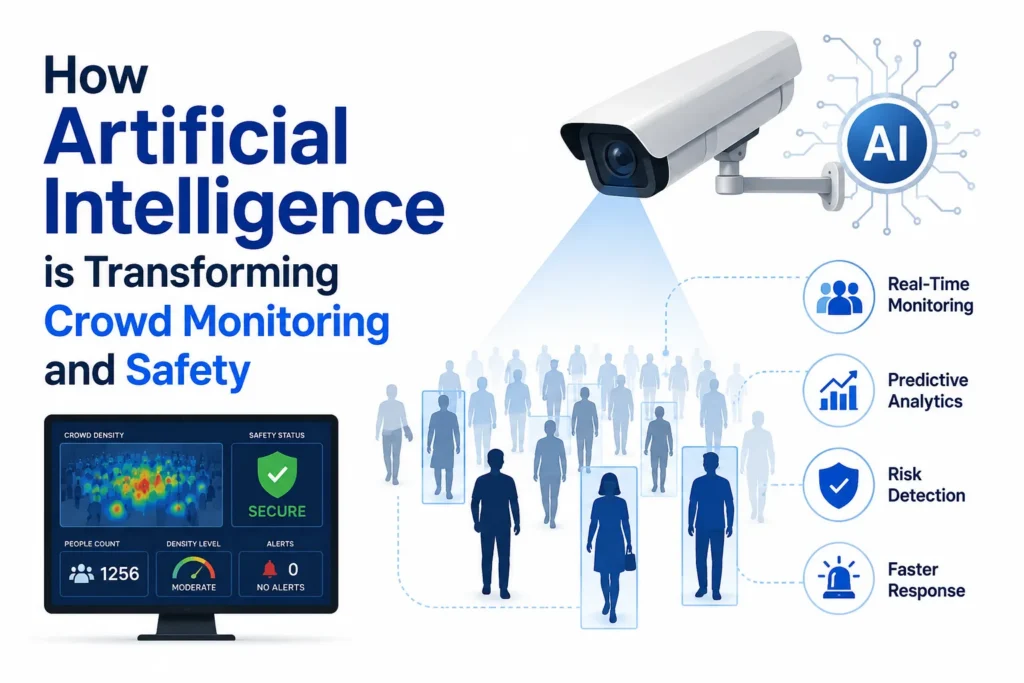
Suppose it is the morning rush hour at a busy railroad station. Thousands of commuters are entering through several gates, passengers are on platforms waiting for the trains, and trains are coming in every few minutes. A congestion point is easy to miss in the midst of dozens of CCTV screens for a human operator to monitor.
Now think of the same station, but powered with Artificial Intelligence. Rather than just creating a video, AI constantly monitors crowd density, movement patterns, queue length and abnormal activity. The system identifies one platform is filling and, in seconds, forecasts the severity of congestion in the next few minutes and notifies the control room. Staff members are deployed, passenger announcements are made and the crowd is directed away, before safety is in danger.
This change is crucial from a reactive monitoring to proactive decision making, making AI Crowd Monitoring one of the most valuable technology in the modern crowd analytics and public safety.
Why Traditional Crowd Monitoring Has Limitations
For the last decades, crowd monitoring has been based on manual observation, security officers and CCTV cameras. These are all still relevant but lose their effectiveness as they are scaled up and become more complex in the size and complexity of the public space.
Some common challenges include:
- Security operators cannot continuously monitor hundreds of camera feeds.
- Human attention decreases during long monitoring shifts.
- Congestion is often detected only after it has already developed.
- Manual crowd counting is slow and prone to errors.
- Predicting future crowd movement is nearly impossible without analytical tools.
Artificial Intelligence addresses these challenges by processing thousands of data points in real time and providing actionable insights rather than just video footage.
How AI Crowd Monitoring Works
Key AI Technologies Used in Crowd Monitoring
Artificial Intelligence is an amalgamation of various technologies which allows for a comprehensive understanding of crowd behavior.
| Technology | Purpose | Application |
| AI Video Analytics | Detect crowd density | Airports, Stadiums |
| Computer Vision | Recognize movement patterns | Railway Stations |
| Deep Learning | Predict congestion | Smart Cities |
| Machine Learning | Learn crowd behavior | Shopping Malls |
| Object Detection | Count people | Public Events |
| Facial Blurring Technology | Privacy protection | Government Projects |
| IoT Sensors | Live occupancy monitoring | Smart Buildings |
| GIS Integration | Spatial crowd mapping | Urban Planning |
Five Ways AI is Revolutionizing Crowd Safety
1. Real-Time Crowd Density Monitoring
The primary benefit of AI Crowd Monitoring is its capability to effortlessly calculate crowd density in vast public areas, even as it grows.The most significant benefit of AI Crowd Monitoring is that it can automatically calculate the density of people in a large public area, even as the crowd grows. AI is able to analyse the live video feed and the sensor data, thereby making accurate calculations on how many people are in a particular location at a particular time rather than having to do this manually or by watching video. When the crowd is approaching pre-established safety limits, the system notifies operators which can then take necessary actions such as moving visitors to a different area, opening new entrances or even sending security guards to address the crowd.
2. Predictive Crowd Analytics
While standard monitoring methods reveal only the current state, AI takes a leap forward to forecast what’s coming next. AI-powered crowd analytics can predict crowd behaviors based on historical data, pedestrian movements, event timelines, weather patterns, and real-time analytics data. This forecasting power allows decision-makers to make choices that prevent overcrowding, instead of responding to it once it’s happened.
3. Intelligent Queue Management
Airports, stadiums, metro stations, hospitals and event venues are places where one can find long queues. AI systems constantly monitor queues, waiting times, and service effectiveness. If queues start to exceed acceptable limits, the system can suggest the opening of new service counters, staffing or visitor redirection to alternative locations. This will not only boost efficiency of the operation, but also make the visitor experience even better.
4. Detecting Unusual Crowd Behavior
AI can detect abnormal crowd behavior, potentially signifying a growing safety concern. Sudden increase in crowd numbers, movement of individuals in opposition to the normal flow, unattended bags, unusual assembly patterns, or sudden and panicked dispersal, for instance. If it’s detected early, a security team can investigate and respond to incidents before they become emergencies.
5. Supporting Emergency Response
In critical situations like a fire, security breach or medical emergency, AI can give the decision maker real time situational awareness. AI can analyze the movement of crowds and determine the least crowded routes for evacuations, which aids emergency response efforts.AI can analyze crowd flow and identify the route with the least congestion for evacuation, supporting the evacuation process. It can also suggest locations for additional staff or medical teams to be deployed to improve response.
Where AI Crowd Monitoring Is Being Used
Artificial Intelligence is transforming crowd management across numerous industries.
| Sector | AI Applications |
| Airports | Passenger flow analysis, queue monitoring |
| Railway Stations | Platform crowd detection |
| Smart Cities | Traffic and pedestrian monitoring |
| Shopping Malls | Visitor analytics |
| Stadiums | Event crowd safety |
| Hospitals | Emergency department occupancy |
| Universities | Campus movement analysis |
| Religious Gatherings | Pilgrim crowd management |
| Metro Systems | Passenger congestion monitoring |
| Convention Centers | Visitor flow optimization |
Software and Platforms Used
Several advanced platforms support AI Crowd Monitoring and Crowd Analytics by integrating video analytics, simulation, GIS, and predictive modeling.
| Software | Primary Function |
| GAMA Platform | Agent-based crowd behavior simulation |
| AnyLogic | Predictive crowd and transport simulation |
| MassMotion | Pedestrian movement analysis |
| Pathfinder | Building evacuation modeling |
| NetLogo | Research-based crowd simulation |
| OpenCV | Computer vision development |
| YOLO (You Only Look Once) | Real-time object and people detection |
| TensorFlow | AI model development |
| ArcGIS / QGIS | Spatial crowd analytics |
| Bentley iTwin | Smart infrastructure digital twin |
These platforms are often integrated to create intelligent systems capable of monitoring crowds, forecasting risks, and supporting operational decision-making in real time.
Case Study: AI Crowd Monitoring During the Hajj Pilgrimage
Every year, millions of pilgrims gather in Makkah, making the Hajj one of the world’s largest recurring mass gatherings. Managing such large crowds requires constant monitoring to reduce congestion and ensure public safety.
Challenge
Authorities had to observe the movement of crowds at various religious premises, determine high crowd density zones and be able to act promptly to deal with variations in conditions.
Solution
AI enabled CCTV analytics, computer vision systems and smart surveillance technologies were used to track the movement of pedestrians throughout the day. These systems used to examine crowd density, walking speed and flow patterns, and to alert control centers in real-time. When used in conjunction with predictive analytics, authorities could anticipate potential congestion areas prior to their becoming congested.
Outcome
During one of the world’s most complex crowd management operations, the use of the AI-enabled crowd monitoring provided an improved situational awareness, facilitated quick operational decisions, optimized crowd movement and enhanced overall crowd safety management.
Benefits of AI Crowd Monitoring
Organizations adopting AI-powered crowd monitoring experience significant operational improvements:
- Faster incident detection
- Improved public safety
- Reduced crowd congestion
- Better emergency preparedness
- Data-driven operational decisions
- More efficient staffing
- Enhanced visitor experience
- Continuous 24/7 monitoring
- Improved infrastructure planning
- Lower operational costs over time
Challenges to Consider
While AI offers substantial benefits, successful implementation also requires careful planning.
Key considerations include:
- Ensuring data privacy and regulatory compliance
- Maintaining high-quality camera coverage
- Integrating AI with existing CCTV systems
- Training staff to interpret AI-generated insights
- Addressing cybersecurity risks
- Regularly updating AI models with new data
A well-designed governance framework is essential to ensure AI systems remain accurate, secure, and trustworthy.
The Future of AI in Crowd Safety
Artificial Intelligence is evolving rapidly, and future systems are expected to become even more intelligent. Emerging innovations include:
- AI-powered digital twins for entire cities
- Drone-assisted crowd monitoring
- Autonomous security robots
- 5G-enabled real-time analytics
- Emotion and behavior recognition (privacy-aware implementations)
- Predictive evacuation modeling
- Generative AI for emergency response planning
- Integration with smart traffic management systems
These technologies will enable governments and security agencies to manage public spaces more efficiently while improving resilience and citizen safety.
Conclusion
AI is revolutionizing the way governments, security companies and urban planning authorities monitor and manage crowds. With the integration of AI Crowd Monitoring and sophisticated Crowd Analytics, organizations can transition from reactive to proactive decision-making based on data.
Whether it’s forecasting traffic jams, optimizing traffic flow, aiding in emergency evacuations, or improving public safety, AI brings intelligence to the table in tackling the growing complexity of urban challenges. In the years to come, AI will increasingly find its way into digital twins, Internet of Things (IoT) sensors, Geographic Information Systems (GIS) and crowd simulation software platforms like GAMA Platform, AnyLogic, MassMotion and Pathfinder, making it an even more important tool for smarter, safer and more resilient cities.
Read Also : Smart Crowd Monitoring System: How AI Crowd Management is Transforming Smart Cities and AI Event Crowd Control
Book a free consultation for appointment
Email us at :grow@simbi.in
Frequently Asked Questions (FAQs)
1. What is AI Crowd Monitoring?
AI Crowd Monitoring involves applying artificial intelligence, computer vision, and video analytics to monitor and analyze crowd dynamics, density, and behavior in real-time, enhancing safety and operational efficiency.
2. How does AI improve crowd safety?
AI can identify traffic jams, anticipate traffic flow, recognize unusual behavior, plan for efficient evacuation, and alert authorities to prepare for incidents before they occur.
3. What industries use AI Crowd Monitoring?
It is widely used in smart cities, airports, railway stations, stadiums, hospitals, shopping malls, universities, convention centers, and large public events.
4. Which software is commonly used?
Popular tools include OpenCV, YOLO, TensorFlow, GAMA Platform, AnyLogic, MassMotion, Pathfinder, ArcGIS, QGIS, and Bentley iTwin.
5. Is AI Crowd Monitoring replacing security personnel?
No. AI serves as a decision support tool which helps security personnel to analyze a massive amount of data and deliver timely alerts to provide better and quicker responses.
6. What is the future of AI in crowd management?
The future will see the introduction of AI-driven digital twins, smart city platforms that provide real-time data and insights, predictive crowd analytics, drone surveillance, and autonomous monitoring systems, all of which will contribute to making cities safer and more resilient.