
AI-Powered Crowd Management for Smart Cities
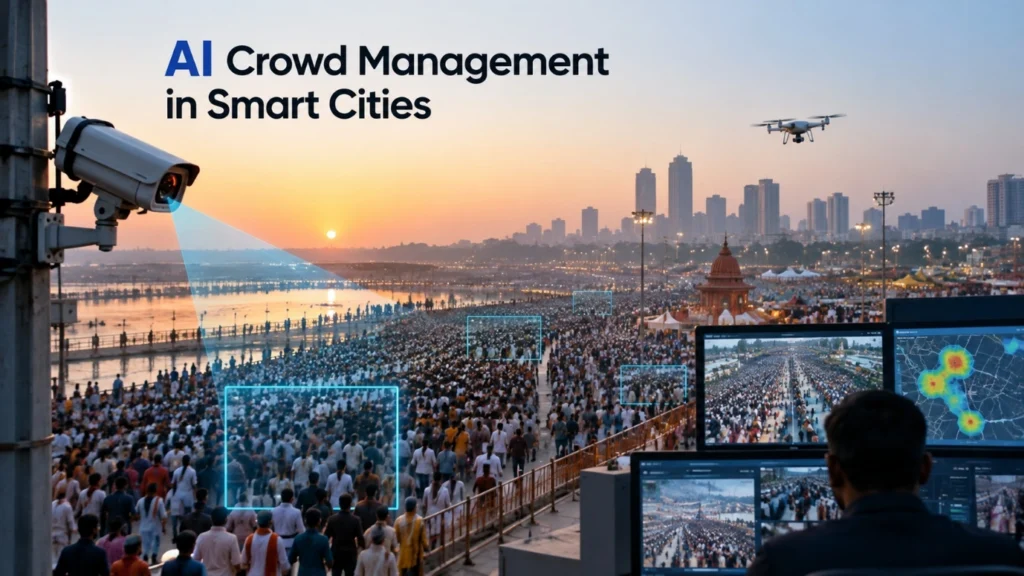
A crowd becomes difficult to manage not simply when there are too many people, but when people become concentrated, movement changes and available routes cannot absorb the flow. A venue may remain within its overall capacity while a staircase, entrance, platform or narrow passage becomes dangerously congested.
This is where AI crowd management is becoming more technically useful. Instead of relying only on personnel watching CCTV screens, modern systems can combine video, sensors, entry and exit information and other operational data to identify changing crowd conditions. The objective is not to let AI control people autonomously, but to provide timely information that helps trained teams decide when and where intervention is required.
READ THIS ALSO: Digital Twin for Smart Cities: How Crowd Simulation Shapes the Future
From Camera Feeds to Crowd Intelligence
Conventional closed-circuit television (CCTV) provides visual information, but intelligent video systems can extract measurable characteristics from that information. Depending on the system, computer vision can estimate crowd density, occupancy, movement direction and changes in flow across defined areas.
This distinction is important because overall attendance does not describe local crowd risk. A venue may have sufficient total capacity while a staircase, entrance or narrow passage becomes congested. Official crowd-safety guidance therefore recommends monitoring both the number of people and their distribution, with particular attention to entrances, exits, queues and potential bottlenecks.

The Data Layer Behind Real-Time Crowd Detection
A useful monitoring system does not necessarily depend on one camera. AI crowd-monitoring system can combine multiple data sources:
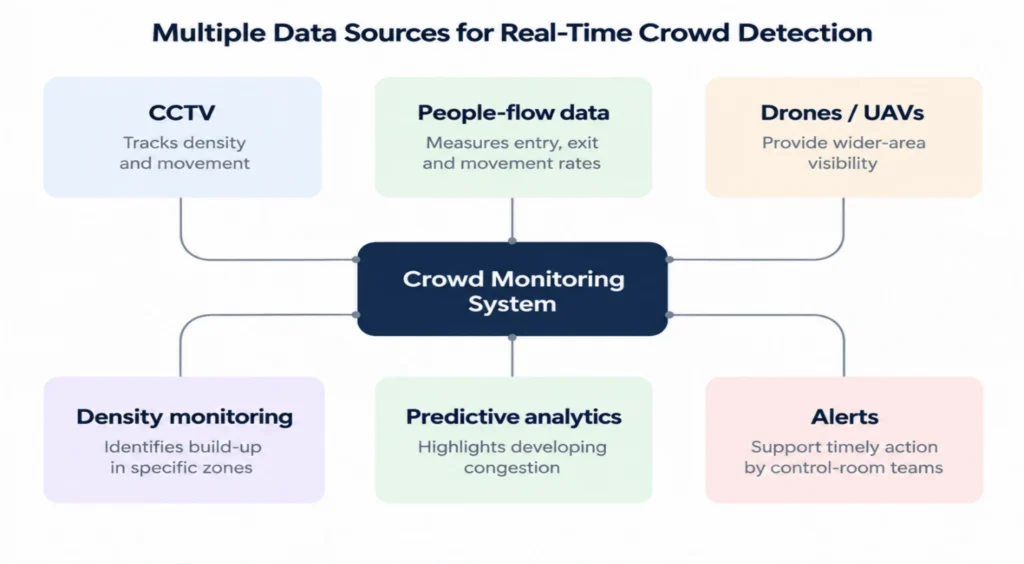
These technologies are recognised in Indian crowd-management guidance for monitoring large public gatherings. National Institute of Disaster Management: Crowd Management Technologies
The important point is that no single data source shows the complete crowd situation; multiple indicators need to be interpreted together. Goa State Disaster Management Authority: Crowd Management Guide
Beyond CCTV: Modern Technologies Supporting Crowd Safety
Modern crowd-management systems can combine several technologies beyond conventional video surveillance:
- RFID and digital tracking: RFID-based systems can support identification and movement-related monitoring during large gatherings.
- Drones and tethered drones: Provide wider-area aerial surveillance and visibility across large event zones. Government of India – Digital Maha Kumbh
- GIS-based mapping: Digital maps can help locate hospitals, police stations, checkpoints, command centres, parking areas, roads and other essential facilities. Government of India – GIS-enabled Maha Kumbh infrastructure
- Underwater drones: Used for continuous river surveillance, with the Maha Kumbh deployment reported to operate up to 100 metres underwater and transmit information to the Integrated Command and Control Centre. Government of India – Maha Kumbh Security Measures
- Remote-controlled life buoys: Support rapid water-rescue operations by reaching individuals in emergency situations. Government of India – Maha Kumbh Security Measures
- Satellite and UAV-based remote sensing: IIRS has documented the use of satellite imagery, UAV data and AI/ML for analysing crowd-density patterns, traffic flow, resource allocation and disaster preparedness. IIRS – Remote Sensing Technology for Kumbh Mela 2025
READ THIS ALSO: Crowd Safety Audit: What Every Public Facility Should Know
Crowd Information Is Not the Same as Crowd Risk
| Information captured | What it can indicate | Why it matters |
| People count | Number entering or occupying an area | Helps assess capacity and accumulation |
| Density | Concentration of people within a defined area | Identifies localised crowding |
| Flow rate | Movement into or out of an area | Shows whether accumulation is increasing |
| Movement direction | Direction and interaction of pedestrian streams | Helps identify conflicting flows |
| Queue length | Build-up around an access point | Highlights potential bottlenecks |
| Camera coverage | Areas visible to the monitoring system | Reveals possible blind spots |
This distinction is useful because no single measurement provides a complete picture of crowd safety. Several indicators need to be interpreted together.
Computer Vision for Density, Movement and Anomaly Detection
Computer vision converts camera footage into measurable information that can support crowd analysis. Depending on the system, it can estimate occupancy, map density across defined zones and track changes in pedestrian movement over time.
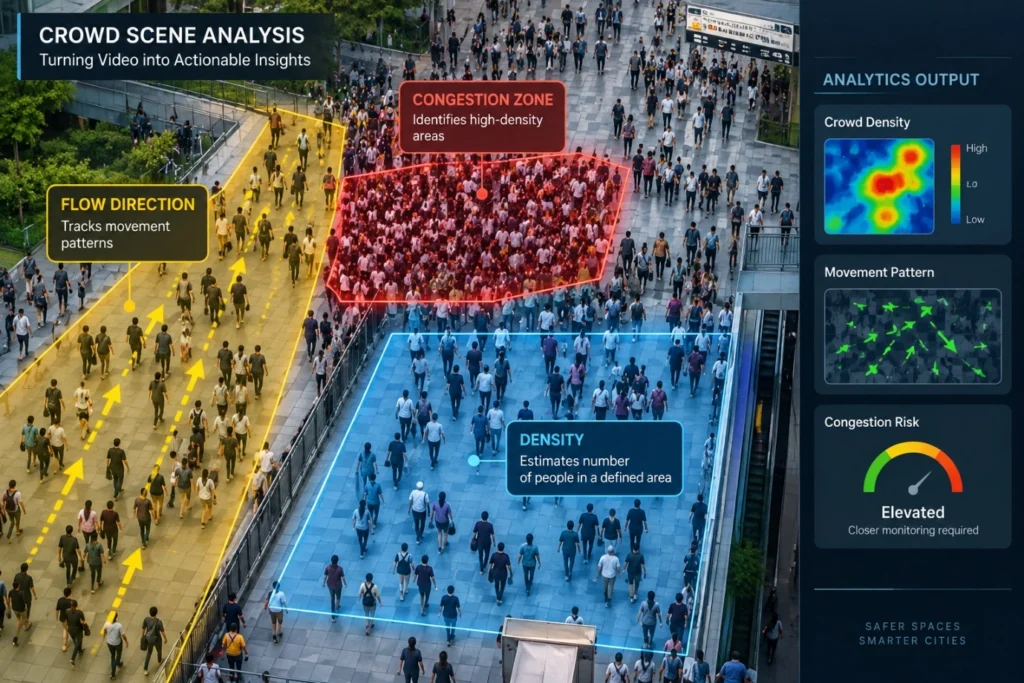
The resulting analysis can help operators identify areas that require closer attention. However, an automated alert does not establish the cause of an unusual pattern. Human operators must assess the surrounding circumstances before deciding whether intervention is necessary.
Performance also depends on real-world conditions. Dense crowds, occlusion, camera placement, lighting, weather and image quality can affect what the system is able to detect reliably.
Predictive Analytics Before Congestion Becomes Critical
Detection shows what is happening now, while predictive analytics estimates what may happen next. By combining current occupancy, arrival rates, movement trends and historical patterns, AI can identify areas where congestion may be developing.
For example, if people are entering a zone faster than they are leaving, the system can flag a rising congestion risk and give operators time to respond.
However, prediction is not a guarantee. Unexpected events, weather, transport disruptions or sudden changes in crowd behaviour can alter the situation. AI provides an early warning; human teams decide what action is appropriate.
Edge Computing and Real-Time Alerting
Edge computing means processing data closer to where it is generated, such as at cameras or local devices, instead of sending all data to a central server.
In crowd management, this can reduce data-transfer delays and support faster alerts when sudden crowd build-up or other predefined conditions are detected. The processed alert can then be sent to the control room for human assessment and action. The actual response speed depends on the hardware, network, algorithms and system design.
From AI Alerts to Operational Crowd Response
An AI alert is only the beginning of a crowd-management decision. Consider a system detecting increasing density near an entrance. The control team can verify the situation and determine whether people should be redirected, another access route opened, barriers adjusted, additional personnel deployed or information communicated to visitors.
Official event-safety guidance places monitoring within a wider framework that includes crowd-management plans, trained personnel, access arrangements, barriers, signage and procedures for managing arrival, circulation and dispersal.
Two principles are therefore particularly important:
- Artificial Intelligence (AI) identifies and prioritises information; people interpret the situation.
- Technology works alongside physical crowd controls and operational planning rather than replacing them.
Maha Kumbh 2025: AI-Assisted Crowd Management at Scale
Maha Kumbh 2025 demonstrates how technology can support crowd management at an exceptional scale. By 11 February 2025, more than 45 crore (450 million) devotees had participated in bathing rituals. Government of India: Maha Kumbh 2025 Attendance
The event used 2,750 AI-based CCTV cameras, drone surveillance and more than 50,000 security personnel. A dedicated application also provided real-time crowd-density information, emergency alerts and directions. Government of India: Maha Kumbh 2025 Security Measures
The key takeaway is the combination of AI surveillance with human coordination and physical crowd controls. Indian Railways also used control rooms, CCTV surveillance and measures such as single entry and exit points and unidirectional passenger movement during major bathing days. Indian Railways: Maha Kumbh Crowd Management
The Limitations Hidden Behind an AI Alert
- Occlusion and blind spots: Dense crowds, poor camera positioning, lighting and weather can reduce detection accuracy.
- False or missed alerts: AI models may generate incorrect alerts or fail to recognise situations that differ from their training conditions.
- Continuous monitoring: AI systems require ongoing evaluation after deployment to identify unexpected outputs and changing real-world conditions.
- Privacy and security: Continuous video monitoring and identification technologies require privacy and security safeguards to protect individuals and their data.
- Human oversight: AI alerts should support operational decisions, not replace trained personnel responsible for assessing the situation and taking action.

From Surveillance to Adaptive Crowd Operations
The next stage of intelligent crowd management is not simply installing more cameras. The stronger model connects sensing, analytics, prediction, communication, physical crowd controls and human decision-making.
When these elements are designed as one operational system, AI can help authorities move from simply observing crowd conditions towards identifying changes earlier and allocating attention where it is most needed.
Conclusion
AI is making crowd management more data-driven by transforming cameras and sensors into information about density, movement and changing conditions. Its practical value lies in supporting earlier awareness and better-informed decisions rather than replacing trained crowd-safety teams. For smart cities and large public gatherings, successful implementation will depend on reliable data, appropriate system design, continuous evaluation, human oversight and responsible privacy and security practices.
Build Smarter Crowd Management Solutions
Effective crowd management requires more than surveillance. It requires the integration of AI, data analytics, monitoring infrastructure and operational planning around the actual requirements of a public environment.