
Queue Management Simulation: Reducing Waiting Time and Improving Customer Experience with Queue Simulation
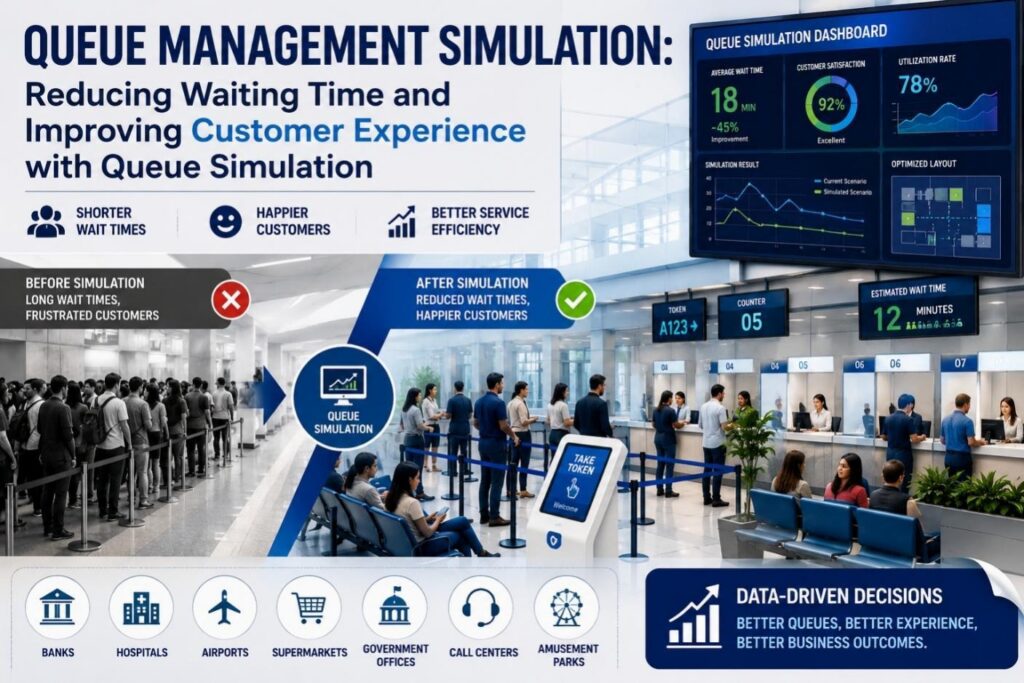
From Long Queues to Seamless Service: The Power of Queue Simulation
Today’s consumers demand efficient, well-structured and convenient service. Long lines at banks, hospitals, airports, supermarkets, government offices, amusement parks and call centers are a frequent source of frustration whether at the office or elsewhere.
Research has consistently proven that overdue times not only have a negative impact on customer satisfaction, but also cause customer dissatisfaction, lost revenue, bad reviews, reduced employee productivity, and reduced customer satisfaction.
That’s where queue simulation becomes vital to the decision-making process. Rather than relying on guesswork, businesses have the ability to utilize sophisticated queue management simulations to anticipate customer arrival, optimize staffing, evaluate service counter efficiency, and outperform customer waiting times before making changes to their operation. This is a complete guide to the workings of queue simulation, the importance of queue management, the mathematics behind it, queue optimization, practical examples and how queue simulation software can help organizations provide excellent customer experiences.
Queue Management: The Foundation of Efficient Customer Service
Queue Management is the art of managing a line of customers with a well considered, monitored and optimized strategy that will deliver services as efficiently as possible. The aim is not just to cut queues down or remove them, but to design a ‘fair’ system which reduces the amount of time people have to wait, but makes the most of the available resources.
A successful queue management system takes into account the number of arrivals, the number of service counters, availability of staff, service time, and queue length, as well as several other factors and aspects.
An integrated approach to these factors can help organizations to optimize their operations, enhance customer flow, and ensure high-quality services throughout their operations, even during periods of high demand.
It’s not about eliminating waiting, but about intelligently managing it so that customers wait less time and wait for more predictable durations, and businesses operate more efficiently.
The Business Value of Queue Simulation
A computer-based modeling procedure for simulating customers’ movements through a waiting system is called queue simulation. Rather than trying things in the real world, organizations create a virtual environment of the operation to respond to questions like:
- How many service counters are needed?
- What happens during peak hours?
- Does it mean that the more cashiers there are, the less time spent waiting?
- How long will customers wait?
- Which is the best queue layout?
- How many staff members are required?
The Growing Need for Efficient Queue Management
Beyond long queuing lines, poor queue management poses a variety of problems. It can have a downside effect on both customers’ satisfaction and business performance in the following ways:
- Delayed deliveries.
- Increased churn rates as the number of customers who stop using the service has risen Disturbed commercial activities by constrained access to the terminal.
- Reduced productivity due to poor workflow efficiency
- The absence of transparency regarding the nonprofit’s activities and value.
- Lack of clarity on the nonprofit’s activities and value.
- Loss of sales and customers due to revenue.
- The ways in which spaces are modified or altered to enhance safety Poor use of resources leading to lower operational efficiencies
Understanding the Components of a Queue
Every queue management system consists of several interconnected elements.
| Component | Description |
| Customer Arrival | Rate at which customers enter the system |
| Waiting Line | Customers waiting for service |
| Service Counter | Location where service is provided |
| Service Time | Time required to complete one customer |
| Queue Discipline | Order in which customers are served |
| Exit | Customers leaving after receiving service |
Types of Queue Systems
1. Single Queue – Single Server
One waiting line serves one counter.
Example:
- Small ticket booth
- Pharmacy window
Advantages:
- Simple
- Easy to manage
Disadvantages:
- Long waiting during busy hours
2. Single Queue – Multiple Servers
One common queue feeds several service counters.
Example:
- Banks
- Airport check-in
- Supermarkets
- Government offices
Benefits include:
- Fair customer distribution
- Better resource utilization
- Reduced average waiting time
3. Multiple Queue – Multiple Servers
Each counter has its own queue.
Examples:
- Grocery checkout lanes
- Toll plazas
- Fast-food restaurants
Challenges include:
- Uneven queue lengths
- Customer frustration from choosing the “wrong” line
4. Priority Queue
Customers are served according to priority rather than arrival time.
Common examples include:
- Hospital emergency departments
- VIP airport services
- Premium customer support
Key Metrics in Queue Simulation
Queue simulation evaluates several performance indicators.
- Average Waiting Time: The average time customers spend before receiving service,Lower waiting times generally improve customer satisfaction.
- Queue Length: The number of customers waiting, Long queues often indicate understaffing or inefficient service processes.
- Service Utilization: Measures how busy employees or service counters are, very high utilization can lead to fatigue and delays, while very low utilization wastes resources.
- Throughput: The number of customers served during a specific period, higher throughput typically indicates greater operational efficiency.
- Abandonment Rate: The percentage of customers who leave before being served, reducing abandonment directly impacts customer retention and revenue.
Mathematical Foundations of Queue Simulation
Queue simulation often builds on queueing theory, which uses probability and statistics to analyze waiting lines. Some commonly used concepts include:
- Arrival rate (λ)
- Service rate (μ)
- Traffic intensity
- Little’s Law
- Poisson arrival processes
- Exponential service times
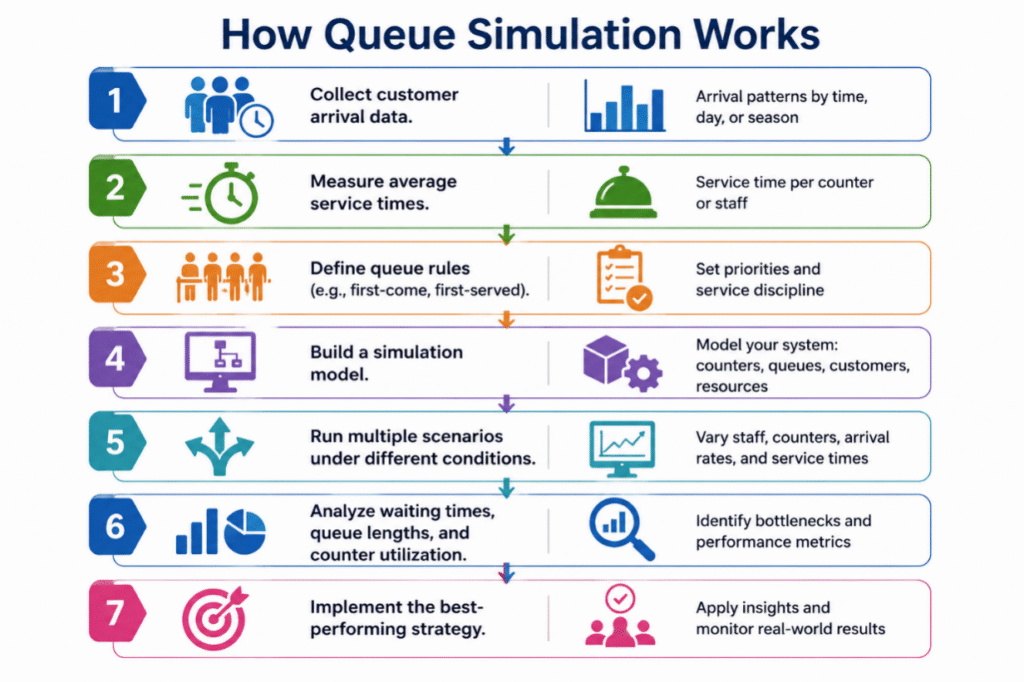
Example:
Hospital Registration Desk
A hospital experiences overcrowding every morning. Instead of hiring additional staff immediately, administrators simulate patient arrivals. The simulation identifies that:
- Most patients arrive between 8:00 AM and 10:00 AM.
- Registration counters remain underutilized after noon.
- Staff schedules can be adjusted to match demand.
By redistributing existing employees rather than increasing headcount, the hospital reduces average waiting times by nearly half.
Queue Optimization Techniques
Dynamic Staffing: Increase staff during peak demand and reduce staffing during quieter periods.
Self-Service Kiosks: Customers complete simple transactions independently, reducing pressure on service counters.
Examples include:
- Airport check-in kiosks
- Hospital registration terminals
- Self-checkout systems
Virtual Queuing: Customers receive digital queue numbers and wait remotely instead of standing in line.
Benefits include:
- Better customer comfort
- Reduced crowding
- Improved waiting experience
Appointment Scheduling: Scheduled arrivals reduce congestion by distributing customer demand throughout the day.
Common in:
- Hospitals
- Government offices
- Passport centers
- Banks
AI-Based Demand Forecasting
Artificial intelligence predicts future customer arrivals based on:
- Historical data for patterns of recurring customers
- Seasonal trends which vary according to the time of year demand.
- Events that usually bring up or down the number of customers.
- Weather conditions which may impact the number of customer visits and the service demand.
- Campaigns aimed at attracting more customers, which need extra manpower.Campaigns which increase customer numbers but need extra workers.
Technologies Used in Modern Queue Simulation
Modern queue simulation systems use advanced technologies to analyze customer flow, predict demand, and optimize service efficiency.
- Discrete Event Simulation (DES): Simulates customer arrival, waiting and service to assess the performance of the queue.
- Agent-based Modelling (ABM): Models the individual behaviour of customers and staff to examine interactions and flow of people.
- Digital Twin Technology: Simulates a physical plant in a virtual environment for testing and optimization of the queue operations.
- AI-Powered Queue Prediction: Predicts customer flow and anticipates peak waiting times with AI.
- Machine Learning Forecasting: Leverages past information to enhance demand forecasting and staffing.
- Computer Vision: Utilizes camera and AI to track the length of queues and customer flow in real-time.
- IoT Occupancy Sensors: Monitors occupancy to manage crowd and customer flow.
- Real-time Customer tracking – helps observe the movement of customers and minimise delays.
- RFID Systems: Automatically tracks customers or assets through service process using RFID tags.
- Cloud-Based Analytics Dashboards: Offers real-time dashboards to track waiting times, queue lengths and service performance.
Industries Using Queue Simulation
Queue simulation is widely adopted across sectors.
| Industry | Application |
| Hospitals | Patient registration, pharmacy, diagnostics |
| Airports | Security screening, baggage handling, check-in |
| Banks | Teller counters, customer service desks |
| Retail | Checkout optimization and staffing |
| Restaurants | Order processing and drive-through management |
| Call Centers | Agent scheduling and call routing |
| Theme Parks | Ride queue optimization |
| Government Offices | Citizen service centers and licensing |
| Logistics | Warehouse loading and unloading queues |
| Manufacturing | Production line workflow optimization |
Benefits of Queue Management Simulation
Organisations implementing queue simulation often experience:
- Faster customer wait times – Customer wait times are optimized by design and staffing, which provides faster service time.
- Enhanced service efficiency – Simulation can pinpoint bottlenecks in processes and optimize them for quicker and more seamless operations.
- Optimize staffing – Resource organisations can configure the staffing level and time for the appropriate staff for the foreseeable demand of customers.
- Lower operating costs – Streamlined resource planning cuts down on over-staffing and unnecessary costs, ensuring quality service.
- Increased customer satisfaction – Faster service and shorter queues enhance the overall customer experience and encourage repeat visits.
- Improved employee productivity – with a balanced workload, employees are less stressed and can serve more customers efficiently.
- Reduce customer drop-off – When the waiting time is shorter, the chances of customers dropping off before receiving service are reduced.
- Optimized resource utilization – Service counters, equipment and staff all are utilized effectively with less idle time and higher performance.
- Data-driven decision-making – Simulation offers realistic information and performance measures, guiding the operations decision-making process.
- Better scalability during load – During peak times, businesses can try various scenarios and prepare resources ahead of time to meet the load without affecting the quality of service.
Common Challenges in Queue Management
However, there can be challenges to implementing effective queue management:
- Unstable business demand
- Seasonal demand fluctuations
- Limited staffing resources
- Inaccurate historical data
- Breakdowns in equipment at service counters
- Customer impatience
- Complex multi-service workflows
- Ability to integrate with existing systems
Best Practices for Successful Queue Optimization
In order to get the most out of the queue simulation and queue management:
- Collect accurate historical arrival and service data.
- Model various demand conditions, such as peak times.
- Monitor real-time performance using dashboards.
- Provide training for staff on optimized workflows.
- If appropriate, use a single queue and multiple servers.
- Use AI and predictive analytics for demand forecasting.
- Monitor the effectiveness of the review queue and make changes to the staffing as needed.
- Use the simulation results and customer feedback to fine-tune service quality.
The Future of Queue Simulation
Intelligent and connected technologies are helping pave the way for the future of queue simulation, offering more efficient, faster service management. The use of innovations like AI-powered real-time queue optimization, digital twin technology, and predictive staffing enables companies to proactively plan their operations and make informed decisions based on anticipating customer needs.
Meanwhile, self-service stands, smart occupancy sensors, and mobile virtual queuing apps are changing the customer experience, minimizing paper wait times. As these technologies become part of IoT devices and cloud-based analytics platforms, businesses can track customer movement in real time, tailor service to individual customers, and continually fine-tune their queuing systems with greater accuracy.
Frequently Asked Questions.
1. What is queue simulation?
2. How does queue management improve customer experience?
3. Which industries benefit most from queue simulation?
4. What data is required for queue simulation?
5. Can AI improve queue management?
Book a free consultation for appointment
Email us at :grow@simbi.in