
Performance-Based Fire Engineering: A Modern Approach to Building Safety
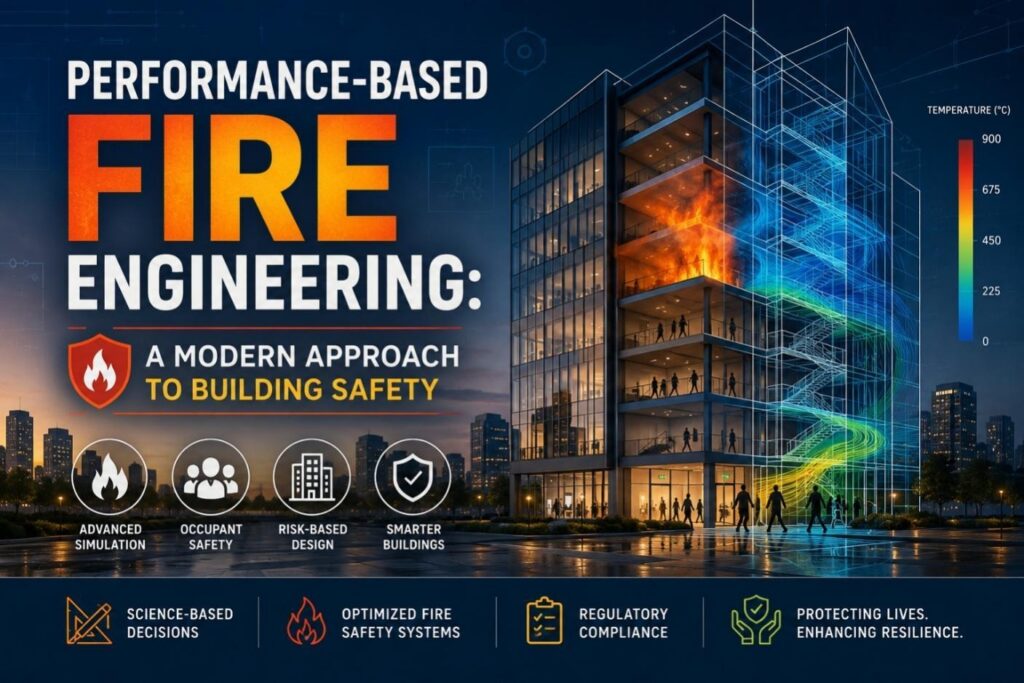
From Prescriptive Codes to Performance-Based Fire Engineering
Today’s buildings are getting more complicated. Unique architectural designs are common in high-rise towers, underground transportation systems, shopping malls, hospitals, airports and mixed-use developments, and often are not able to meet traditional prescriptive fire codes.
Where performance based fire engineering has changed the construction industry, it is in the creation of a methodology that allows it to be used to show that a building will demonstrate the required level of safety within realistic fire situations, instead of having to meet code requirements which are already pre-prescribed.
READ ALSO: Choosing the Right Crowd Simulation Software
What is Performance-Based Fire Engineering?
Performance Based Fire Engineering (PBFE) is an engineering method that assesses the performance of a building under a fire condition rather than looking at whether it satisfies a set of prescribed construction rules. The engineer sets measurable safety goals and shows that, with scientific computation and modelling, the design meets the requirements. Common safety objectives are:
- Safe evacuation of occupants
- Limiting smoke spread
- Preventing structural collapse
- Protecting firefighters
- Minimizing property damage
- Ensuring business continuity
Rather than asking,
“Does this building follow every code requirement?”
Performance-based engineering asks,
“Will people remain safe if an actual fire occurs?”
That difference completely changes the design process.
Building Safety Beyond Traditional Fire Codes
Conventional prescriptive codes include features like corridor width, stair dimensions, fire resistance, maximum travel distance, sprinkler systems, smoke detector location, etc. These are standardised regulations that have worked well in traditional buildings with simple plans.
Today’s designs are much more complex, however, with large atriums, open-plan offices, transportation hubs, stadiums, data centres, airports, underground facilities and renovated heritage structures. In many of these projects, the use of prescriptive code requirements may severely restrict design options, raise construction costs, or even become impractical.
Here, performance-based fire engineering is the better approach to solve the problem. Engineers can prove that an alternative design provides the same (or greater) level of fire safety using scientific analysis, fire modeling and engineering calculations, and that it meets modern standards of design.
The Core Principles of Performance-Based Fire Engineering
Successful fire safety engineering revolves around five scientific principles.
| Principle | Objective |
| Fire Growth Analysis | Predict fire development over time |
| Smoke Movement | Estimate smoke spread throughout the building |
| Human Behavior | Analyze evacuation response |
| Structural Fire Engineering | Evaluate structural stability during fire |
| Risk Assessment | Measure probabilities and consequences |
The Science Behind Fire Safety Engineering
Fire is a very dynamic and unpredictable phenomenon with many interacting factors and each fire scenario is unique. The rate of heat release (HRR) and the ventilation conditions, fuel load, combustible materials, height of the ceiling, airflow patterns, building geometry, and even the weather all have a significant influence on the way a fire grows and spreads.
Engineers can use this analysis of these complex interactions to assess potential risks, optimize fire protection systems, and create safe buildings that will be effective in a real fire emergency.
How Simulation Drives Performance-Based Fire Engineering
Nowadays, simulation is the backbone of performance based fire engineering and is a tool which allows fire engineers to assess building safety much more closely than using traditional building design approaches.
Instead of making assumptions and using broadly applicable code requirements, engineers simulate thousands of possible scenarios in a detailed computer program before a building is built. These models are used to predict key aspects of fire development, flame spread, smoke buildup, temperatures, visibility loss, toxic gas levels, evacuation times for occupants, structural temperatures, and access for fire fighters.
Simulations can forecast the building’s performance in a realistic fire emergency, which can assist engineers in identifying potential fire hazard areas, optimizing the performance of fire protection systems, validating design decisions, and helping to ensure occupants can evacuate safely and emergency responders can access affected areas.
Major Types of Fire Engineering Simulations
1.Fire Dynamics Simulation
Fire Dynamics Simulation (FDS) creates a model of the growth of a fire, heat transfer, smoke generation, and temperature changes. The ability to help engineers detect unsafe conditions early on, and design more efficient fire protection solutions, is one of the purposes of these simulations.
2. Smoke Movement Simulation
Smoke Movement Simulation provides the prediction of smoke movement, smoke layer height, ventilation performance, toxic gas exposure and visibility. These insights are useful for engineers in their design of efficient smoke control systems and in keeping safer evacuation routes during a fire.
3. Evacuation Modeling
Evacuation Simulation determines walking speeds, crowd congestion, exit selection, crowd interaction and evacuation time to see if occupants are able to evacuate the building before fire conditions become dangerous.
4. Structural Fire Analysis
Structural Fire Analysis determines the effects of extreme-hot temperatures on a building by modelling the temperature of the steel, the behavior of the concrete, structural deformations, collapse risk and fire resistance time. These simulations assists engineers to ensure that the structure will be stable for sufficient time for safe evacuation and emergency response.
5. Risk Assessment Simulation
Risk Assessment Simulation (RAS) is a simulation of thousands of potential fires to determine fire probability of occurrence, fire damage, occupant risk, and system reliability. Such information can help engineers make decisions and create safer and more resilient fire protection solutions.
Designing a Modern Shopping Mall
Imagine a five-story shopping mall featuring:
- Large central atrium
- Glass roof
- Restaurants
- Multiplex cinema
- Children’s play zone
- Underground parking
- Open food court
A prescriptive code may require additional fire walls that disrupt the architectural vision. Instead, engineers perform performance-based fire engineering by simulating multiple fire scenarios.
Scenario
A fire starts in a restaurant kitchen on the second floor during a busy weekend evening. The simulations analyze:
- How quickly flames spread
- Smoke movement into the atrium
- Performance of smoke exhaust fans
- Activation of sprinklers
- Occupant evacuation times
- Firefighter access routes
- Structural temperature rise
Simulation Outcome
The results show that:
- Smoke extraction systems maintain a clear smoke layer above occupants.
- Sprinklers control fire growth before flashover.
- All occupants evacuate within the available safe egress time.
- Structural temperatures remain below critical limits.
Example:
High-Rise Residential Tower
Consider a 45-story residential building with sky gardens every 10 floors. Traditional codes might require extensive compartmentation that reduces the openness of shared spaces.
Fire safety engineering simulations are used to analyze the potential spread of smoke from a fire in one apartment to the other apartments via the vertical shaft, sky gardens, and stairwells. The analysis reveals pressurized stairs, automatic smoke control devices and strategically positioned fire curtains do help to maintain tenable escape routes and all residents can be evacuated safely. This enables the innovative architectural design to be preserved while still assuring occupant protection.
Available Safe Egress Time (ASET) vs Required Safe Egress Time (RSET)
One of the most important concepts in performance based fire engineering is comparing:
| Metric | Meaning |
| ASET | Time before conditions become unsafe |
| RSET | Time occupants need to evacuate safely |
A safe design requires:
ASET > RSET
If simulations show otherwise, engineers can tweak the design, making the detection systems more sensitive, add bigger doors, make the smoke system better, or change the evacuation routes until they have enough safety margins.
Benefits of Performance-Based Fire Engineering
| Benefit | Impact |
| Better Life Safety | Optimizes evacuation and smoke management |
| Design Flexibility | Supports innovative architecture |
| Cost Optimization | Reduces unnecessary construction costs |
| Scientific Decision-Making | Uses evidence instead of assumptions |
| Regulatory Confidence | Demonstrates compliance through analysis |
| Improved Structural Protection | Evaluates fire effects on building materials |
| Risk Reduction | Identifies hazards before construction |
| Future Readiness | Adapts to evolving building designs |
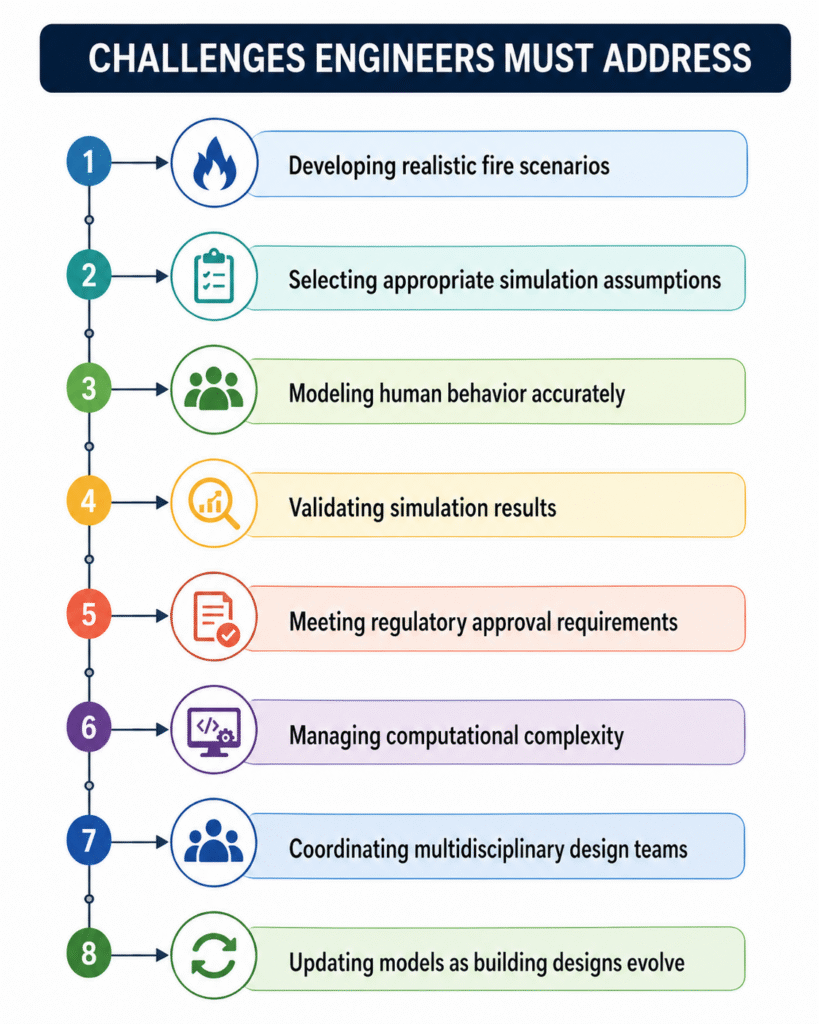
Best Practices for Simulation-Based Fire Safety Engineering
Successful projects generally follow a structured workflow:
- Establish fire protection goals.
- Collect architectural and occupancy data.
- Determine valid fire scenarios.
- Develop evacuation/exodus models and computational fires.
- Validate input assumptions.
- Run multiple simulations.
- Discuss the difference between ASET and RSET.
- Sift and modify design according to results.
- Create engineering documentation for regulatory review.
- When changes are made to the building design, update models.
Emerging Trends in Fire Safety Engineering
Technology is rapidly enhancing simulation-driven fire engineering,future developments include:
- AI-driven fire prediction – Leverages AI to foresee fire behavior and pinpoint risk areas ahead of time.
- Digital twin buildings – Develops virtual copies of buildings to monitor and analyze continuously in real time for fire safety.
- IoT-connected Fire Detection Systems – Combines Smart sensors to deliver real-time fire detection and quicker response to emergency
- Machine learning for smoke forecasting – Forecasts smoke movement and spread to aid evacuation planning.
- e.Cloud-based fire simulation platforms – Faster, scalable and collaborative fire modelling, anywhere.
- Autonomous inspection drones – helps to assess fires, buildings, and evaluate fire damage.
- Real-time evacuation guidance: Provides evacuation route recommendations in real-time depending on the current situation with fire.
- Smart building integration – integrates fire protection systems into intelligent building management and automates response actions.
- Virtual reality firefighter training – Provides realistic training scenarios for fire fighters without real-world dangers.
- Predictive maintenance of fire protection systems – Applies data analytics to identify potential equipment problems before they become a failure.
Why Performance-Based Fire Engineering Is the Future
More prescriptive codes are no longer enough as buildings get taller, more complicated and ever more ambitious. Performance based fire engineering enables designers to incorporate the required safety in terms of measurable performance, not rules.
The fire safety engineering approach involves a multi-disciplinary process of computational fire modelling, evacuation analysis, structural assessment and fire risk evaluation to deliver solutions that safeguard lives and promote innovative design.
It also gives stakeholders objective data that buildings will perform safely under real fire conditions, and it is a crucial practice for the next generation of resilient infrastructure.
Designing Buildings That Perform When It Matters Most
Fire safety is more than just checklists. Performance based fire engineering now employs sophisticated simulations, scientific models, and risk-based analysis to assess the response of buildings to realistic fire events, prior to the building’s use.
This not only improves the safety of the people using the space but also gives architects and builders the flexibility to design innovative structures while maintaining the level of protection. From the design of tall towers and hospitals, to airports, industrial plants and commercial buildings, fire safety engineering provides data-driven answers that can inform decisions, optimize fire safety systems and ensure safe building performance.
Throughout the evolution of simulation technologies, performance-based design will be a more significant factor in the future of safe, sustainable and intelligent buildings.
Book a free consultation for appointment
Email us at :grow@simbi.in