
What is Crowd Simulation and Why is it Important for Public Safety?
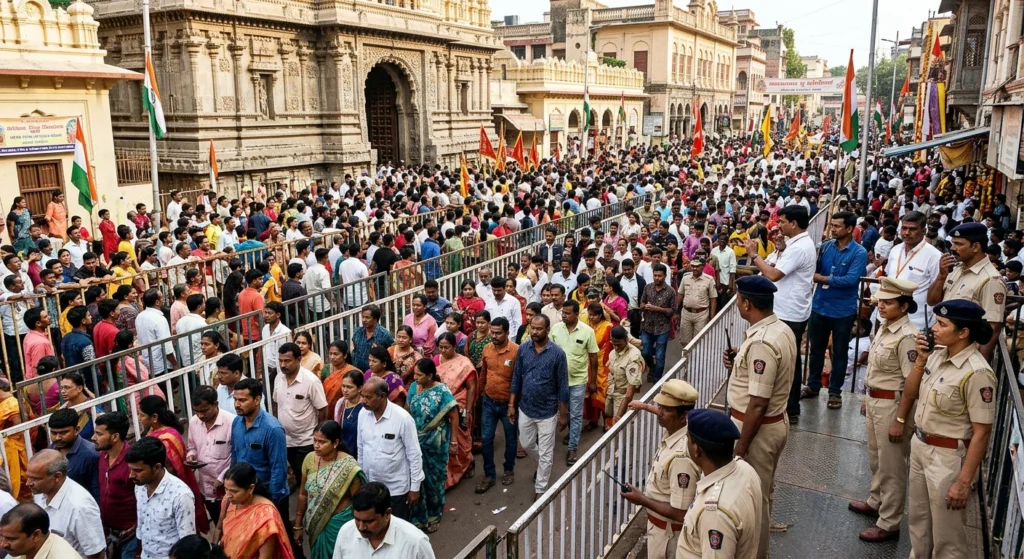
The public gatherings have grown in size and complexity, and are more dynamic than ever. Thousands (or even hundreds of thousands) of people move from one place to another in shared spaces at sporting events, concerts, religious services, transportation hubs, shopping malls, airports, stadiums, educational campuses and smart cities. These events add social, cultural and economic value, but simultaneously pose great challenges in terms of pedestrian traffic, traffic congestion, emergency evacuations and public safety.
Previously relying solely on experience, observation, and static infrastructure planning, now managing large crowds more than ever requires new methods. Today’s public safety needs are data-driven, as it is necessary to forecast the behavior of people in both normal and emergency situations. That’s where the technology of Crowd Simulation has proved to be one of the most beneficial in the field of Urban Planning, Event Management, and Safety Engineering.
Crowd simulation lets planners, architects, engineers, event planners, and government officials model pedestrian behavior before a facility is built or an event occurs, instead of assuming how pedestrians will behave. These simulations can be used as a tool to look for bottlenecks, optimize the movement of the crowd, design evacuation plans and minimise the risk of safety issues before anyone is in the space.
With increasing urban density and the ever-growing number of public venues, crowd simulation is increasingly becoming indispensable to risk management and public safety planning, rather than just an option.
READ THIS : Top Common Crowd Management Mistakes for Safer Events
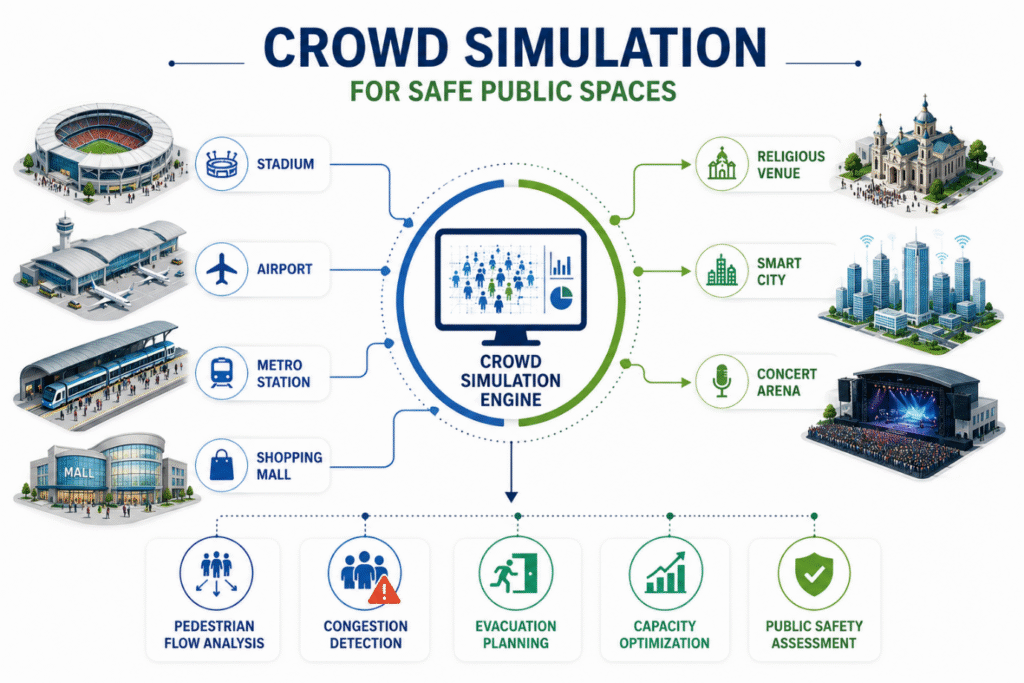
Figure 1: Crowd Simulation in Public Safety Planning
Understanding Crowd Simulation Beyond Computer Animation
While the word “simulation” may conjure images of computer graphics or virtual reality, Crowd Simulation is a scientific modelling approach that can be applied to understand pedestrian flow in various settings. It is an interdisciplinary field of engineering, mathematics, behavior, transportation, and computational models to simulate movements of a single individual and a group in physical environments.
These individuals, known as “agents” or “people,” follow certain rules that are predetermined and include the number of steps they take, the direction they go, the personal space needs, the time they take to react to others, or the reaction time to obstacles. These agents can be simulated at the same time in software to accurately predict crowd behavior during normal operations and during extraordinary situations.
Crowd simulation delivers dynamic visual models of movement, enabling decision makers to gain insight into the impact design decisions will have on actual human motion, as opposed to using theoretical capacity calculations in traditional planning. A comprehensive crowd simulation typically evaluates:
- Pedestrian movement patterns
- Walking speeds and densities
- Queue formation
- Bottleneck locations
- Entry and exit utilization
- Waiting times
- Crowd congestion
- Emergency evacuation performance
- Accessibility and inclusive movement
- Interaction with physical infrastructure
This predictive capability allows planners to identify operational risks before they affect public safety.
Why Public Safety Depends on Predictive Crowd Analysis
Large gatherings involve continuous movement, changing pedestrian flow, and unpredictable human behaviour. Although a venue may fully comply with structural design standards, operational challenges can still arise when crowd behaviour differs from the assumptions made during planning. Narrow corridors, poorly positioned entrances, unclear emergency exits, or uneven pedestrian distribution can quickly lead to congestion, causing delays, disrupting movement, and increasing safety risks.
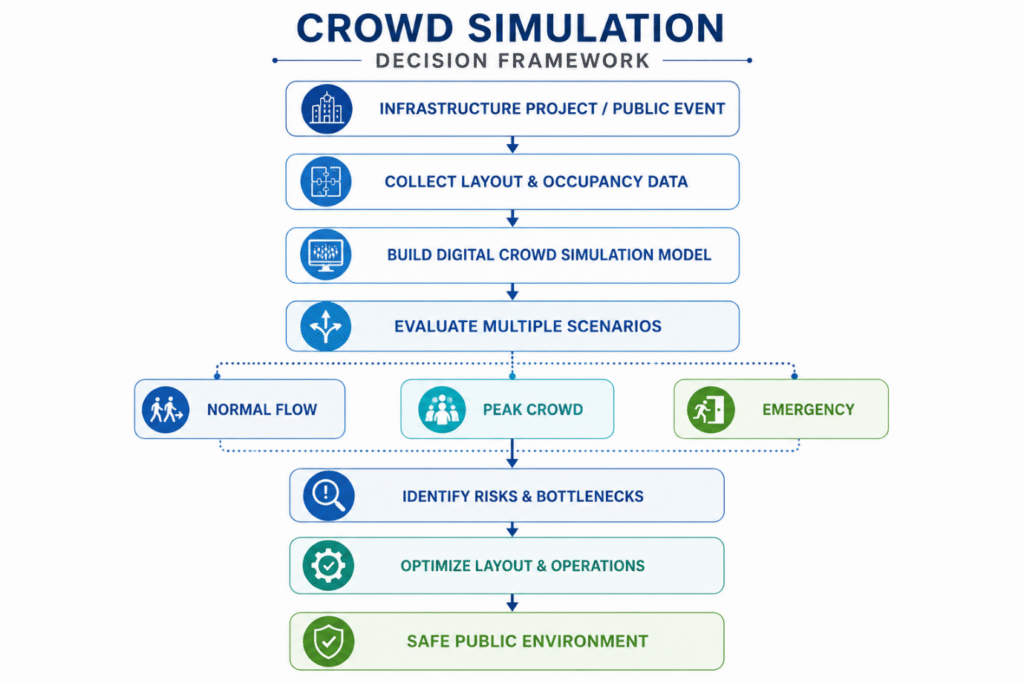
Crowd Simulation addresses these challenges by allowing planners to evaluate multiple scenarios before an event takes place. Instead of reacting to problems after they occur, engineers can test different venue layouts, crowd management strategies, and emergency procedures within a virtual environment to identify and resolve potential issues in advance.
Public safety agencies use simulation to answer several critical operational questions, including:
- Can all occupants evacuate within the required safety timeframe?
- Which entrances or exits experience the highest pedestrian demand?
- Where are crowd bottlenecks most likely to occur?
- How will passengers or spectators respond if one exit becomes unavailable?
- Is the venue operating within safe occupancy limits?
- How can pedestrian movement be distributed more evenly?
- Which design modifications will improve evacuation efficiency?
These insights enable informed decision-making, strengthen emergency preparedness, and significantly reduce operational uncertainty.
Example: Managing Crowd Safety During a Major Stadium Event
Imagine a newly built sports stadium with seating for 65,000 spectators preparing to host an international football final. Gates open two hours before kickoff, and thousands of fans begin arriving simultaneously through multiple entrances. During halftime and immediately after the final whistle, large numbers of spectators head toward food courts, restrooms, parking areas, and exit gates at the same time.
Without careful planning, several operational challenges may arise:
- Long queues at security checkpoints
- Congestion around food courts and concession areas
- Overcrowding on staircases and concourses
- Delays at emergency exits
- Uneven distribution of spectators across entry gates
- Increased risk of crowd compression near popular exits
Before the event begins, engineers perform a Crowd Simulation using a digital model of the stadium. The simulation evaluates pedestrian movement during both normal operations and emergency evacuation scenarios. It identifies congestion hotspots, predicts queue lengths, estimates evacuation times, and analyses how spectators respond when one or more exits become unavailable.
Based on the simulation findings, organizers introduce several operational improvements before match day:
- Redistribute spectators across multiple entry gates
- Increase security screening capacity at high-demand entrances
- Introduce one-way pedestrian movement in selected concourses
- Deploy additional crowd marshals at congestion hotspots
- Reposition temporary barriers to improve pedestrian circulation
- Modify emergency evacuation routes to reduce exit congestion
- Install dynamic digital signage to direct spectators toward less crowded exits
As a result, pedestrian movement becomes more efficient, congestion is reduced, evacuation performance improves, and overall public safety is significantly enhanced without requiring major structural changes to the stadium.
Standard Operating Procedures (SOPs) Developed from the Simulation
Following the simulation study, event organizers establish operational SOPs to ensure consistent crowd management throughout the event.
| Operational Area | Standard Operating Procedure (SOP) |
| Entry Management | Open all designated gates, monitor queue lengths continuously, and redirect visitors to lower-density entrances. |
| Security Screening | Increase screening personnel during peak arrival periods and maintain target processing times. |
| Crowd Flow Management | Implement one-way pedestrian circulation in high-traffic corridors and monitor congestion using CCTV or crowd monitoring systems. |
| Emergency Response | Activate predefined evacuation routes, deploy trained marshals, and communicate instructions through the public address system. |
| Communication | Use dynamic digital signage and mobile notifications to guide visitors toward less congested areas and exits. |
| Post-Event Exit Strategy | Stagger exit operations, coordinate with traffic management authorities, and continuously monitor crowd density until the venue is cleared. |
Table 1. How Crowd Simulation Supports Public Safety
| Public Safety Objective | Role of Crowd Simulation |
| Evacuation Planning | Predicts evacuation time and identifies safer exit strategies |
| Crowd Flow Optimization | Reduces congestion and improves pedestrian circulation |
| Capacity Assessment | Evaluates safe occupancy levels for different environments |
| Emergency Preparedness | Tests multiple emergency response scenarios before implementation |
| Infrastructure Planning | Supports safer building and public space design |
| Risk Identification | Detects bottlenecks and high-density zones before occupancy |
Rather than replacing engineering judgment, crowd simulation enhances decision-making by providing measurable evidence that supports safer planning and operational strategies.
Where Crowd Simulation Creates the Greatest Impact
As cities continue to grow and infrastructure becomes more complex, the use of Crowd Simulation has expanded well beyond stadiums and entertainment venues. Today, organizations across a wide range of industries rely on simulation technologies to improve operational efficiency, strengthen public safety, and meet national as well as international safety standards.
Major application areas include:
- Airports and aviation terminals
- Railway and metro stations
- Sports stadiums and arenas
- Shopping malls and commercial complexes
- Hospitals and healthcare facilities
- Educational campuses
- Religious gatherings and pilgrimage sites
- Smart cities and urban development projects
- Convention and exhibition centers
- Theme parks and tourist attractions
- Industrial facilities
- High-rise commercial buildings
Each of these environments has its own unique patterns of pedestrian movement, making Crowd Simulation an essential tool for planning everyday operations as well as preparing for emergency situations.
Designing Safer Spaces Through Data-Driven Decision Making
Modern infrastructure projects are increasingly integrating Crowd Simulation into the design process rather than waiting until construction is complete. By evaluating pedestrian movement before a facility is built, architects, engineers, and public safety professionals can optimize layouts, improve accessibility, reduce congestion, and enhance emergency preparedness while avoiding costly structural changes later in the project.
Crowd Simulation also enables organizations to compare multiple design options under identical operating conditions. This allows decision-makers to assess the performance of each alternative and select the layout that offers the best balance of safety, operational efficiency, and overall user experience.
Emerging Technologies Are Transforming Crowd Simulation
Rapid advancements in digital technology are reshaping the capabilities of Crowd Simulation. Today’s simulation platforms go far beyond traditional static pedestrian models by integrating Artificial Intelligence (AI), Building Information Modeling (BIM), Geographic Information Systems (GIS), Internet of Things (IoT) sensors, and real-time analytics to create highly accurate models of pedestrian movement.
By combining these technologies, organizations can evaluate crowd behaviour under changing environmental conditions, monitor pedestrian activity in real time, and strengthen safety planning through predictive analytics. As smart cities continue to evolve, digital crowd modelling is becoming an essential component of intelligent urban infrastructure and modern public safety planning.
Key technological innovations supporting Crowd Simulation include:
- Artificial Intelligence (AI) for predicting pedestrian behaviour
- Building Information Modeling (BIM) integration to validate design decisions
- Geographic Information Systems (GIS) for spatial analysis
- Digital Twin technology for real-time infrastructure monitoring
- IoT sensors for live pedestrian data collection
- Computer vision for monitoring crowd density
- Cloud-based simulation platforms that enable collaborative planning
- Machine learning algorithms for scenario optimization
Instead of functioning as standalone software, modern Crowd Simulation platforms are increasingly integrated into connected digital ecosystems that support infrastructure planning, operational management, and emergency response within a unified environment.
Table 2. Industries Using Crowd Simulation for Public Safety
| Industry / Sector | Primary Crowd Simulation Application |
| Airports | Passenger flow optimization and terminal planning |
| Railway & Metro Stations | Platform congestion management and evacuation planning |
| Sports Stadiums | Entry, exit, and spectator movement analysis |
| Shopping Malls | Pedestrian circulation and emergency preparedness |
| Hospitals | Emergency evacuation and visitor movement planning |
| Educational Institutions | Campus safety and evacuation analysis |
| Smart Cities | Urban pedestrian mobility planning |
| Religious Venues | Pilgrim movement and crowd density management |
| Convention Centers | Visitor flow optimization during large events |
| Industrial Facilities | Worker movement and emergency response planning |
Each sector applies crowd simulation differently, but the common objective remains the same: improving safety while maintaining efficient pedestrian movement.
Figure 2: Crowd Simulation Decision Framework
From Reactive Crowd Management to Predictive Public Safety
Traditional crowd management relied heavily on experience, visual observation, and reactive measures implemented only after congestion had already occurred. Today, public safety planning places far greater emphasis on prevention than on response. By simulating thousands of pedestrian movements before a facility is built or an event takes place, organizations can identify operational weaknesses early and implement evidence-based improvements before problems arise.
This proactive approach offers several important operational benefits:
- Reduced evacuation times
- Improved emergency preparedness
- Better utilization of entrances and exits
- Safer pedestrian circulation
- Enhanced accessibility for all users
- Lower operational risk during large gatherings
- Greater confidence in safety planning and decision-making
As safety regulations and industry standards continue to evolve, simulation-based planning is increasingly viewed as a fundamental part of risk assessment rather than simply an optional engineering tool.
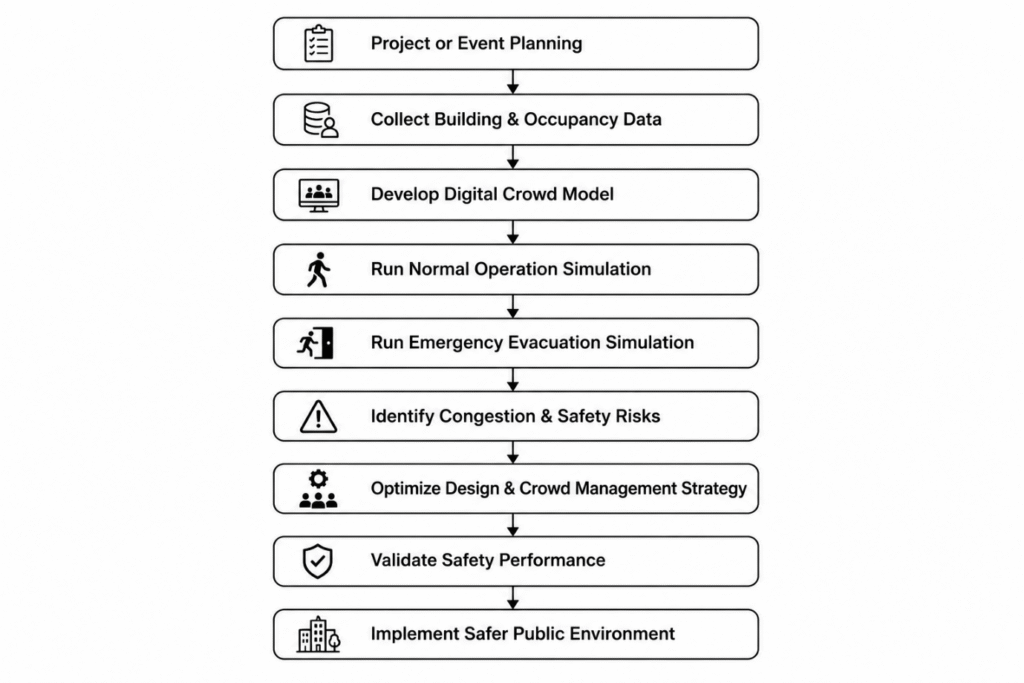
Figure 3: Crowd Simulation Workflow for Public Safety Planning
The Future of Crowd Simulation
The future of Crowd Simulation is moving toward intelligent, real-time decision support. As digital twins, AI-powered analytics, autonomous monitoring systems, and smart infrastructure become more widely adopted, simulation models will increasingly work alongside live operational data instead of being used only during the planning phase. This evolution will allow authorities and facility managers to detect potential congestion before it develops, dynamically optimize pedestrian movement, and strengthen emergency response through continuous monitoring and predictive insights.
Future developments are expected to include:
- AI-assisted real-time crowd prediction
- Digital Twin integration for smart infrastructure
- Automated risk detection using computer vision
- Cloud-based collaborative simulation platforms
- Predictive evacuation planning
- Intelligent crowd monitoring for mega events
- Smart city integration for pedestrian mobility management
These innovations will help public safety professionals move beyond reactive crowd management and create adaptive environments that continuously support safer and more efficient pedestrian movement.
Modern public safety depends not only on how buildings are designed but also on understanding how people move within them. Crowd Simulation provides a scientific framework for analysing pedestrian behaviour, improving infrastructure planning, and strengthening emergency preparedness before potential risks become real-world incidents. Whether planning airports, stadiums, hospitals, transportation hubs, or smart cities, simulation enables organizations to make informed decisions that balance operational efficiency with public safety. As urban environments continue to grow in size and complexity, Crowd Simulation will remain a key technology for creating safer, more resilient, and better-connected public spaces.
Build Safer Public Spaces Through Advanced Crowd Simulation
Effective crowd management starts well before people enter a building or public venue. Simbi Labs India provides advanced Crowd Simulation solutions that enable architects, engineers, government agencies, event organizers, and infrastructure developers to analyse pedestrian movement, optimize crowd flow, and strengthen public safety through data-driven simulation and predictive analysis.
Book a free consultation for appointment
Email us at :grow@simbi.in