
Top Market Research Companies in Bangalore 2026
Looking for the best market research companies in Bangalore? Bangalore is one of India’s major business and technology hubs, making reliable market research essential for understanding customers, competitors, pricing, demand, and emerging opportunities. Professional market research companies in Bangalore help startups, SMEs, and established businesses collect and analyse reliable data to make informed decisions.
Making Informed Business Decisions Through Market Research
All good business decisions are based on accurate information. The quality of a company’s decision-making process is almost entirely dependent on the quality of the data it is using when a new product is introduced, when a company crosses into a new market, or when he or she needs to grasp the new expectations of customers. That is why, many organizations are relying on market research firms in Bangalore to assist them to make informed decisions rather than taking chances.
Bangalore has become one of the most vibrant business hubs in India with fast-growing startups, established technology firms, healthcare providers, manufacturers and retail brands. With this kind of competition, a guess is a costly investment. To validate ideas, to grasp the customers, and mitigate risk before investing resources, businesses require accurate, structured, and statistically sound research.
This is where Simbi Labs fits in. As a market research company in Bangalore, Simbi Labs works with startups, SMEs, corporate organizations, and institutions to convert raw data into clear, actionable business insight. Rather than offering generic reports, the focus is on research that is methodologically sound, transparent, and directly useful for decision-making. The sections below explain what market research involves, why it matters for Bangalore’s business landscape, and how Simbi Labs approaches this work as a dependable research partner.
Read Also : Why do we want to do Market Research
Foundations of Market Research
Market research is the systematic process of collecting, analysing and interpreting information about a market, its customers, and competitive environment. It provides solutions when intuition alone fails: What is customers’ true desire? How do they behave? How much do they have to pay? What are the risks prior to a product launch? Market research is fundamentally a process of gathering data and analysing it properly to yield results that can be used for business decisions.
This can be achieved via surveys, interviews, observational studies, secondary data review or a mix of these approaches, depending on the goal. The reasons for market research are that it affects results. Businesses that make decisions using verified data are more likely to: a) Understand true customer needs and not assumed needs
- Minimize financial risk with new product launches
- Determine pricing strategies from the actual willingness-to-pay information
- Know what competitive positioning is in a category
- Monitor changing customer sentiment/demand over time
Why Businesses in Bangalore Need Market Research
Bangalore’s business landscape is very peculiar and this is the reason why research for any decision making is so important. What works in a software start-up will not necessarily work in a pharmaceutical manufacture or a retail chain, and every industry has its own justification for structured research investment.
1.Startup ecosystem: Bangalore is one of the best startup cities in India. Startups have limited budgets, and don’t yet have the resources to develop products based on untested assumptions. Market research allows founders to gauge interest, tweak positioning and get a feel for their target market before scaling.
2.Technology sector: Software and IT firms have fast paced areas where customers’ needs evolve rapidly. By continuously researching the market, these businesses will remain focused on the needs of the users and will also detect new opportunities in time.
3.Healthcare: Healthcare providers and organizations require research to gain insights into patient experiences, gaps in services, and patient treatment preferences, all of which directly impact the quality of care and healthcare operational planning.
4.Manufacturing: Manufacturers use research to predict sales, understand their supply chain and distribution channels, and determine customer interests in new products prior to entering full-scale production.
5.Retail and e-commerce: Retail and e-commerce businesses rely on the knowledge of purchase behavior, price sensitivity and channel preference. The research here directly influences the merchandising, promotions and customer retention strategy.
Because the city’s business environment spans so many sectors, a market research company in Bangalore needs the flexibility to work across industries while still applying rigorous, consistent methodology.
Beyond sector-specific needs, a few themes apply across almost every business in Bangalore’s competitive market:
- Understanding customer behavior before designing products or campaigns
- Validating a product or service concept before full-scale launch
- Monitoring how competitors are positioned within the same category
- Making informed decisions in a market where customer preferences shift quickly
Services Offered by a Professional Market Research Company in Bangalore
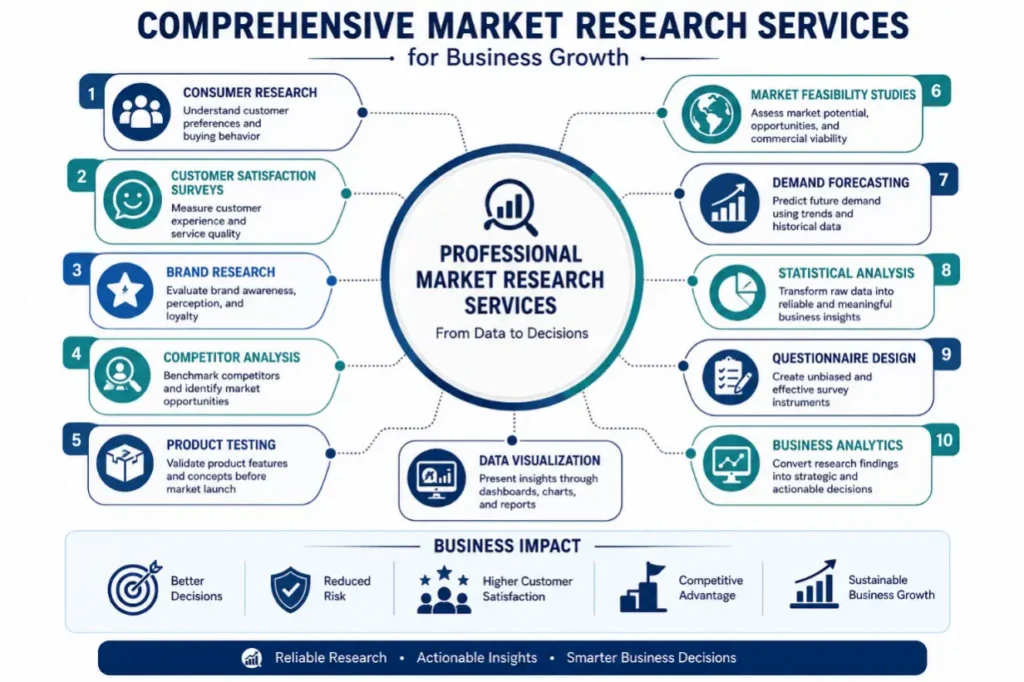
A capable research partner should be able to support a business across the full research lifecycle, not just one part of it. The core services that most organizations require include:
- Consumer research – gaining insight into attitudes, preferences and purchasing behaviour of a target group
- Customer satisfaction surveys – assess the quality of service and opportunities for development
- Brand research: Brand awareness, brand perception, brand recall in the market.
- Competitor analysis – analysing a business against the other business in the category, not based on assumptions
- Product Testing – testing of features, usability and appeal to ensure before product launch.
- Market feasibility studies – determining the commercial viability of a new product, a new service, or a new market entry.
- Demand Forecasting – Predicting the future demand based on historical and market data
- Statistical analysis – using the right statistical tools to give valid and reliable results
- Questionnaire design – structuring a survey that the questions are unbiased and will yield usable data
- Business analytics – turning research data into insights to guide strategy
- Data visualization – communicating results in a way that makes them easily understood and acted upon by the decision maker
Qualitative vs Quantitative Market Research
Most research projects rely on one of two broad approaches, or a combination of both. Understanding the difference helps businesses choose the right method for their objective.
| Aspect | Qualitative Research | Quantitative Research |
| Purpose | Explores motivations, opinions, and reasons behind behavior | Measures behavior, opinions, and trends numerically |
| Data Type | Non-numerical (words, themes, observations) | Numerical (statistics, percentages, scores) |
| Common Methods | In-depth interviews, focus groups, observational studies | Surveys, structured questionnaires, experiments |
| Sample Size | Smaller, purposefully selected | Larger, statistically representative |
| Best Used For | Understanding “why” customers think or act a certain way | Measuring “how many” or “how much” |
| Output | Themes, patterns, narrative insights | Statistical results, trends, correlations |
Why Simbi Labs is a Trusted Market Research Company in Bangalore
Choosing a research partner is not just about outsourcing a task; it is about trusting another organization with decisions that will shape business strategy. Simbi Labs approaches this responsibility with a research-first mindset rather than a sales-first one.
- Experienced research professionals: Projects are handled by professionals with backgrounds in research methodology and statistics, not generalists applying a one-size-fits-all template.
- Customized research solutions: No two businesses face the same questions. Research design, sampling strategy, and analysis methods are built around the specific objective at hand rather than a fixed package.
- Statistical expertise: Findings are only useful if they are statistically sound. Simbi Labs applies appropriate statistical techniques so that conclusions reflect the data accurately, rather than overstating what the numbers actually show.
- Advanced analytics and survey design: Well-designed surveys reduce bias and improve response quality. Combined with analytical tools, this produces data that is both accurate and genuinely usable.
- Data quality and ethical research practices: Every research process follows ethical data collection standards, with respondent confidentiality treated as a non-negotiable requirement, not an afterthought.
- Actionable insights: Reports are structured so that findings translate directly into decisions — not just charts and numbers, but clear implications for strategy.
- End-to-end research support: From defining the research question to final reporting, the process is managed as one connected effort, which reduces gaps and inconsistencies between stages.
Industries Served by Simbi Labs
Simbi Labs’ team of experts provide tailored market research and data analysis solutions across a wide variety of industries, understanding that each industry has specific market challenges and research needs. It has been helping organizations in the healthcare, pharmaceutical, education, manufacturing, FMCG, retail, information technology (IT), startups, non-governmental organizations (NGOs), government projects, and academic fields. Leveraging industry expertise and powerful statistical techniques, Simbi Labs empowers clients to derive meaningful insights, make informed decisions, fine-tune strategies, and secure sustainable business and research results.
Our Market Research Process
A process is what makes reliable research rather than a guess in the guise of data. For each project Simbi Labs operates in a well defined flow:
- Business objectives – All projects start with a clear discussion of what decision the research needs to support.
- Research planning – A research design is formulated, considering the objective, time and resources.
- Questionnaire development – Survey instruments are designed to reduce bias and collect relevant and usable data.
- Sampling strategy – The approach used to collect samples is defined to ensure that the samples obtained are representative of the target population.
- Data Collection – Information collected by using the selected method (survey, interviews, or observation research).
- Data validation – Data gathered is validated for consistency, completeness, and accuracy prior to analysis.
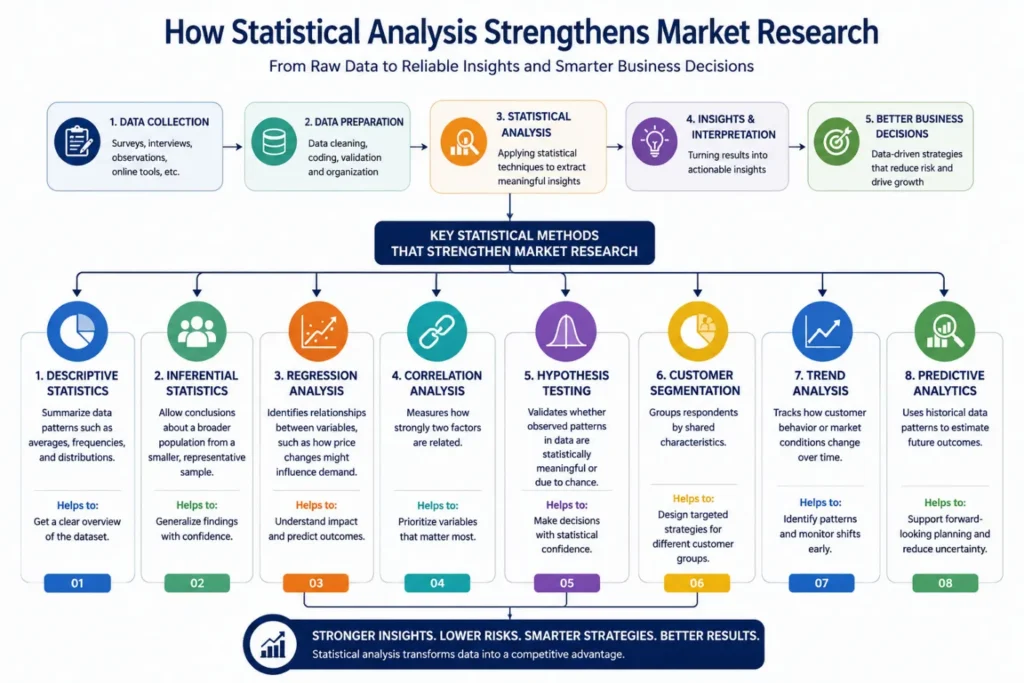
- Statistical Analysis – Selecting the appropriate statistical methods is used according to the research question and type of data.
- Visualization – findings are translated into easily-interpreted charts, tables and dashboards. 9.Business recommendations – Analysis turns into actionable recommendations linked to the initial business goal.
- Final reporting – A final report is completed, organised so that it is usable for technical and non-technical stakeholders.
Key Features and Their Business Benefits
| Feature | Benefit |
| Customized research design | Research is aligned precisely with business objectives instead of generic templates |
| Statistical consulting expertise | Findings are analytically sound and defensible |
| Ethical data collection practices | Respondent confidentiality and data integrity are protected throughout |
| Transparent methodology | Clients understand exactly how findings were derived |
| Clear, actionable reporting | Insights are presented in a way that directly supports decision-making |
| Cross-industry experience | Research approach adapts to sector-specific requirements |
| End-to-end project management | One consistent team manages the project from planning to final report |
Common Challenges Businesses Face Without Market Research
Skipping structured research does not eliminate risk; it simply moves that risk further down the line, often after money has already been spent. Common consequences include:
- Poor product launches – Products built without validating actual customer demand often underperform after launch.
- Wrong pricing decisions – Pricing based on internal assumptions rather than customer willingness-to-pay can suppress sales or erode margins.
- Customer dissatisfaction – Without regular feedback research, service or product gaps go unnoticed until customers disengage.
- Low return on investment – Marketing and product spend without research backing frequently targets the wrong audience or message.
- Weak marketing decisions – Campaigns built on assumptions about customer behavior tend to underperform compared to research-informed campaigns.
- Competitive disadvantage – Businesses that don’t track category trends risk falling behind competitors who do.
Why Bangalore Businesses Trust Simbi Labs
Fostering trust in a research partner does not happen in one project, but through being consistent. There are a handful variables that are always important to organizations that Simbi Labs collaborates with:
- Research quality – Methodology is planned to generate valid and defensible research results. b) Timely delivery – Business decisions may have a deadline and research timelines are based on that.
- Industry experience: Knowledge of industry dynamics enhances the relevance of research design.
- Data accuracy – There are steps of validation in the process to prevent inconsistencies before analysis.
- Personalized consultancy – Suggestions instead of templates.
- Transparent communication – clients are updated on methodology, progress and limitations throughout the project.
- Actionable insights – not a summary of data, but something the client can do with it.
Ready to Make Data-Driven Business Decisions?
Partner with Simbi Labs for reliable market research, statistical analysis, and customized business insights that help reduce risk and support smarter decisions.
Get in touch with our experts today.
Book a free consultation for appointment
Email us at :grow@simbi.in
Frequently Asked Questions
1.What does a market research company do?
Market research companies plan and execute studies to gain insight into business customers, market conditions and the competitive environment, and then provide insights that inform business decisions.
2. Why is market research important?
It helps avoid expensive pitfalls that are based on an assumption rather than facts, thus assisting businesses to make fact-based choices on pricing, product, and strategy.
3. How much does market research cost?
The price depends on the project size, methodology, number of samples and the time frame. Once the research goal is understood, a clear estimate of cost is usually thrown out.
4. How long does a market research project take?
Timelines depend on the research method and scale of data collection, ranging from a few weeks for smaller studies to several months for large, multi-phase projects.
5. What industries use market research?
Nearly every industry benefits from research, including healthcare, pharmaceuticals, manufacturing, retail, e-commerce, education, IT, and government projects.
6. What research methods does Simbi Labs use?
Both qualitative methods, such as interviews and focus groups, and quantitative methods, such as structured surveys and statistical analysis, are used depending on the research objective.
7. Does Simbi Labs provide statistical analysis?
Yes. Statistical consulting is a core part of the service, including descriptive statistics, regression, hypothesis testing, and predictive analytics.
8. Can startups benefit from market research?
Yes. Startups often benefit the most, since research helps validate product-market fit and reduces risk before significant capital is committed.
9. Does Simbi Labs offer customized research?
Yes. Every project is designed around the client’s specific business objective rather than a fixed, generic research template.
10. How can I get started with Simbi Labs?
The process begins with a discussion of your business objective, after which a suitable research design and timeline are proposed.