QGIS Uses: 6 Real-World Applications Across Different Industries
QGIS uses extend far beyond creating maps. QGIS is an open-source Geographic Information System used for spatial data analysis, mapping, environmental monitoring, agriculture, urban planning, disaster management, transportation, healthcare, and research.

Geographic information now supports planning and decision-making across industries. The real-world uses of QGIS extend beyond map creation by connecting locations, resources, and populations. QGIS, an open-source GIS platform, supports geographic data analysis, visualisation, and interpretation across urban development, environmental monitoring, agriculture, disaster management, transportation, healthcare, energy, and research.
READ THIS : GIS Survey Services
1. From Spatial Data to Practical Decisions
The real strength of QGIS lies in bringing multiple geographic datasets into a single analytical framework. Satellite imagery, GPS coordinates, road networks, population information, land-use records, elevation models, and field observations can be examined together rather than as isolated sources of information.
This changes the nature of decision-making. Consider the planning of a new public facility. Instead of selecting a location based only on available land, planners can simultaneously assess population distribution, road connectivity, distance from existing facilities, and infrastructure availability. The resulting decision is therefore supported by spatial evidence rather than a single criterion.
| Application Area | Practical Use of QGIS |
| Urban planning | Land use, zoning, and infrastructure analysis |
| Environment | Forest, water, and ecosystem monitoring |
| Agriculture | Soil, crop, and irrigation analysis |
| Disaster management | Flood and vulnerability mapping |
| Transportation | Route and accessibility analysis |
| Healthcare | Service accessibility and disease mapping |
| Energy and utilities | Site selection and asset mapping |
| Research | Spatial data analysis and visualisation |
Spatial Intelligence in Urban Development and Infrastructure
Cities involve complex relationships between land, people, infrastructure, and public services. QGIS helps planners analyse these relationships within a single spatial framework.
For example, land-use patterns can be assessed alongside population growth and infrastructure availability to support better decisions about roads, utilities, and public facilities. Rather than simply identifying available land, planners can determine where development will provide the greatest accessibility and long-term value.
Environmental and Natural Resource Decision-Making
QGIS supports environmental analysis by combining satellite imagery, field observations, and location-based measurements. This allows users to compare conditions across areas and identify significant environmental changes.
Its applications include forest monitoring, watershed and groundwater studies, biodiversity mapping, habitat analysis, and environmental impact assessment. Comparing imagery from different periods, for instance, can reveal changes in forest cover or other environmental conditions.
Precision Agriculture and Resource-Efficient Farming
Agricultural conditions often vary within the same farm. Soil, moisture, terrain, water availability, and crop performance can differ significantly from one area to another.
QGIS helps visualise these differences so that management decisions can be targeted. By combining field boundaries with crop and irrigation data, farmers or consultants can identify areas requiring specific interventions. This makes soil mapping, crop monitoring, irrigation planning, and resource allocation among the important uses of QGIS in modern agriculture.
Risk, Resilience, and Disaster Preparedness
Disaster planning depends on understanding both the location of hazards and the areas exposed to them. QGIS allows multiple datasets to be examined together to identify geographic risk.
For flood preparedness, elevation, drainage, rainfall, settlements, and critical infrastructure can be analysed within one framework. Similar approaches support landslide, cyclone, wildfire, and earthquake assessments, helping agencies develop vulnerability maps, preparedness plans, and evacuation strategies.
Network-Based Applications in Transportation and Logistics
Transportation and logistics depend on understanding how locations are connected. QGIS can analyse road networks, population centres, public facilities, travel accessibility, and delivery routes.
This supports route planning and helps identify underserved transport areas. Accident hotspot analysis can also reveal road segments requiring further investigation, showing how QGIS supports decisions based not only on asset locations but also on the relationships between them.
Read Also : Adding Basemaps in QGIS using Plugins
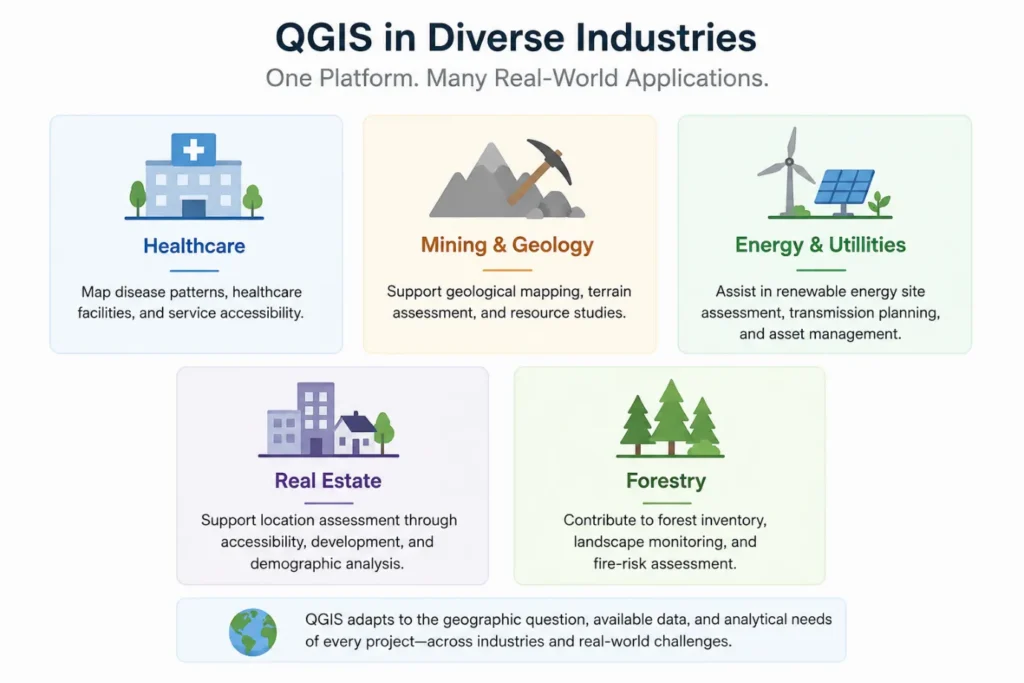
2. Expanding Industry Applications Beyond Traditional Mapping
3. Research and Analytical Workflows Powered by QGIS
For researchers, QGIS offers an environment where geographic data can move through a structured analytical process:
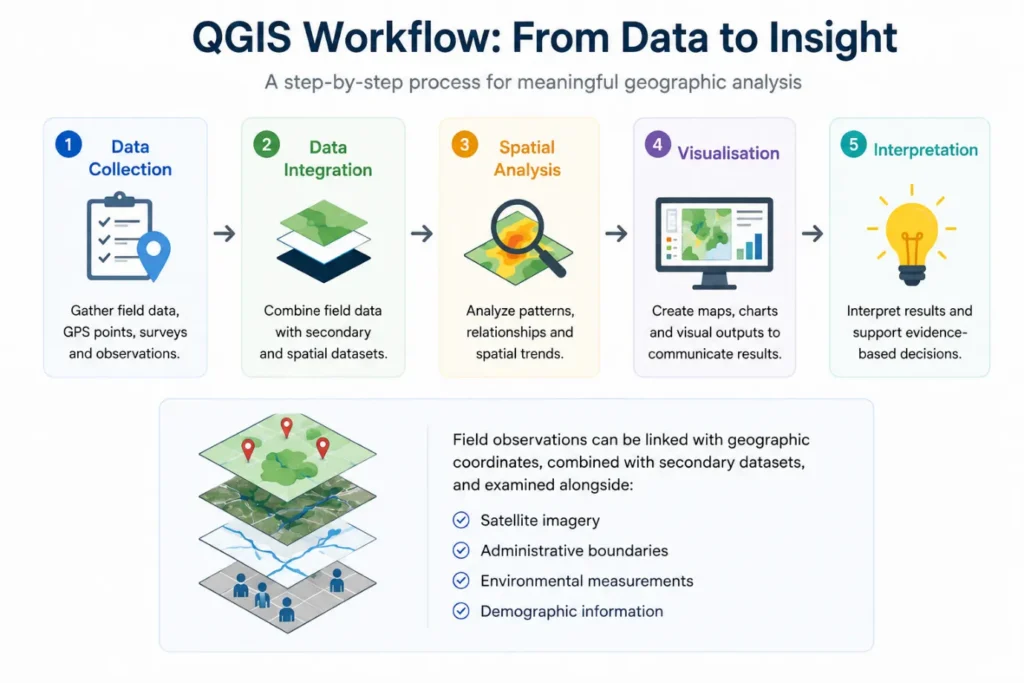
The availability of plugins, database integration, raster and vector capabilities, and Python-based automation also allows workflows to become increasingly customised as project complexity grows.
4. Applied QGIS Scenarios: From Data to Decision
Scenario 1: Healthcare Facility Planning
A planner combines population density, road access, travel distance, and existing hospital locations. The analysis identifies communities with high demand but limited access to healthcare services.
Scenario 2: Flood Vulnerability Assessment
Elevation, drainage, rainfall, and settlement information are brought together to identify locations requiring greater preparedness and infrastructure attention.
Scenario 3: Agricultural Irrigation Planning
Field boundaries, terrain, crop information, and water availability are analysed to understand where irrigation strategies may need adjustment.
These scenarios illustrate the practical value behind the real-world uses of QGIS. The process begins with data, but the objective is to reach a better-informed decision.
5. The Strategic Value of QGIS for Professional Workflows
The growing adoption of QGIS is linked to its flexibility as an open-source platform.
It can support:
- Raster and vector data analysis
- GPS and field-data integration
- Spatial database connectivity
- Satellite and remote-sensing workflows
- Plugin-based extensions
- Python automation and customised analysis
For professional users, these capabilities allow QGIS workflows to be adapted to the specific requirements of a project. It can therefore provide a flexible and cost-effective option for organisations requiring geospatial analysis without depending entirely on a fixed software environment.
Need QGIS Support for Your Project?
Need help with QGIS mapping, spatial analysis, remote sensing, GIS surveys, or research-based geospatial projects? Simbi Labs provides professional GIS and QGIS support for businesses, researchers, and organisations.
Get QGIS & GIS Support
6. Professional QGIS and GIS Support for Complex Projects
Many projects require more than basic map preparation. A land-use assessment may require spatial data preparation and analysis. An environmental project may involve satellite imagery and field datasets. A research study may require spatial interpolation, visualisation, and analytical mapping.
Professional QGIS and GIS support can therefore include mapping, geospatial analysis, environmental applications, remote sensing, data visualisation, and customised research workflows.
Simbi Labs provides support for research and industry projects involving QGIS-based mapping, spatial analysis, and geospatial data applications.
The real-world uses of QGIS continue to grow because organisations increasingly depend on location-based information to understand complex problems. Whether the objective is to monitor environmental change, improve infrastructure planning, analyse agricultural conditions, or assess geographic risk, QGIS provides a practical environment for converting spatial data into meaningful action.
Book a free consultation for appointment
Email us at :grow@simbi.in
Frequently Asked Questions
1. What are the main real-world uses of QGIS?
QGIS supports applications in planning, environmental monitoring, agriculture, disaster management, transportation, healthcare, utilities, and research.
2. Which industries use QGIS?
The platform is used across government, planning, environmental management, agriculture, logistics, healthcare, mining, energy, forestry, and research.
3. Can QGIS be used for professional projects?
Yes. QGIS can support professional mapping, spatial analysis, visualisation, remote sensing, and customised geospatial workflows.
4. Is QGIS useful for academic research?
Yes. It is widely applicable to research involving environmental, geological, public health, demographic, social, and other geographic datasets.
5. What does QGIS full form mean?
QGIS is commonly expanded as Quantum Geographic Information System, although the platform is generally known simply as QGIS.