
Power Analysis for Means in SPSS: A Practical Guide with Examples

Introduction
Statistical power is one of the most critical, yet often overlooked, concepts in research design. In simple terms, it’s your study’s ability to detect a real effect when it actually exists. Too little power, and you risk missing important findings (Type II error). Too much power, and you may waste resources collecting more data than necessary.
Power Analysis in SPSS allows you to determine the right sample size before collecting data or evaluate whether your existing study design is adequate. In this blog, we focus specifically on the “Means” option within SPSS’s Power Analysis menu. We’ll explore what each test does, how to run it step-by-step, and how to interpret the output—using a hypothetical student performance dataset to make the process crystal clear.
Read Also : Data Types in Statistics: Building the Foundation for Accurate Analysis
What is Independent-Sample t-Test – Power Analysis?
Purpose:
To check whether male and female students have significantly different post-test scores and to determine if the sample size is sufficient for detecting a meaningful difference.
Example:
You want to check if male and female students have significantly different post-test scores in your class.
From our dataset, We have:
i. Males (n = 10) — Test_Score_Post ranges from 65 to 85.
ii. Females (n = 10) — Test_Score_Post ranges from 69 to 80.
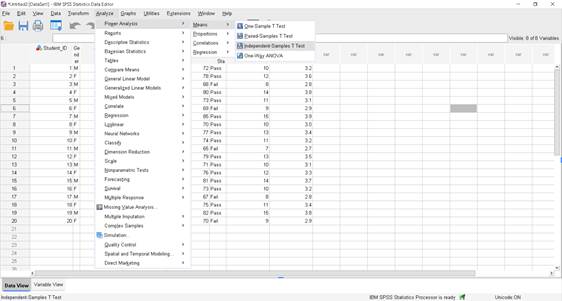
What are the Steps In SPSS?
Go to Analyze → Power Analysis → Means → Independent-Sample t-test.
Step 1 – Sample size for each group
From your data:
i. Group 1 = Males → 10 students
ii. Group 2 = Females → 10 students
Step 2 – Population mean difference
From your dataset, calculate the mean of Test_Score_Post for each gender:
i. Mean (Males) = (72+68+85+77+71+65+81+67+82+75) / 10 = 74.3
ii. Mean (Females) = (78+80+69+70+74+79+76+73+75+70) / 10 = 74.4
Population mean difference = 74.3 − 74.4 = -0.1 (absolute value: 0.1).
Step 3 – Pooled standard deviation
Formula:
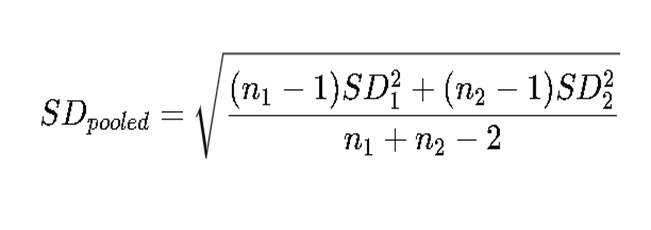
From your data:
i. SD (Males) ≈ 6.0
ii. SD (Females) ≈ 3.7
Pooled SD ≈ 4.95.
Step 4 – Test direction and significance level
i. Select Nondirectional (two-sided) because we are testing for any difference.
ii. Significance level stays at 0.05

Final filled values:
i. Sample size for group 1: 10
ii. Sample size for group 2: 10
iii. Population mean difference: 0.1
iv. Pooled standard deviation: 4.95
v. Test direction: Nondirectional (two-sided)
vi. Significance level: 0.05

How to write interpretation of Independent-Sample t-Test – Power Analysis?
The analysis compares the post-test means between two independent groups (males and females) with equal variances assumed.
The effect size is very small (0.020), meaning the difference in group means is negligible relative to variability.
With only 10 participants per group, the achieved statistical power is just 0.050, far below the commonly desired 0.80 threshold.
This low power means there is a high risk of failing to detect a real difference if one exists.
What is One-Way ANOVA in Power Analysis?
Example: One-Way ANOVA Power Analysis in SPSS
Goal: Compare post-test mean scores across different GPA categories.
Dataset Used: 20 students with Test_Score_Post and GPA values.
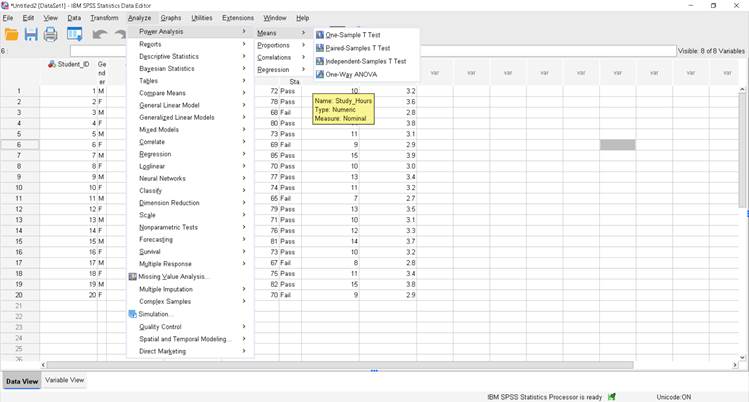
What are steps in SPSS?
Step 1 – Create GPA Categories
From your data, categorize GPA into 3 groups:
i. Low GPA (≤ 3.0) n = 6
ii. Medium GPA (3.1–3.5) n =9
iii. High GPA (≥ 3.6) n = 5
Step 2 – Calculate Group Means
From your Test_Score_Post column:
| GPA Category | Mean Test_Score_Post |
| Low | 68.0 |
| Medium | 73.875 |
| High | 81.5 |
Step 3 – Calculate Pooled Population Standard Deviation
Pooled SD from your dataset = 2.40 (based on within-group variability).

Step 5 – Fill in the Dialog Box
In the dialog:
i. Estimate power (or choose Estimate sample size if needed)
ii. Pooled population standard deviation: 2.40
iii. Add groups:
Read Also : Mastering SPSS Descriptive Analysis: A Beginner-Friendly Guide to Frequencies
| Group size | Group weight | Group mean |
| 5 | 1 | 68.0 |
| 8 | 1 | 73.875 |
| 6 | 1 | 81.5 |
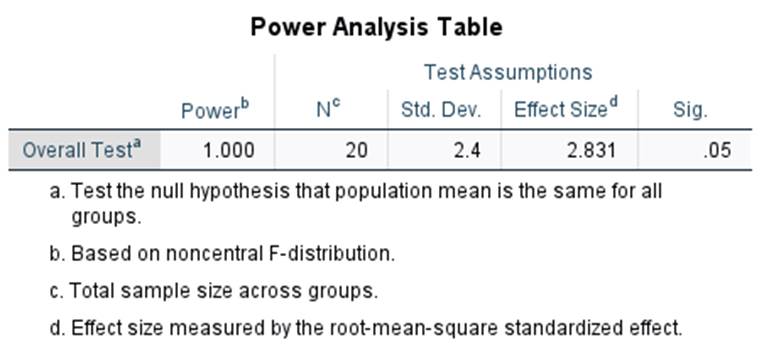
How to write interpretation in One-Way ANOVA in Power Analysis?
This power analysis shows a Power of 1.000, meaning the test is virtually certain to detect real differences among GPA groups if they exist.
The total sample size is 20 students across all categories.
The pooled standard deviation of 2.4 and effect size of 2.831 indicate a very large difference between group means relative to variability.
At a significance level of 0.05, the null hypothesis that all group means are equal is highly unlikely to be retained.
For an in-depth understanding, please refer to our book, “Academic Research Fundamentals: Research Writing and Data Analysis”. It is available as an eBook here, or you may purchase the hardcopy here .