Beyond Sales Numbers: How FMCG Brands Use Consumer Mapping Strategies for FMCG Brands in India to Win Indian Markets
Why Consumer Understanding Has Become Essential in FMCG
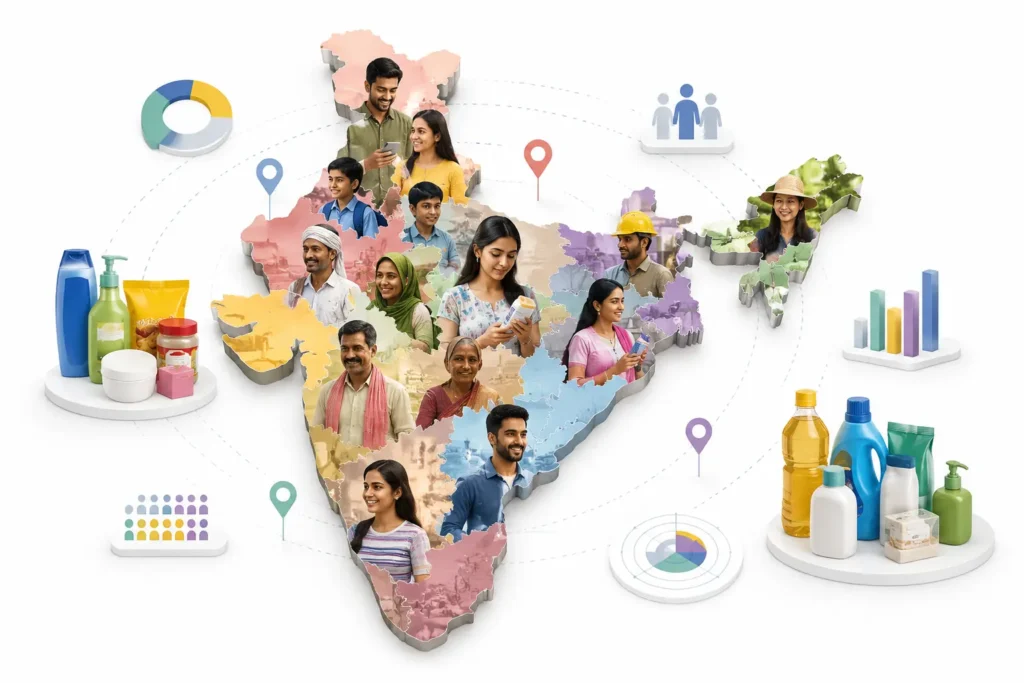
The FMCG industry in India is going through an incredible transformation with brands vying in the urban, semi-urban and rural markets. Consumer tastes and needs change rapidly with the change in lifestyle, digital influence, price sensitivity, and geographic diversity. In this climate, companies can’t rely exclusively on the sales report or their guess to make their choices. They must be more deeply mapped when it comes to customer thinking, buying, comparing and reacting processes in actual market situations, particularly through effective consumer mapping strategies for FMCG brands in India.
The increasing need for precise consumer mapping has led to the development of an increasingly common and important method of research: Structured FMCG research. Organized data collection systems are now in place as brands seek to understand how customers are buying their products, gauge performance and make more informed decisions about future positioning on the market, leveraging consumer mapping strategies for FMCG brands in India.
What Consumer Mapping Means in FMCG Research
Consumer mapping involves collecting and analysing data about consumers to gain insight into their behaviour, preferences, motivations and purchasing habits in various retail settings. This information is gathered from consumers, retail outlets, distributors and digital channels in FMCG sectors, and structured research methods are employed, particularly through consumer mapping strategies for FMCG brands in India.
Consumer mapping is not only about finding out what consumers are buying but why they are making their purchasing choices. This can enable businesses to optimize the development of their products, pricing strategies, distribution planning and marketing effectiveness across the Indian markets by implementing effective consumer mapping strategies for FMCG brands in India.
Why Consumer Mapping Is Growing Rapidly in India with Effective Strategies
Consumer behavior in India is complicated and unpredictable, as its retail market is diverse and eclectic, with each region having its own unique preferences and shopping habits. Purchasing habits, brand loyalties, spending priorities, and other things can vary dramatically from one area to another.
· Growth of organized retail and e-commerce platforms
· Rising demand for personalized customer experiences
· Expansion of regional and local FMCG brands
· Faster product innovation cycles
· Increased dependence on data-driven marketing strategies
Businesses that invest in strong consumer mapping gain a clearer understanding of customer expectations and market opportunities.
How FMCG Companies Conduct Consumer Mapping
Defining Business Objectives
Research teams first identify what they need to measure, such as customer satisfaction, product awareness, pricing response, or shopping frequency.
Selecting Data Collection Methods
Organizations use multiple approaches to strengthen consumer mapping, including:
· Online customer surveys
· Retail outlet audits
· Field interviews and observations
· Mobile-based feedback systems
· Distributor and retailer interactions
Data Processing and Validation
Collected responses are cleaned and validated to remove duplicate entries and inconsistencies.
Analysis and Insight Generation
Advanced analytics and AI systems help identify patterns, trends, and behavioral insights from large datasets.
Reporting and Strategic Planning
Insights are converted into dashboards and reports that support marketing, sales, and product decisions.
Features That Strengthen Modern Consumer Mapping
Professional FMCG research providers now use advanced systems that improve both speed and scalability.
· Multi-channel online and offline data collection
· Real-time reporting dashboards
· Geo-tagging and location tracking tools
· AI-driven predictive analytics
· Large-scale data processing capabilities
· Strong privacy and compliance standards
These capabilities allow businesses to generate more accurate and actionable consumer mapping insights.
Business Advantages of Effective Consumer Mapping
Stronger Customer Understanding
Brands gain deeper visibility into customer needs, purchasing behavior, and brand expectations.
Better Market Decisions
Accurate insights support pricing, product positioning, and promotional planning.
Faster Product Improvement
Customer feedback helps businesses refine products before large-scale launches.
Competitive Market Advantage
Understanding consumer trends enables brands to respond faster than competitors.
Higher Marketing Efficiency
Targeted campaigns become more effective when supported by reliable consumer mapping.
These advantages explain why FMCG businesses increasingly prioritize data-driven customer research.
Where Consumer Mapping Creates the Biggest Impact
Retail and Distribution Monitoring
Tracking product placement, availability, and pricing across stores.
Product Launch Research
Testing consumer reactions before introducing products to larger markets.
Brand Tracking
Measuring awareness, customer loyalty, and brand recall over time.
Consumer Behavior Analysis
Understanding how purchasing patterns differ across demographics and regions.
Across all these areas, consumer mapping helps FMCG companies make smarter strategic decisions.
Technologies Driving Smarter Consumer Mapping
Modern FMCG research increasingly depends on digital technologies and AI-powered systems.
· Mobile survey applications for field data collection
· AI and machine learning for predictive modeling
· Cloud-based analytics dashboards
· Visualization tools such as Microsoft Power BI and Tableau
· NLP systems for sentiment and feedback analysis
These technologies improve the speed, scale, and precision of consumer mapping across Indian markets.
Choosing the Right FMCG Research Partner
The quality of consumer mapping often depends on the expertise of the research provider. Businesses should evaluate:
· Experience in FMCG and retail research
· Use of AI-driven analytics tools
· Strong quality assurance systems
· Ability to customize research models
· End-to-end services from collection to reporting
A professional research partner helps organizations convert raw data into valuable consumer mapping insights
Future Trends in Consumer Mapping
The future of consumer mapping is becoming increasingly intelligent, automated, and real-time.
· AI-powered predictive consumer analysis
· Real-time customer tracking systems
· Voice and sentiment recognition technologies
· Automated survey deployment platforms
· Integration of IoT and big data ecosystems
These innovations are reshaping how FMCG brands understand and engage customers in India.
Final Perspective
In today’s fast-changing retail environment, Consumer Mapping strategies FMCG Brands in India are becoming essential for understanding buyer behavior, improving customer engagement, and increasing market performance. With structured data collection, advanced analytics, and AI-powered insights, FMCG companies can identify purchasing trends, track consumer preferences, and respond quickly to changing market demands across India.
Brands that invest in consumer mapping right can make better consumer connection and sustainable growth.
Looking for FMCG Consumer Research Solutions?
We offer every kind of field survey services, customer behavior analysis, AI driven reporting, market intelligence and advanced analytics suitable for the companies in India in FMCG space.
Join the conversation, and turn consumer mapping into effective business growth strategies.
Book a free consultation for appointment
Email us at : grow@simbi.in
Contact Simbi Labs today discover how consumer mapping strategies for FMCG Brands in India can help businesses analyze buyer behavior, identify purchasing trends, improve market segmentation, strengthen retail targeting, and drive sustainable business growth across competitive Indian FMCG markets.