
Why Every Large Event Needs a Crowd Risk Assessment for Large Events
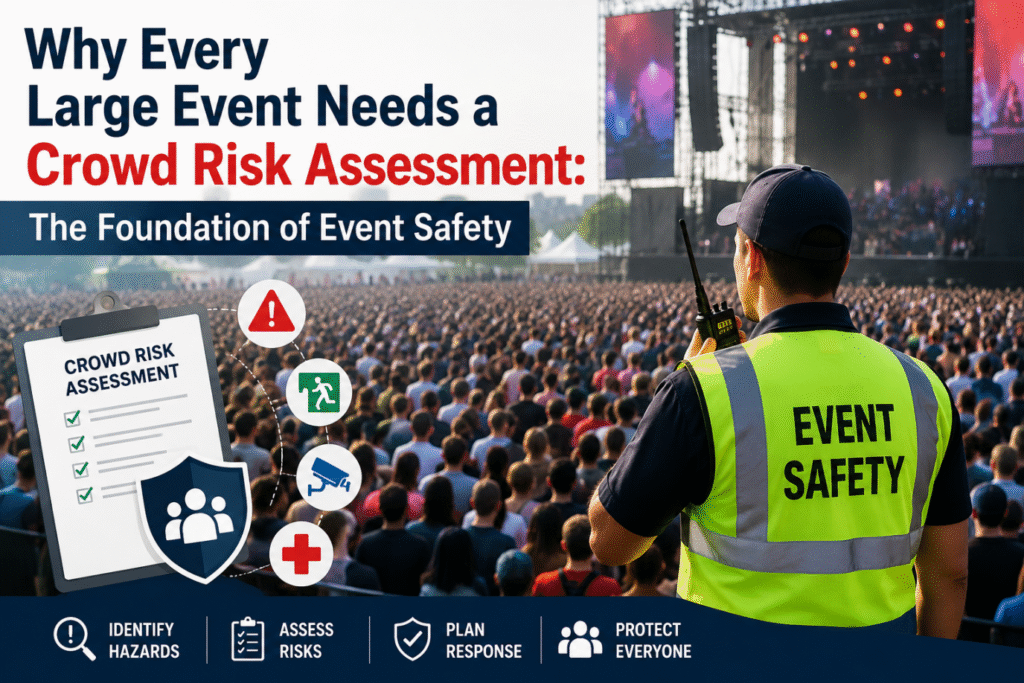
From a music festival full of 50,000 people, to a religious event where millions of pilgrims gather, a sports event and a corporate convention, there’s one thing that’s common to all large events – people management. Organizers tend to pay attention to entertainment, logistics, marketing, and ticket sales, but what matters most to the success of any event is the nearly immeasurable and most important aspect—ensuring the safety of all participants from preventable hazards.
A crowd risk assessment is the process of identifying hazards, assessing the risks posed by those hazards, and taking measures to prevent harm before the event starts. It is the foundation for ensuring the safety of any event, allowing organizers to quickly handle incidents and reduce the risk to others, as well as damage to property and facilities. Even a well-planned event can turn into a dangerous situation without adequate planning.
A lack of space, exit routes, communication, weather elements, medical issues, and/or infrastructure can turn into a life-threatening scenario in mere minutes.
This detailed guide illustrates the importance of crowd risk assessments, how they operate, typical crowd risks they can identify, and the ways in which cutting-edge technology is revolutionizing event safety planning.
Read Also : Crowd Safety Audit: What Every Public Facility Should Know
Breaking Down Crowd Risk Assessment
A crowd risk assessment is a systematic assessment of all potential safety risks at an event. It covers the site, number of attendees, crowd behavior, emergency preparedness, facilities, environment, and operations. Instead of waiting for incidents to happen, organisers look at potential risks and take action to prevent them before they even arrive at the venue.The assessment typically answers questions such as:
- What hazards exist?
- Who could be affected?
- How likely is each risk?
- What would the consequences be?
- How can the risk be reduced?
- How will emergencies be managed?
Creating Safer Public Gatherings Through Crowd Risk Assessment
Large crowds provide high intensity settings where thousands of individuals are interacting at the same time. If risks aren’t taken note of early on in the project, they can become major problems quickly.A proper assessment helps organizers:
- Prevent overcrowding
- Improve emergency preparedness
- Protect attendees and staff
- Reduce operational disruptions
- Improve evacuation efficiency
- Meet legal safety requirements
- Protect organizational reputation
- Optimize resource allocation
Understanding Crowd Hazards
Every event presents unique hazards depending on its location, audience, activities, and infrastructure.
- Overcrowding: If there are too many people in a place, they cannot move properly and this could escalate into a crowd crush or trampling incident.
- Crowd Surges : Rapidly crowding towards entrances, stages, exits, and attractions can result in hazardous buildup.
- Bottlenecks : Congestion areas are frequently narrow pathways, security checkpoints, food courts, or ticket validation areas.
- Emergency Evacuations: Rapid, organized evacuation procedures are needed for fire alarms, security threats, structural failure, and in extreme weather conditions.
- Weather Risks Risk at outdoor events can occur from:
- Heavy rain
- Heat waves
- Lightning
- Strong winds
- Flooding
- Medical Emergencies : The more people that are there, the more likely there will be dehydration, fainting, injuries, cardiac events or panic attacks.
- Infrastructure Failures: Potential failures include:
- Stage collapse
- Power outages
- Barrier failures
- Temporary seating collapse
- Communication breakdown
Scenario: Music Festival Without Risk Assessment
Imagine an outdoor music festival expecting 40,000 attendees.
Organizers focus primarily on artist schedules, food vendors, and ticketing while overlooking crowd dynamics.
At 7 PM, the headline performer takes the stage.
Thousands of spectators rush forward simultaneously.
Consequences include:
- Security barriers collapse.
- Several attendees fall.
- Emergency vehicles cannot reach injured individuals because access routes are blocked.
- Panic spreads rapidly.
- Event organizers struggle to communicate evacuation instructions.
What began as a successful festival quickly becomes a major emergency.
A comprehensive crowd risk assessment would have predicted high-density zones, modeled crowd movement, installed stronger barriers, expanded emergency access routes, and deployed additional crowd marshals.
How Crowd Risk Assessment Improves Event Safety
Hazard Identification: This is the initial phase of a crowd risk assessment and identifies hazards prior to the event. These can range from physical and environmental risks, human behavior risks, infrastructure weaknesses, security threats, to medical issues. Early identification will enable organizers to take preventative measures and enhance the safety of the event.
Risk Evaluation: An assessment of the likelihood of a hazard, the potential impact from the hazard, the number of people that will be affected by the hazard, and the response available to deal with the hazard. This enables organizers to prioritize resources and give attention to the most significant risks that can be controlled in an effective way.
Risk Mitigation Planning: After risks have been assessed, preventive actions are taken, such as the installation of more entry gates, crowd barriers, evacuation routes, medical support, extra staffing, and signage, to make the event safe.
Emergency Response Planning: Effective emergency response planning involves knowing how to respond to unexpected situations like fire situations, medical emergencies, extreme weather, missing children, security issues, crowd disturbances or infrastructure failure. Protocols and trained staff will enable a prompt and coordinated response that lessens risk and protects attendees.
Operational Readiness: The Key to Safe Events
Operational readiness ensures that safety plans are practical, thoroughly tested, and capable of being executed effectively during an event. The following table outlines the key components of operational readiness and their primary responsibilities.
| Operational Component | Purpose | Key Elements |
| Staff Training | Ensures personnel are prepared to respond effectively during routine operations and emergencies. | • Emergency protocols • Crowd management techniques • Communication procedures • First aid basics • Incident reporting |
| Communication Systems | Enables fast, accurate, and reliable information sharing among event staff and emergency responders. | • Two-way radios • Public announcement systems • Emergency alerts • Control room coordination • Backup communication channels |
| Medical Preparedness | Provides immediate medical assistance and supports rapid emergency response during health-related incidents. | • Ambulances • First aid centers • Trained medical teams • Defibrillators (AEDs) • Patient transport routes |
| Security Coordination | Maintains public safety by monitoring crowd activities and responding to security threats. | • Entry screening • Suspicious activity monitoring • Crowd density monitoring • Emergency exit supervision • VIP movement management |
| Traffic Management | Ensures the safe and efficient movement of vehicles and pedestrians before, during, and after the event. | • Parking control • Designated pedestrian routes • Shuttle services • Emergency vehicle access • Public transport coordination |
Emergency Planning: Preparing for the Unexpected
Every event should include a detailed emergency management plan.
It should define:
- Incident command structure
- Roles and responsibilities
- Evacuation procedures
- Shelter locations
- Medical response protocols
- Communication hierarchy
- Recovery procedures
The Role of Technology in Crowd Risk Assessment
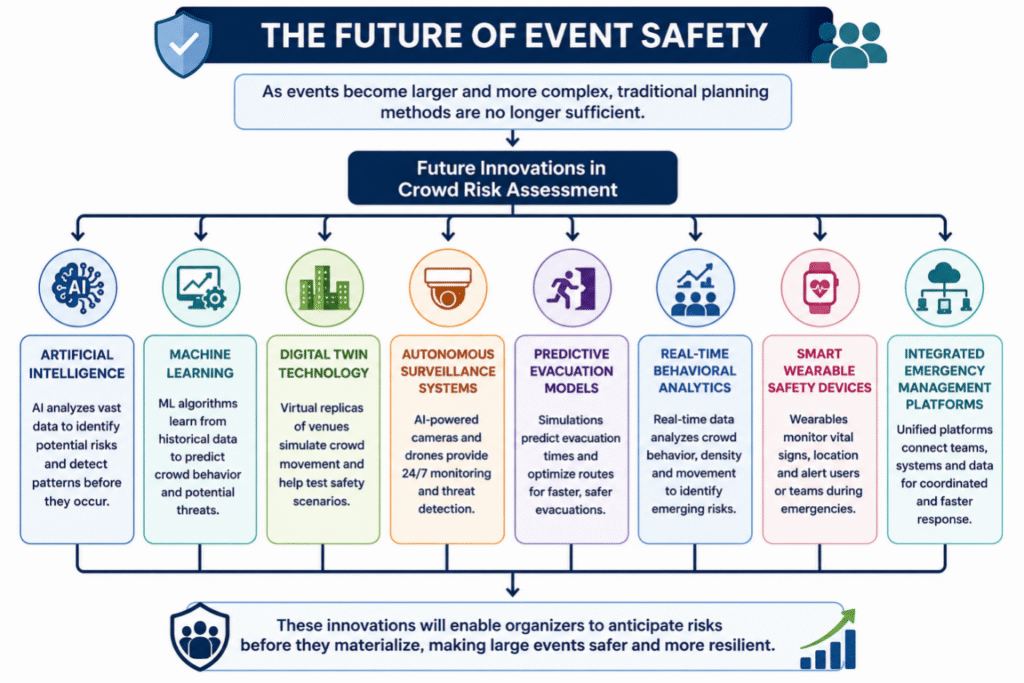
The advent of modern technology has revolutionized the way crowd risk is assessed, providing more accurate predictions of risk, monitoring and prompt decision making during large events. In today’s digital era, advanced digital tools are employed to help event organizers detect potential hazards before they become serious events, in addition to manual observation.
AI-powered crowd analytics can identify abnormal crowd behaviours and forecast potential crowd congestion, and CCTV video analysis systems give real-time monitoring of crowd movement throughout the venue. Drone surveillance can provide an aerial perspective of large events, providing security personnel with real-time information to look for bottlenecks and to track areas that are out of reach.
Furthermore, IoT occupancy sensors and real-time people counting systems monitor the number of people in the space, ensuring that the area is not overcrowded. Many organizers also use digital twin simulations to simulate various scenarios of the event before it even happens, GIS mapping for the optimization of emergency routes and the deployment of resources, and predictive crowd modelling to predict crowd movement in different scenarios.
These technologies work together to increase the safety of events, allowing for proactive planning, better emergency response, and safer and more efficient management of massive events.
Example:
Stadium Event Planning
A football stadium expects 70,000 spectators.
Before match day, planners conduct a crowd risk assessment.
They identify:
- Two high-risk entry gates
- Potential congestion near food courts
- Slow evacuation from upper seating
- Limited wheelchair access
- Peak arrival times
Based on the assessment, organizers:
- Open additional entrances.
- Increase security staff.
- Reposition medical teams.
- Add digital wayfinding signs.
- Stagger gate opening times.
- Optimize emergency vehicle routes.
On match day, crowd movement remains smooth despite record attendance.The assessment prevented operational failures before they occurred.
Benefits of Crowd Risk Assessment
A good evaluation provides measurable benefits.
- Enhances the safety of the event as a whole
- Prevents crowd-related accidents
- Enhances emergency preparedness
- Supports regulatory compliance
- Reduces operational risks
- Improves staff coordination
- Optimizes crowd flow
- Protects organizational reputation
- Increases attendee confidence
- Reduces financial liabilities
Common Mistakes Organizers Should Avoid
Event planning is an ongoing process of evaluation and preparation. Here are some common pitfalls to avoid, which can adversely affect the ability to assess crowd risk and ensure event safety:
- Making a presumption that past events ensure future safety.
- Failure to observe crowd behaviour and crowd dynamics.
- Assuming that fewer people will attend the event and fewer people will be at the event during peak times.
- Lack of communication amongst staff and emergency services.
- Poor emergency exits or signs indicating evacuation route.
- Lack of equipment and first aid provision.
- Not doing crowd simulation exercises prior to the event.
- Failure to observe weather warnings and concern for the environment.
- Failure to plan for contingencies in case of an emergency.
10.Failure to keep risk assessments up to date due to changes in events and/or attendance.
Best Practices for Effective Crowd Risk Assessment
Organizations should adopt the following practices:
- Conduct assessments early in the planning process.
- Review venue capacity thoroughly.
- Analyze historical event data.
- Simulate crowd movement scenarios.
- Train all operational staff.
- Coordinate with emergency services.
- Monitor crowd density in real time.
- Test emergency communication systems.
- Continuously update risk assessments.
- Conduct post-event reviews for continuous improvement.
The Path to Safer and More Resilient Events
The value of a successful event is not based on the number of people who attended or on the entertainment provided, it is based on the number of people who came back home safely.
Crowd risk assessment forms the cornerstone of event safety providing the basis on which event organizers can identify hazards, prepare for events and ensure that they are operational long before gates are thrown open.
This comprehensive crowd risk assessment process helps to reduce risk and increase the confidence and resilience of an organization, from identifying hazards, planning for emergencies, to monitoring the crowd in real-time and assessing the event afterwards. With the advancements in technology, the use of predictive, AI and simulation technologies in safety planning will become the norm to ensure the hosting of safe, well-managed events, regardless of their scale.
Book a free consultation for appointment
Email us at :grow@simbi.in
Frequently Asked Questions
1. What is a crowd risk assessment?
A crowd risk assessment is the process of identifying, evaluating, and controlling hazards that may affect people during an event. It helps organizers reduce risks, improve emergency preparedness, and maintain safe crowd movement.
2. Why is event safety important for large gatherings?
Event safety protects attendees, staff, and property by preventing overcrowding, managing emergencies, ensuring smooth operations, and meeting legal safety requirements. It also builds public confidence in the event.
3. When should a crowd risk assessment be conducted?
It should begin during the earliest planning stages and continue throughout event preparation. The assessment should also be updated whenever attendance, venue layout, weather, or operational plans change.
4. What are the most common hazards at large events?
Typical hazards include overcrowding, crowd surges, blocked exits, severe weather, medical emergencies, infrastructure failures, fire risks, security threats, and communication breakdowns that can disrupt safe event operations.
5. How does technology improve crowd risk assessment?
AI analytics, CCTV monitoring, IoT sensors, digital twins, drone surveillance, and real-time people counting help organizers monitor crowd behavior, predict congestion, and respond quickly to potential safety issues.