
Fire and Smoke Simulation: Understanding Occupant Safety During Emergencies
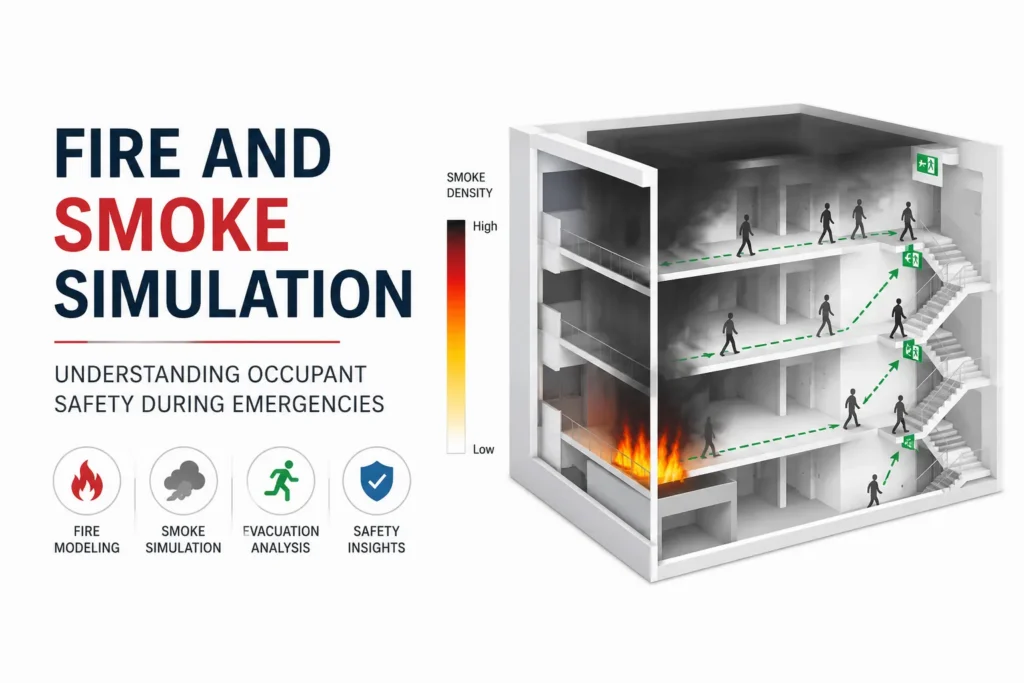
Some of the most serious events that can happen in buildings, industrial plants, transportation centers, hospitals, shopping malls, stadiums and public places are fire emergencies. Fire does direct damage, but smoke inhalation is consistently found to be the leading cause of death from fire, and can severely impair visibility and make it very hard to escape during a fire. Advancements in smoke simulation and fire modelling technology now allow engineers, architects, safety consultants and emergency planners to simulate the way a fire and smoke would affect a building before it is even built. These digital simulations can be used to identify high risk areas, to check the evacuation routes, to optimize the smoke control system and to enhance the safety of the occupants. Fire modelling today is not just about meeting regulations. It has become an integral part of performance based building design and contributes to the safety of that infrastructure and to minimise potential risk in the event of an emergency.
Read Also : Building Design Optimization Using Crowd Simulation: Designing Safer and Smarter Spaces Before Construction
Why Fire and Smoke Simulation Matters
The traditional approach to fire safety design utilizes prescriptive building codes, fire alarms, sprinklers and emergency exits. Although these measures are still vital, they are not a reliable indicator of smoke distribution in complex situations.
Every building has unique characteristics:
- Multi-storey layouts
- Underground parking
- Long corridors
- Open atriums
- HVAC systems
- Large occupancy loads
These characteristics are important in determining the flow of smoke in a fire.
Using smoke simulation, engineers can visualize:
- Smoke propagation
- Temperature distribution
- Toxic gas concentration
- Heat release
- Visibility reduction
- Occupant exposure
- Safe evacuation time
Engineers can assess several potential emergency situations prior to the construction or renovation process, rather than assuming which one will happen.
How Fire Modelling Works
The fire modelling involves computational physics, fluid dynamics, and equations of heat transfer, which recreate realistic fire scenarios.
The simulation considers:
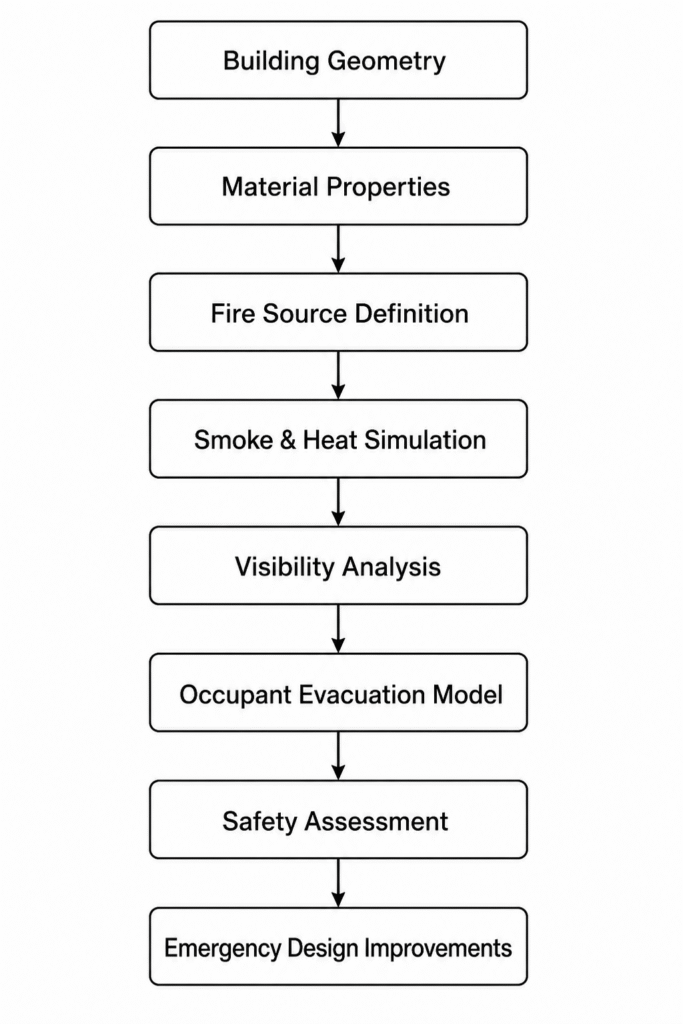
- Building geometry
- Fire ignition location
- Combustible materials
- Heat release rate
- Ventilation systems
- Wind conditions
- Occupant density
- Exit locations
The software then estimates the subsequent flow of smoke and heat within the building over time.
Typical Fire Simulation Workflow
Key Components of Smoke Simulation
1. Smoke Spread
Smoke usually spreads much faster than flames.
Simulation predicts:
- Ceiling layer formation
- Corridor smoke migration
- Vertical smoke movement
- Stairwell contamination
- HVAC influence
Understanding smoke spread helps improve smoke extraction systems and compartment design.
2. Visibility Analysis
Low visibility has a detrimental effect on evacuation. The simulation calculates distances of visibility inside the building, as a function of time.
Example:
| Smoke Density | Visibility | Evacuation Impact |
| Low | >20 m | Normal movement |
| Moderate | 10–20 m | Slower evacuation |
| High | 5–10 m | Increased confusion |
| Very High | <5 m | Critical evacuation conditions |
3. Temperature Distribution
Fire modelling predicts the temperature in various locations of the building.
High temperatures may:
- Block escape routes
- Damage structural components
- Increase burn risks
- Affect firefighter operations
4. Toxic Gas Concentration
Fire smoke contains hazardous gases including:
- Carbon monoxide (CO)
- Carbon dioxide (CO₂)
- Hydrogen cyanide (HCN)
Using simulation, the duration of exposure for each occupant can be estimated and areas of high risk in which adequate ventilation is needed can be identified.
5. Available Safe Egress Time (ASET)
ASET is the time that occupants have before conditions become life threatening.
Simulation calculates:
- Smoke layer descent
- Temperature rise
- Visibility thresholds
- Toxic gas accumulation
The intent is to make sure that ASET is greater than the Required Safe Egress Time (RSET).
Integrating Smoke Simulation with Evacuation Modelling
Smoke simulation is even more useful when used in conjunction with evacuation modelling of the crowds.
Instead of assuming occupants move normally, advanced simulations account for:
- Reduced visibility
- Walking speed reduction
- Congestion
- Panic behavior
- Blocked exits
- Route changes
- Mobility-impaired occupants
This combination approach will give an accurate picture of emergency evacuation.
Technologies and Software Used
Today, fire modeling is based on high performance computational tools that can recreate fire behavior and occupants’ interactions with fire with great fidelity.
| Software | Primary Use | Typical Users |
| Fire Dynamics Simulator (FDS) | Smoke simulation and CFD-based fire modelling | Fire Engineers |
| Pathfinder | Occupant evacuation modelling | Safety Consultants |
| PyroSim | Graphical interface for FDS | Fire Protection Engineers |
| GAMA Platform | Agent-based evacuation and crowd behaviour simulation | Researchers |
| NetLogo | Educational and behavioural fire evacuation models | Universities |
| AnyLogic | Multi-method evacuation and emergency simulations | Smart City Planners |
| MassMotion | Crowd movement analysis in large infrastructures | Transport & Stadium Designers |
| BIM (Revit) | Building geometry integration | Architects & Engineers |
How These Tools Work Together
One typical scenario for using PyroSim or FDS is to import a Building Information Model (BIM) and simulate the fire and smoke behavior. The environmental conditions (visibility, temperature, smoke concentration, etc.) that result are then exported to tools for evacuation such as Pathfinder. Engineers can also use platforms like GAMA or NetLogo to simulate how people make decisions, how they get around and how they interact with each other, and study the occupants’ reaction to changes in the emergency situation.
Real-World Case Study: Fire Simulation in a High-Rise Office Building
The proposed design for a new 28-storey commercial office tower with more than 3,500 people was to be subjected to a performance-based fire safety assessment for approval.
Challenge
The building included:
- Large open atriums
- Underground parking
- High occupant density
- Multiple interconnected floors
Engineers were worried that smoke may quickly permeate the atrium, impairing visibility and delaying the evacuation.
Solution
The project team used:
- Fire Dynamics Simulator (FDS) for smoke simulation
- PyroSim for creating the fire model
- Pathfinder for occupant evacuation analysis
Several fire scenarios were tested, including:
- Electrical room fire
- Cafeteria kitchen fire
- Basement parking vehicle fire
- Office workstation fire
Results
The simulations showed the smoke from an atrium fire spreading to upper floors much quicker than normal, making it difficult to see in the important escape routes. Based on these findings, the design team implemented:
- Additional smoke exhaust fans
- Improved smoke curtains around the atrium
- Revised stairwell pressurization
- Wider exit corridors
- Enhanced emergency signage
Follow-up simulations proved to enhance evacuation performance and allowed occupants to find their safe exits before it became uninhabitable. This project demonstrated the value of combining fire modelling with evacuation analysis to inform design changes considerably earlier than a building is even occupied.
Benefits of Fire and Smoke Simulation
Organizations increasingly adopt simulation-based fire engineering because it offers:
- Improved occupant safety
- Optimized evacuation routes
- Reduced design uncertainty
- Better smoke management
- Compliance with performance-based fire codes
- Cost-effective design modifications before construction
- Enhanced emergency preparedness
- More efficient firefighter planning
Best Practices for Effective Fire Modelling
- Develop accurate 3D building geometry.
- Use realistic material and fuel properties.
- Model multiple fire origin scenarios.
- Include HVAC and ventilation effects.
- Simulate different occupant populations, including vulnerable groups.
- Integrate smoke simulation with evacuation analysis.
- Validate results against relevant fire engineering standards where possible.
- Update models when building layouts or occupancy patterns change.
Future Trends in Fire Safety Simulation
Advances in artificial intelligence, cloud computing, and digital twins are transforming fire engineering. Emerging capabilities include:
- AI-assisted prediction of fire growth and smoke spread
- Real-time sensor integration for dynamic simulations
- Digital twins for continuous safety monitoring
- IoT-enabled smart smoke detection
- Augmented reality tools for firefighter training
- Machine learning for evacuation optimization
- Autonomous emergency decision-support systems
These innovations will help to implement smarter buildings and smart cities with more adaptive and data-driven fire safety strategies.
Conclusion
With buildings becoming larger and more complex, safety of the occupants cannot be achieved with just the traditional code compliance. Smoke simulation and fire modelling can help provide engineers with the ability to understand the evolution of fires, heat and smoke during an emergency and how people will react to these hazards. Combining state-of-the-art simulation tools like Fire Dynamics Simulator (FDS), PyroSim, Pathfinder, GAMA and NetLogo can help pinpoint hazards at an early stage, optimise evacuation strategies and enhance the safety of occupants. From the design of a high-rise office building to a hospital, private space to public area, simulation-driven fire engineering can inform informed decisions that save lives and ensure robust emergency preparedness.
Book a free consultation for appointment
Email us at :grow@simbi.in
Frequently Asked Questions (FAQs)
1. What is smoke simulation?
Smoke simulation uses the computational models to simulate the spread of smoke in a building in the event of a fire to assess visibility, temperature and occupant safety.
2. What is fire modelling?
Fire modelling is a method of simulating the growth of a fire, its heat release, the way smoke spreads, and how it affects people and buildings, in a digital model.
3. Why is evacuation modelling important in fire safety?
Evacuation modelling is used to simulate occupant flow in an emergency, and to pinpoint bottlenecks, enhance evacuation routes and emergency planning.
4. Which software is commonly used for fire and smoke simulation?
These are some of the popular tools used: Fire Dynamics Simulator (FDS), PyroSim, Pathfinder, GAMA Platform, NetLogo, AnyLogic, MassMotion.
5. Who benefits from fire and smoke simulation?
These simulations are used by fire engineers, architects, building designers, safety consultants, industrial facilities, hospitals, stadiums, universities, and government agencies to enhance safety and regulatory compliance.
6. Can fire simulation reduce construction costs?
Yes. By finding safety concerns in the design stage, modifications can be done at a lower cost prior to construction, which would be much more expensive to do later.