
Key Issues and Challenges in Spice Grinding
Authors and Affiliations


This paper explores the progression of spice grinding, starting with age-old methods such as stone mills and mortar-and-pestle, and moving towards advanced equipment like hammer mills, pin mills, jet mills, cryogenic units, and superfine grinders. It describes how factors like processing temperature, moisture levels, and particle size influence the flavour, aroma, and beneficial compounds in spices. The research identifies key issues, including heat build-up that leads to the loss of volatile oils, irregular particle sizing, contamination concerns, and heavy energy usage. It also outlines recent technological advances, such as employing liquid nitrogen in cryogenic grinding to safeguard sensitive elements, using superfine milling to enhance nutrient absorption, and integrating automation for improved uniformity and hygiene.
Understanding the Key Issues and Challenges in Spice Grinding is crucial for enhancing the quality of spice products in the market.
About the Journal
This research was published in the International Journal of Agro Nutrifood Practices (Volume 5, Issue 2, June 2025, e-ISSN: 2583-066X) (IJANP) IJ. The journal focuses on advancements in agricultural, nutritional, and food technology practices. It provides a platform for researchers, technologists, and industry professionals to share innovations, case studies, and experimental findings that can improve productivity, sustainability, and product quality in the agro-food sector.
Factors Affecting Grinding Quality
The outcome of the grinding process depends on multiple factors:
1. Temperature – High heat during grinding can degrade essential oils and active compounds.
2. Moisture Content – Influences texture, flow, and grinding efficiency.
3. Particle Size – Affects flavour release and uniformity in spice blends.
The Key Issues and Challenges in Spice Grinding also involve maintaining the integrity of flavour and aroma during processing.
Addressing the Key Issues and Challenges in Spice Grinding can lead to improved product quality and consumer satisfaction.
Identifying the Key Issues and Challenges in Spice Grinding is essential for optimising production processes.
The Key Issues and Challenges in Spice Grinding often lead to higher production costs and inefficiencies.
To tackle the Key Issues and Challenges in Spice Grinding, innovations in technology are vital.
Understanding the Key Issues and Challenges in Spice Grinding is important for maintaining food safety.
Excessive heat from conventional grinding often results in volatile oil loss, reducing aroma and nutritional value.
Implementing solutions for the Key Issues and Challenges in Spice Grinding can significantly enhance productivity.
Many industries are facing the Key Issues and Challenges in Spice Grinding that affect their market competitiveness.
Addressing the Key Issues and Challenges in Spice Grinding is essential for achieving optimal results.
Persistent Challenges
The Key Issues and Challenges in Spice Grinding have evolved with advancements in technology.
Reviewing the Key Issues and Challenges in Spice Grinding can provide insights into future developments.
Addressing the Key Issues and Challenges in Spice Grinding is critical for enhancing consumer trust.
The Key Issues and Challenges in Spice Grinding need to be addressed for sustainable practices.
Through innovation, we can overcome the Key Issues and Challenges in Spice Grinding.
For stakeholders, recognising the Key Issues and Challenges in Spice Grinding is imperative for strategic planning.
Only through understanding the Key Issues and Challenges in Spice Grinding can we drive progress.
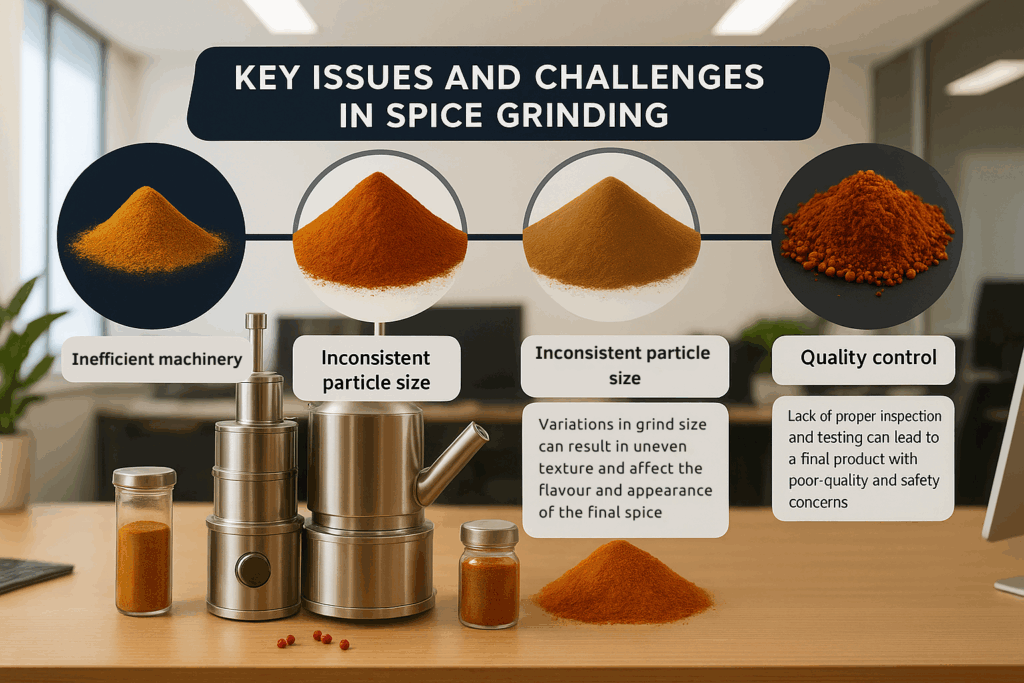
1. Heat Generation – Leads to flavour loss and nutrient degradation.
2. Particle Size Inconsistency – Causes uneven flavour distribution in spice blends.
3. Contamination Risks – Cross-contamination between spices processed in the same equipment.
4. High Energy Consumption – Adds to production costs, especially with large-scale operations.
Modern Solutions
Cryogenic Grinding – Uses liquid nitrogen to keep temperatures low, ideal for heat-sensitive spices like turmeric, ginger, and cardamom.
Superfine Grinding – Produces micro- or nanoscale particles for improved bioavailability and flavour release.
Automation and AI Integration – Controls particle size, temperature, and hygiene while reducing human error.
About the Paper
1. The paper “Key Issues and Challenges in Spice Grinding” reviews both historical and modern grinding technologies. It:
2. Explains the mechanical, thermal, and operational principles behind different grinding methods.
3. Analyses the impact of processing variables—such as grinding temperature, moisture content, and particle size—on spice quality, shelf life, and market value.
4. Compares energy requirements and performance efficiency of conventional systems versus advanced technologies like cryogenic and superfine grinding.
Ultimately, resolving the Key Issues and Challenges in Spice Grinding will shape the future of the industry.
The findings on the Key Issues and Challenges in Spice Grinding will inform future research and development.
5. Discusses contamination risks and ways to mitigate them through hygienic design and automation.
6. Includes case-based insights from industrial setups and lab trials to highlight practical applicability.
How This Approach Solves Problems in Industry
The combined use of cryogenic grinding, superfine milling, and automation offers practical solutions to common industrial challenges:
| Industry Problem | How the Approach Solves It |
| Loss of Aroma and Nutrients | Cryogenic grinding maintains low processing temperatures, preserving volatile oils and bioactive compounds. |
| Inconsistent Texture and Particle Size | Superfine milling delivers uniform fineness, ensuring consistent spice blends and quality control. |
| High Energy Costs | Modern systems are designed for better energy efficiency compared to older machinery. |
| Frequent Equipment Downtime | Automation supports predictive maintenance, reducing unplanned stoppages. |
| Contamination Risks | Enclosed, automated systems improve hygiene and meet food safety regulations. |
Research Approach
The paper draws from technical studies, industrial trials, and comparative evaluations of grinding systems. It reviews both small-scale and industrial applications, focusing on efficiency, energy savings, and product quality retention.
Simbi Labs India
Simbi Labs, headquartered in India, has contributed expertise and research support for advancing spice grinding technologies. Under the leadership of its CEO, Rakesh Kharra, the organisation has been actively involved in evaluating grinding processes, studying quality retention, and promoting energy-efficient and sustainable methods. Their involvement in this study demonstrates a commitment to bridging the gap between traditional practices and modern, technology-driven solutions in the spice industry.
For industry collaborations, technology consulting, or research partnerships, you can connect with Simbi Labs at:
Email: grow@simbi.in
Read This Full Article Here : Key Issues and Challenges in Spice Grinding
Conclusion
Advancements in grinding technology—such as cryogenic and superfine systems—have improved spice quality and process efficiency, yet long-standing issues like energy use, contamination, and nutrient loss still need solutions. The future of spice grinding lies in sustainable, eco-friendly, and energy-efficient technologies that meet global quality standards while reducing environmental impact.
For an in-depth understanding, please refer to our book, “Academic Research Fundamentals: Research Writing and Data Analysis”. It is available as an eBook here, or you may purchase the hardcopy here .
For an in-depth understanding, please refer to our book, “Academic Research Fundamentals: Research Writing and Data Analysis”. It is available as an eBook here, or you may purchase the hardcopy here .