
Solving Common Manufacturing Challenges with Lean Six Sigma: Practical Fixes That Work

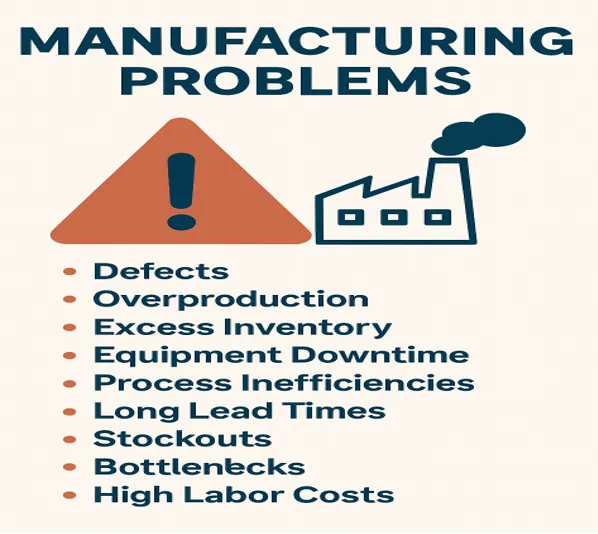
Manufacturing plants often face a variety of challenges that slow down productivity, increase waste, and affect quality. Fortunately, the Lean Six Sigma approach offers powerful tools to identify, analyse, and eliminate these issues systematically. This blog highlights ten of the most common problems in manufacturing and provides practical Lean Six Sigma solutions for each, including insights into Lean Six Sigma manufacturing challenges.
Read Also : The Hidden Costs of Common Manufacturing Mistakes — A Lean Six Sigma Perspective
1. Overproduction
Problem:
Producing more than what is needed leads to wasted resources, inventory build-up, and increased storage costs.
Fix Using Lean Six Sigma:
Apply Just-In-Time (JIT) production and use Kanban systems to produce only when there’s a real demand. Value stream mapping helps visualize the flow and eliminate excessive production.
2. Excess Inventory
Problem:
Unnecessary inventory ties up capital, takes up space, and risks product obsolescence.
Fix Using Lean Six Sigma:
Use the 5S methodology to organize storage and DMAIC (Define, Measure, Analyze, Improve, Control) to find the root causes. Establish reorder points and switch to demand-driven inventory models.
3. Defects and Quality Issues
Problem:
Frequent defects cause rework, delays, and customer dissatisfaction.
Fix Using Lean Six Sigma:
Apply Six Sigma’s DMAIC to identify variation in processes. Use tools like Root Cause Analysis, Fishbone Diagrams, and Failure Mode and Effects Analysis (FMEA) to detect and correct causes.
4. Equipment Downtime
Problem:
Machine failures lead to production halts and financial losses.
Fix Using Lean Six Sigma:
Introduce Total Productive Maintenance (TPM) and OEE (Overall Equipment Effectiveness) tracking. Perform regular maintenance and train operators to detect early signs of failure.
5. Long Changeover Times
Problem:
Changing tools or setups between batches wastes time and resources.
Fix Using Lean Six Sigma:
Implement SMED (Single-Minute Exchange of Dies) techniques to streamline setup procedures and reduce changeover to under 10 minutes.
6. Unbalanced Workflows
Problem:
Uneven distribution of tasks leads to bottlenecks or idle time.
Fix Using Lean Six Sigma:
Use Takt Time calculations to align workflow with customer demand. Apply Line Balancing to evenly distribute work across stations.
7. Wasted Motion
Problem:
Unnecessary movements by workers (reaching, walking, bending) reduce productivity.
Fix Using Lean Six Sigma:
Use 5S and layout redesign to minimize motion. Conduct time-motion studies to identify and reduce inefficiencies in workstation setup.
8. Underutilized Talent
Problem:
Failing to use employee skills results in missed opportunities for innovation and improvement.
Fix Using Lean Six Sigma:
Encourage Kaizen (Continuous Improvement) culture. Empower employees through cross-training and involve them in problem-solving teams.
9. Inaccurate Data Collection
Problem:
Decisions based on flawed or outdated data can harm operations.
Fix Using Lean Six Sigma:
Implement Statistical Process Control (SPC) and real-time dashboards to monitor process health. Use Measurement System Analysis (MSA) to ensure data reliability.
10. Customer Complaints
Problem:
High return rates and poor service affect brand loyalty and revenue.
Fix Using Lean Six Sigma:
Use Voice of the Customer (VOC) tools to gather feedback. Map the Customer Journey, identify CTQs (Critical to Quality factors), and improve processes that directly affect satisfaction.
Implementation Strategy in Manufacturing Using These Techniques
| Step | Lean Six Sigma Tool | Statistical Technique Used | Purpose |
| 1. Define Problem | SIPOC, VOC | Pareto, Descriptive Stats | Understand scope and customer need |
| 2. Measure | Process Mapping | Control Charts, MSA | Collect and validate process data |
| 3. Analyze | RCA, 5 Whys | Histogram, Regression, ANOVA | Find root cause of issues |
| 4. Improve | DoE, Kaizen | Hypothesis Testing, DoE | Optimize process for better results |
| 5. Control | Standard Work, Control Plans | SPC, Capability Analysis | Sustain improvements and prevent regression |
Example: Reducing Defects in Injection Molding Using Lean Six Sigma
Problem:
A plastic manufacturer faced a 12% defect rate (burn marks & short shots) in its injection molding process.
Lean Six Sigma Approach (DMAIC):
- Define: Customer complaints highlighted poor product quality.
- Measure: Control charts showed instability; MSA confirmed reliable measurement tools.
- Analyze: Pareto & ANOVA revealed night shift temperature settings caused most defects.
- Improve: Design of Experiments (DoE) optimized temperature, pressure, and speed.
- Control: Standardized process settings, implemented SPC for ongoing monitoring.
Read Also : Overcoming Inefficiencies in Your Manufacturing Process
Result:
Defect rate dropped to 2.5%
Annual cost savings of ₹15 lakhs
80% reduction in customer returns
Key Statistical Tools Used:
1. Control Charts: A statistical tool used to monitor process stability over time by distinguishing normal variation from unusual shifts or defects.
2. ANOVA (Analysis of Variance): A method to compare the means of multiple groups and determine whether differences are statistically significant.
3. DoE (Design of Experiments): A structured approach to testing multiple factors at once to identify which variables influence process outcomes the most.
4. Gage R&R (Repeatability & Reproducibility): A measurement system analysis that evaluates whether variations in data come from the measurement tool or the operator.
5. Regression Analysis: A technique that identifies relationships between variables, helping predict outcomes or quantify the impact of one factor on another.
Conclusion:
Manufacturing problems like defects, delays, and equipment downtime are common, but they don’t have to be permanent. By applying Lean Six Sigma tools and statistical techniques, businesses can identify root causes, streamline processes, and deliver consistent quality. Whether it’s reducing waste or improving productivity, Lean Six Sigma offers a structured approach that delivers measurable results. With the right strategy and team engagement, even complex manufacturing challenges can turn into long-term improvements and savings.
For an in-depth understanding, please refer to our book, “Academic Research Fundamentals: Research Writing and Data Analysis”. It is available as an eBook here, or you may purchase the hardcopy here .