
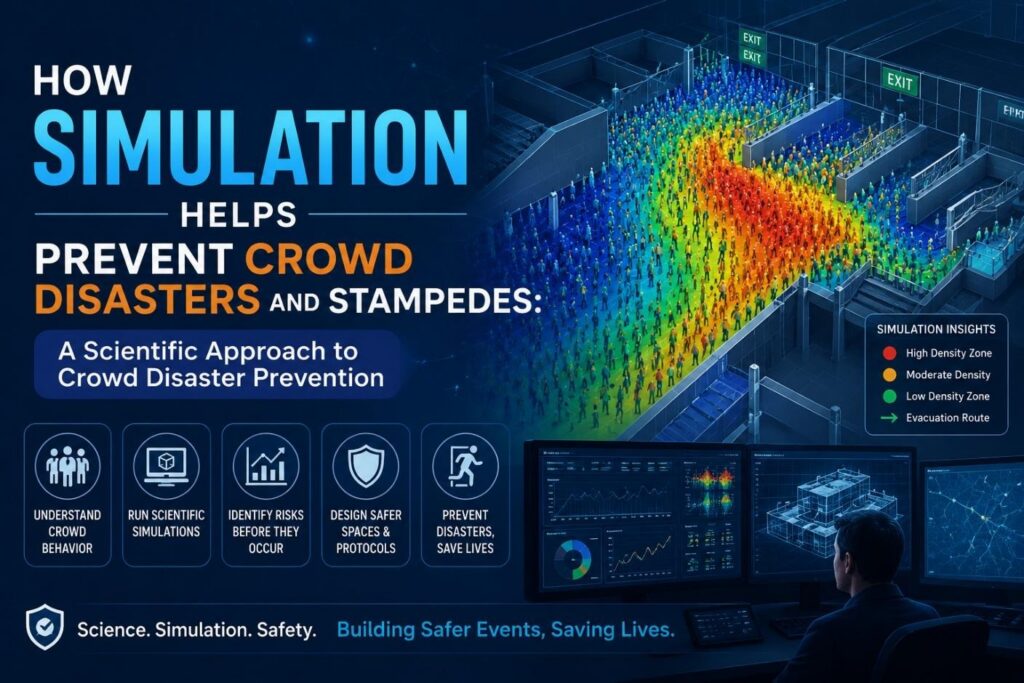
How Simulation Helps Prevent Crowd Disasters and Stampedes: A Scientific Approach to Crowd Disaster Prevention
Crowd Safety Challenges in Large Gatherings: Moving from Reaction to Prediction
Large gatherings have become an important part of modern life. Music festivals, sporting events, religious pilgrimages, political rallies, transport hubs, shopping malls, and public celebrations often bring together thousands or even millions of people. While these occasions create memorable experiences, they also present one of the most significant and frequently overlooked public safety challenges: crowd disasters.
Contrary to common belief, stampedes rarely occur because people suddenly panic. In most cases, crowd disasters develop when crowd density rises beyond safe limits, movement becomes restricted, pressure builds between individuals, and the crowd begins to behave as a single, uncontrollable force.
As a result, crowd disaster prevention has evolved beyond traditional security planning into a specialized field supported by engineering, artificial intelligence, and simulation technology.
Today, crowd simulation enables planners to identify dangerous situations before they develop, evaluate multiple emergency scenarios, improve evacuation strategies, and optimize infrastructure well before people enter the venue.
This guide explains how simulation has become one of the most effective tools for stampede prevention, explores the engineering principles behind safe crowd movement, examines lessons learned from past incidents, and shows how organizations can create safer environments through predictive planning.
ReadAlso : How AI Crowd Monitoring Improves Risk Detection and Safety
Understanding Crowd Disasters
A crowd disaster occurs when the movement of people becomes unsafe because of excessive density, restricted mobility, inadequate infrastructure, or poor event management.
Unlike isolated incidents, crowd disasters usually involve hundreds or even thousands of interconnected individuals whose movements directly affect one another.
As crowd density reaches unsafe levels, people gradually lose the ability to control their own movements.
Instead, they become part of a moving mass.
Small disturbances can quickly travel through the crowd as pressure waves, leading to falls, crushing, suffocation, or a chain reaction of collapses.
Why Traditional Event Planning Is No Longer Enough
Conventional event planning often relies on attendance estimates, security personnel, CCTV surveillance, and predefined emergency procedures. Although these measures remain important, they cannot always predict how large crowds will respond to unexpected situations.
Modern events involve complex pedestrian movement, where overcrowding, blocked routes, or sudden changes in crowd behavior can rapidly create hazardous conditions. Traditional planning often detects problems only after they have developed, leaving very little time for an effective response.
Crowd simulation addresses these limitations by predicting congestion hotspots, testing evacuation strategies, analyzing pedestrian behavior, and identifying potential risks before an event takes place. This proactive approach strengthens crowd disaster prevention while improving stampede prevention through safer venue layouts and more effective crowd management strategies.
The Science Behind Crowd Simulation
Crowd simulation applies mathematical models to recreate how people move through real-world environments. It generates virtual pedestrians that respond to factors such as walking speed, personal space, obstacles, route selection, crowd density, and emergency situations. By evaluating thousands of simulated interactions, the software predicts crowd behavior, identifies possible safety risks, and supports better planning before real-world events begin.
Why Simulation Is Essential for Crowd Disaster Prevention
Simulation converts uncertainty into measurable engineering decisions. Rather than responding to dangerous situations after they occur, it allows planners to predict and address potential problems before they arise.
Its benefits include:
- Identifying bottlenecks before construction
- Optimizing pedestrian routes
- Testing emergency plans
- Reducing crowd pressure
- Improving evacuation times
- Increasing emergency accessibility
- Designing safer venues
- Supporting regulatory compliance
- Reducing operational risk
- Protecting lives
The Engineering Principles Behind Safe Crowd Movement
Effective crowd movement is governed by several engineering concepts.
1. Crowd Density
Density measures how many people occupy one square meter,approximate crowd conditions:
| Crowd Density | Condition |
| 1–2 people/m² | Comfortable movement |
| 3–4 people/m² | Restricted movement |
| 5–6 people/m² | Dangerous congestion |
| Above 6 people/m² | High crush risk |
2. Flow Rate
Flow rate measures how many people pass through a point every second,poor flow leads to:
- Queue buildup
- Pressure accumulation
- Delays
- Congestion
3. Bottleneck Analysis
Narrow pathways can naturally become congestion points, increasing the risk of unsafe crowd buildup. Simulation helps identify bottlenecks caused by areas such as staircases, ticket counters, security checkpoints, food courts, escalators, corridors, and temporary barriers. By detecting these problem areas in advance, planners can redesign layouts and improve crowd flow for safer movement.
4. Pressure Mapping
Modern simulation estimates pressure between pedestrians,high-pressure zones are early indicators of potential crushing incidents.Pressure maps allow planners to redesign layouts before construction.
How Simulation Helps Prevent Stampedes
Simulation plays a vital role in stampede prevention by supporting safety planning at every stage of an event.
1. Predicting Dangerous Congestion
Crowd simulation helps identify locations where crowd density could exceed safe limits before an event takes place. Virtual models evaluate pedestrian movement and reveal potential bottlenecks, enabling organizers to take preventive measures such as creating additional exits, widening corridors, redistributing facilities, and modifying queue systems to maintain safe and continuous crowd movement.
2. Testing Emergency Evacuations
Simulation offers a safe way to evaluate emergency evacuation plans without placing people at risk. Organizers can examine a range of emergency situations, including fires, bomb threats, severe weather, structural failures, medical emergencies, and security incidents. Each simulation produces measurable results, including evacuation times, crowd movement patterns, and potential delays, helping strengthen emergency preparedness.
3. Optimizing Entry and Exit Systems
Well-managed entry and exit systems are essential for preventing overcrowding. Crowd simulation helps determine the most effective way to operate gates by identifying which entrances should remain open, forecasting peak arrival periods, optimizing gate allocation, and assessing the capacity of security checkpoints.
This enables organizers to shorten waiting times while reducing congestion in busy areas.
4. Managing Queue Systems
Poorly designed queues can increase crowd pressure and create unnecessary safety risks. Simulation enables organizers to evaluate different queue layouts, including barrier arrangements, waiting areas, queue-merging strategies, and overflow management plans. By assessing these options, organizations can create safer and more efficient queue systems that also improve the visitor experience.
5. Ensuring Emergency Vehicle Access
Crowd simulation also assesses how emergency vehicles move through crowded environments. It verifies that ambulance routes remain accessible, fire trucks can reach critical locations without obstruction, and medical teams can quickly access affected individuals during emergencies. This improves overall event safety while supporting a faster emergency response.
Preventing a Festival Crowd Crush
Imagine a three-day outdoor music festival expecting 75,000 attendees.
Without simulation:
- Food stalls are concentrated in one area.
- A headline performance finishes at 10:00 PM.
- Most attendees move toward the main exit.
- Temporary fencing narrows a critical corridor.
Within minutes, the exit area reaches dangerous crowd density. Movement slows significantly, people at the rear continue pushing forward, several individuals lose their footing, and the risk of a crowd crush increases rapidly.
With simulation completed during the planning stage:
- The software predicts severe congestion after the headline performance.
- Two additional exits are opened.
- Food and merchandise stalls are distributed across several zones to spread pedestrian traffic.
- Exit routes are widened by repositioning barriers.
- Performances on smaller stages are staggered to reduce simultaneous departures.
- Digital signage directs visitors toward less crowded exits.
The result is smoother crowd dispersal, lower crowd pressure, shorter exit times, and a significantly lower risk of a stampede.
Example: Stadium Evacuation Improvement
A sports stadium with a capacity of 50,000 spectators carries out a crowd simulation before the season begins.
The simulation reveals that:
- East-side staircases become congested within three minutes.
- Emergency exits on the north side remain underused.
- Food court queues extend into evacuation routes.
- Security screening delays post-match departures.
Engineers respond by:
- Widening staircase landings.
- Relocating concession queues.
- Improving directional signage.
- Opening additional exit gates after the final whistle.
- Positioning crowd marshals at predicted congestion points.
Lessons Learned from Historical Crowd Disasters
Many major crowd disasters around the world have shared similar contributing factors. Although every incident is different, investigations consistently reveal many of the same planning shortcomings.
Key lessons include:
- Overcrowding can develop gradually and remain unnoticed without continuous monitoring.
- Poor communication often leads to confusion and unsafe crowd movement.
- Blocked or insufficient exits can significantly delay evacuation.
- Temporary barriers and poor layouts frequently create hidden bottlenecks.
- Ticket sales should always match the venue’s approved safe occupancy.
- Crowd monitoring should continue throughout the event, not only at entry points.
- Emergency plans should be validated through realistic simulation instead of relying solely on written procedures.
Engineering Controls That Reduce Crowd Risk
Engineering controls reduce risk by introducing physical and operational measures that eliminate hazards before human intervention becomes necessary.
- Wider pedestrian pathways to improve movement and reduce congestion.
- Multiple emergency exits to provide safer evacuation routes.
- One-way pedestrian routing to prevent conflicting crowd movements.
- Separate entry and exit corridors to minimize overcrowding and bottlenecks.
- Intelligent queue barriers to organize waiting areas more efficiently.
- Real-time crowd density monitoring to detect unsafe crowd buildup.
- Digital wayfinding systems to guide people through complex environments.
- Automated occupancy counting to monitor crowd numbers accurately.
- Adaptive gate management to regulate entry and exit flow based on demand.
- Temporary diversion routes to redirect pedestrian movement during peak congestion or emergencies.
AI and Digital Twins in Crowd Safety
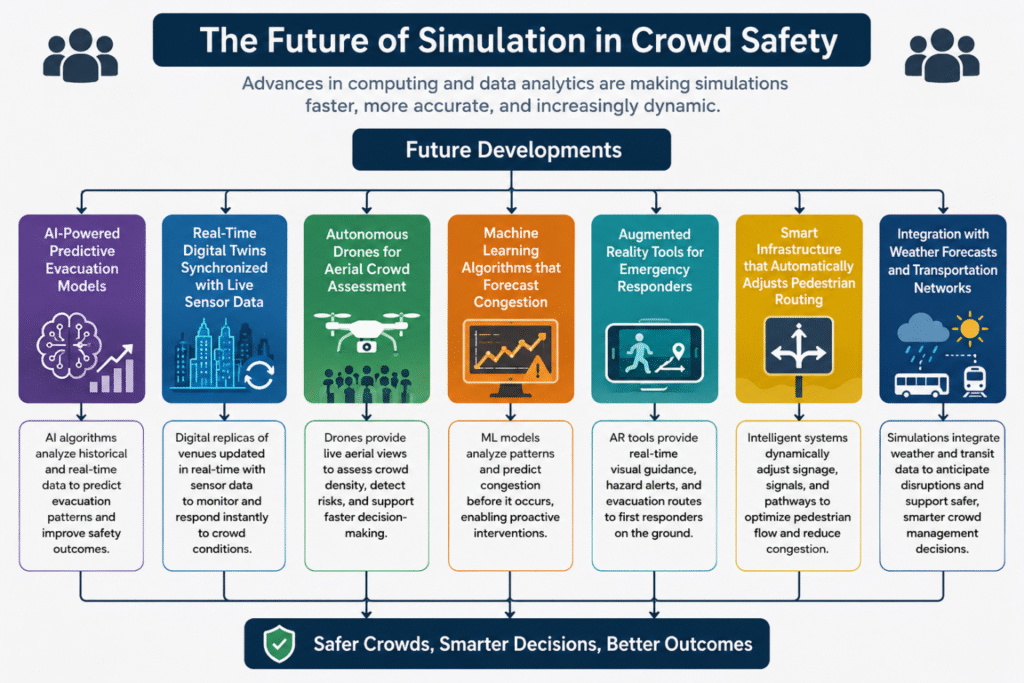
Modern crowd disaster prevention increasingly relies on advanced technologies that combine simulation, real-time monitoring, and predictive analytics. Artificial intelligence analyzes crowd behavior and identifies potential risks before they become critical, while digital twin models create virtual replicas of venues for continuous monitoring and management of crowd movement. IoT occupancy sensors provide accurate crowd density information, computer vision and CCTV analytics detect unusual movement patterns, and drone-based monitoring offers broader visibility across large gatherings.
Wearable communication devices improve coordination among event staff, while dynamic digital signage and automated alert systems deliver timely guidance as conditions change. Together, these technologies support proactive decision-making, strengthen emergency preparedness, and enable faster operational responses that help prevent crowd-related incidents.
Best Practices for Effective Crowd Disaster Prevention
Organizations can improve safety planning by following these best practices:
- Conduct crowd simulations during the design phase.
- Assess maximum safe occupancy instead of relying only on venue capacity.
- Evaluate multiple emergency scenarios.
- Identify and remove bottlenecks before the event begins.
- Train staff through simulation-based exercises.
- Monitor crowd density continuously during operations.
- Update plans using post-event data and lessons learned.
- Coordinate security, medical, and emergency services through a unified command structure.
- Keep attendees informed through clear signage and public announcements.
- Review crowd management plans regularly whenever venue layouts or event formats change.
Building Safer Events Through Predictive Planning
The success of any event depends not only on entertainment or attendance but also on the ability to keep every person inside the venue safe. Preventing crowd disasters requires a proactive approach that brings together engineering, operational planning, and advanced simulation technologies.
By modeling crowd behavior, identifying potential hazards, testing emergency scenarios, and evaluating engineering controls before an event takes place, simulation enables organizers to make informed safety decisions. As venues continue to grow in size and public gatherings become more complex, incorporating predictive simulation into event planning is no longer simply an added advantage—it has become an essential part of effective stampede prevention, safer infrastructure, and more resilient public spaces.
Book a free consultation for appointment
Email us at :grow@simbi.in
Frequently Asked Questions (FAQs)
1. What is crowd disaster prevention?
Crowd disaster prevention is the process of identifying and minimizing risks that could lead to crowd crushes, stampedes, or unsafe congestion. It combines careful planning, engineering controls, monitoring systems, and simulation to maintain public safety.
2. How does simulation help in stampede prevention?
Simulation recreates how people move through a venue during both normal operations and emergency situations. It identifies bottlenecks, predicts congestion, evaluates evacuation routes, and helps planners improve layouts before an event begins.
3. What causes most crowd disasters?
Most crowd disasters occur because of excessive crowd density, blocked exits, poor venue design, inadequate crowd management, and communication failures rather than panic alone. Careful planning and early risk assessment can significantly reduce these dangers.
4. Which events benefit most from crowd simulation?
Large concerts, sporting events, religious gatherings, festivals, airports, railway stations, shopping malls, convention centers, and public celebrations benefit the most because they involve complex pedestrian movement and large numbers of people.
5. Can crowd simulation improve emergency evacuation planning?
Yes. Crowd simulation allows organizers to evaluate fires, medical emergencies, security threats, and severe weather scenarios in a virtual environment, helping optimize evacuation routes, staffing levels, and emergency response times without placing people at risk.