
How NetLogo Crowd Evacuation Planning Can Improve Emergency Exit Design

An emergency evacuation plan is an important component of the safety of public spaces. The ability to evacuate large quantities within a reasonable time to a safe area is a requirement for stadiums, exhibition halls, shopping centres, transport terminals and other high occupancy buildings. An important planning question is: How many emergency exits are needed and how wide are they to be for a given occupancy?
This can be answered with the help of Crowd Evacuation Planning (CEP) with the aid of simulation. Rather than using only fixed assumptions or just considering one configuration, simulation can help planners and researchers determine the size of the crowd, how many emergency exits and exit widths should be used in a facility or event configuration before the final configuration is determined.
READ MORE: How to Validate a NetLogo Crowd Evacuation Model
Why Crowd Evacuation Planning Needs Simulation
It is difficult to study experimental emergency evacuations. The full-scale evacuation drills require a great deal of resources, are disruptive, and may not allow for a large variety of scenarios to be tested. They can also not reproduce the pattern of congestion that develops when hundreds or thousands of people are moving to the same exit.
Another way is to use Agent-Based Modeling. Every individual is represented as their own agent navigating through an environment that is simulated. Many agents can create crowd level effects, like congestion or bottlenecks. This blog is based on the study that created an 80 × 80 m public exhibition hall NetLogo Simulation. Visitors were represented by autonomous agents which detected any nearby emergency exits, moved towards them and ignored the presence of other agents. The model focused on the relationship between the number of occupants and the ability to leave the building. Testing Crowd Size and Emergency Exit Capacity
In the simulation, the following variables were considered: number of exits, width of the exit, and crowd size. Crowd sizes of 500, 1,000 and 2,000 visitors were tested. The exits were from one to four and the exit widths were 2 m, 4 m and 6 m.From these combinations 36 evacuation scenarios were generated. Because agent-based simulations can vary according to the initial location of agents, each scenario was repeated 30 times with different random seeds. Overall, 1,080 simulations were run with NetLogo BehaviorSpace.This experimentation design enables study of individual effects as well as interactions. A wider exit can help alleviate congestion (and the larger the crowd, the more exits the better), but the advantages can vary depending on the number of people and exits.

What Did the NetLogo Simulation Show?
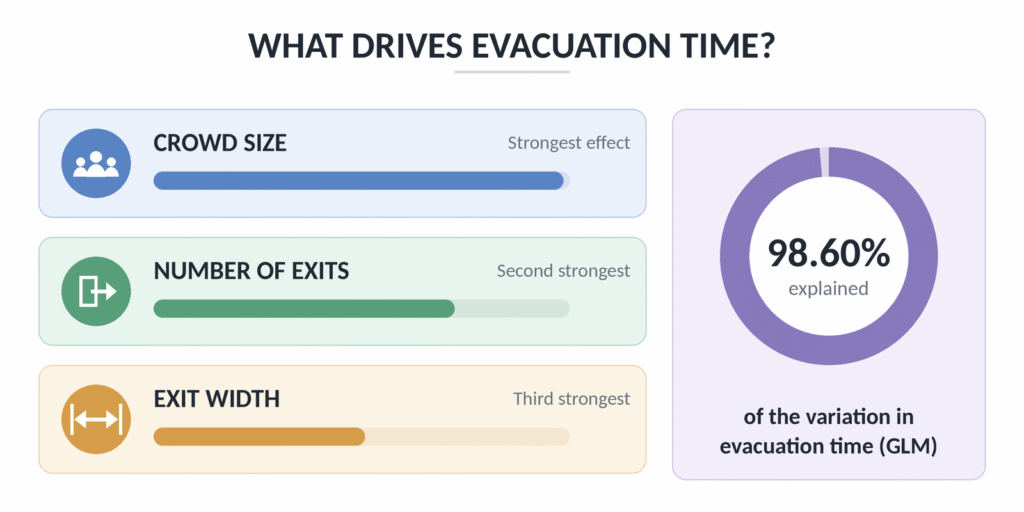
Evacuation time generally increased with the number of people, but reducing the number of exits and widening the exits decreased the evacuation time. The results revealed that, according to GLM, crowd size, number of exits, and width of the exit had significant effects on evacuation time. The most significant factor was the number of persons in the crowd, followed by number of exits and width of exit. The model explained 98.60% variation from the observed evacuation time, with the selected factors accounting for the majority of the variation.
The results also suggest a key planning lesson. Multiple exits can be more effective than widening existing exits as they spread out pedestrian traffic at several points and may help alleviate congestion at any one point.
Moving Beyond the Fastest Evacuation
The Crowd Evacuation Capacity Planning (CECP) framework is one of the contributions of the study.
Traditional optimization often asks:
Which exit configuration produces the shortest evacuation time?
CECP asks a more practical question:
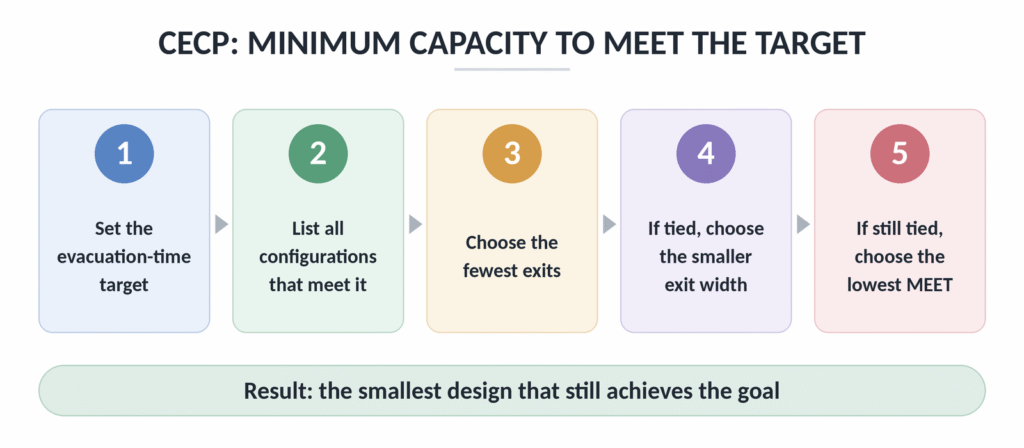
“What is the minimum Emergency Exit Capacity required to meet a specific evacuation-time target?”
The framework establishes a list of all the configurations that achieve this required target and then chooses the configuration with the minimum number of exits. Where multiple configurations use the same number of exits, the smaller exit width would be preferred. If still alternatives exist, then the one with the minimal MEET is chosen.This method relates simulation to real facility planning by not recommending unnecessary facilities if a smaller configuration will achieve the evacuation objective.
Practical Results for 14, 22 and 28 Minutes
The minimum design for 500 visitors for a 14 minute evacuation was determined to be two 4 m exits, with a mean evacuation time of about 12.54 minutes. There were 4 4 m exits for 1,000 visitors. All tested configurations failed to evacuate 2000 visitors in 14 minutes.
The two required exits were 2 m for 500 visitors and 2 x 6 m for 1,000 visitors, and 4 x 6 m for 2,000 visitors.
The 28 minutes target was recommended to have one 4 m exit for 500 visitors, two 4 m exits for 1000 visitors and four 4 m exits for 2000 visitors.
These results show that Emergency Exit Capacity has to be viewed in conjunction with other variables, such as occupancy and evacuation-performance goals. What works for 500 persons does not necessarily work for 2,000 persons.
How NetLogo Simulation Can Support Emergency Planning
NetLogo Simulation enables researchers and planners to model individual evacuation flows and gain insight into evacuation outcomes. Additionally, BehaviorSpace can run repeated experiments with different numbers of people and different numbers and widths of exits.
Simulations can be used in the design phase to compare exit-capacity alternatives offered by architects. Facility managers can determine if there is still an acceptable occupancy for the current exits. Event organizers may compare the number of persons they expect at the event against the number of evacuation facilities available, and/or emergency planners can check whether the evacuation-time goals set for the event are attainable.
This also helps with valuable “what if” analysis. If it is not possible to meet a specific evacuation target, planners can explore other options such as increasing the number of ways to evacuate, widening exits, decreasing the number of people in a space, or changing another aspect of the evacuation plan.
This makes Evacuation Time Optimization more than just a technical exercise and moves it into the realm of decision support process.
Why does Simbi Labs Provide This Service?
Many questions of safety and planning cannot be well answered by a single calculation or a single real world trial – so Simbi Labs offers support with simulation based research and analytics. Organisations might need to consider a number of occupancy and exit scenarios before a choice can be made, and researchers may want to have a repeatable method of testing assumptions and clearly explain results.
The aim of the service is to transform a practical question into a structured model and then to convert the findings into evidence that is easily understood. This may range from scenario design, NetLogo AgentBased Modelling, repeated experiments in the BehaviourSpace, statistical analysis, interpretation, visualisation and research ready reporting, depending on the project. This enables clients to compare different options, like adding exits, widening exits, changing occupancy etc., before making a costly or safety critical decision.
The value for Simbi Labs of crowd evacuation simulation is not just the production of computer model. It is about informing architects, facility managers, event organizers, emergency planners and researchers about what is involved in making a safety decision and how to articulate that information.
Local building codes, fire-safety regulations and qualified professional judgement are valid ways of meeting the requirement and should be used in conjunction with simulation. This kind of analysis contributes to decision support and research evidence to help make planning decisions more informed, transparent and evidence-based.
Important Limitations
The model presented here is designed to be a simplified representation of real evacuation behaviour. The visitors start to evacuate immediately, they are aware of the location of the exits, they move at the same speed and they act calmly. This does not include obstacles, mobility impairments, changes in routes or environmental hazards.These assumptions allow for the decoupling of the effect of exit capacity, but should be treated as supporting data for decision making purposes, not as mandatory building code requirements. Future development may include variations in walking speed, mobility constraint, obstacles, dynamic routing and variations in emergency conditions and actual building layout. The framework for smart-building emergency management can be further extended with real-time technologies to monitor and optimise the occupancy.
Conclusion
The key to successful Crowd Evacuation Planning is not just to evacuate as quickly as possible. It is also a matter of determining a minimum infrastructure necessary to meet a defined safety objective.Agent Based Modeling, NetLogo Simulation and Crowd Evacuation Capacity Planning can be integrated to link occupancy conditions with measurable Emergency Exit Capacity requirements. The study establishes that crowd size, number of exits and the width of exits are all factors affecting evacuation performance. For architects, facility managers, event planners, and emergency planners, simulation-based capacity planning enables a structured approach to balancing public safety, occupancy and infrastructure needs while creating an evidence-based Emergency Evacuation Planning.
Book a free consultation for appointment
Email us at : grow@simbi.in
Frequently Asked Questions
1. What is Crowd Evacuation Planning?
Crowd Evacuation Planning involves analysing how people can move safely and efficiently from a crowded facility or public space to designated safe areas during an emergency. It can include evaluating occupancy, exit capacity, pedestrian movement and potential congestion.
2. How can NetLogo be used for evacuation simulation?
NetLogo can represent individual people as autonomous agents and simulate their movement through a defined environment. Researchers can then examine how changes in crowd size, exit numbers, exit width and other variables affect evacuation outcomes.
3.What is Agent-Based Modeling in crowd evacuation?
Agent-Based Modeling represents individuals as separate agents with defined behaviours and movement rules. Interactions among these agents can produce collective patterns such as congestion, bottlenecks and changes in evacuation time.
4. Can evacuation simulation determine the required number of emergency exits?
Simulation can help compare different exit configurations under defined assumptions and evacuation-time targets. However, simulation results should not be treated as a substitute for applicable building codes, fire-safety regulations or qualified professional assessment.
5.How can Simbi Labs support a crowd evacuation simulation project?
Simbi Labs supports research and simulation projects involving NetLogo Agent-Based Modeling, scenario design, statistical analysis, simulation experiments, visualisation and research-ready reporting. These services can help researchers and organisations evaluate complex scenarios and communicate their findings clearly.