
How to Avoid Overstocking and Stockouts in Manufacturing

In manufacturing, inventory management is a constant balancing act. Carry too much stock, and you tie up capital, waste warehouse space, and risk items becoming obsolete. Keep too little, and production grinds to a halt, orders are delayed, and customers lose confidence.
Striking the right balance between overstocking and stockouts isn’t just about counting items — it’s about predicting needs, managing supplier performance, and responding quickly to changes in demand or supply.
Read Also : Inventory Control in Textile Manufacturing
Why Getting Inventory Right Matters
For many manufacturers, inventory accounts for a large share of total costs. Poor inventory control leads to:
1. Wasted capital that could be reinvested elsewhere in the business.
2. Higher operational expenses from excess handling, storage, and insurance.
3. Production disruptions that can cascade into late deliveries and lost business.
Managing stock effectively means aligning procurement, production, and sales so materials arrive just in time — not too early, not too late.
What are the Causes of Overstocking & Stockouts
1. Inaccurate demand forecasting.
2. Supplier unreliability.
3. Poor internal communication between sales and production.
4. Long lead times and import delays.
5. Sudden market changes.
What are the Risks of Overstocking
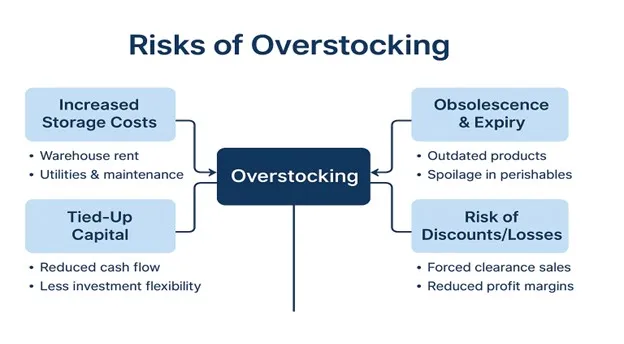
1. Increased Holding Costs
Warehouses aren’t free. Beyond rent or depreciation, you pay for lighting, climate control, handling, insurance, and security. Extra stock inflates these costs unnecessarily.
2. Product Obsolescence
In fast-moving industries like electronics or fashion, overstock quickly becomes outdated. Even in slower markets, changes in specifications can render old materials unusable.
3. Tied-Up Caapital
Money locked into unsold stock is money unavailable for new equipment, skilled labor, or product innovation.
4. Shrinkage and Damage
The longer items sit in storage, the higher the risk of loss through theft, misplacement, or damage.
What are the Risks of Stockouts
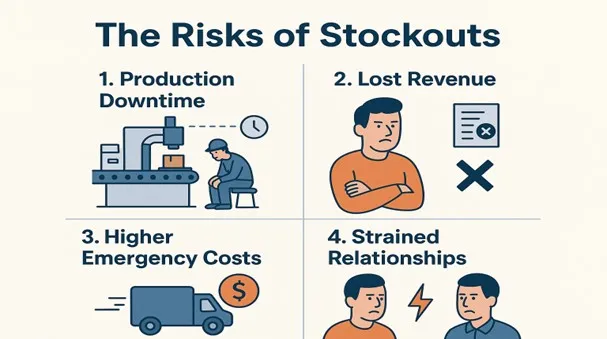
1. Production Downtime
If a critical part isn’t available, machines sit idle, workers wait, and delivery schedules fall apart.
2. Lost Revenue
A stockout can mean unfilled orders — and sometimes the customer doesn’t come back.
3. Higher Emergency Costs
Last-minute purchases often come with premium pricing and expensive expedited shipping.
4. Strained Relationships
Frequent shortages frustrate customers and stress supplier relationships.
How to Avoid Both Extremes
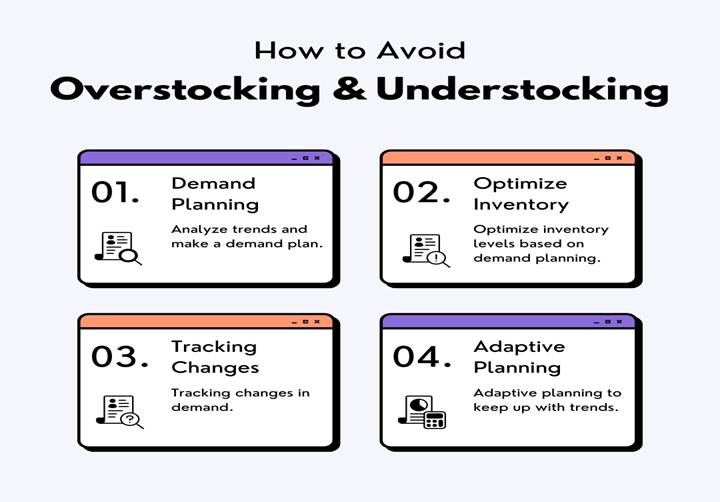
1. Improve Demand Forecasting
i. Use at least 12 months of historical sales and production data.
ii. Factor in seasonal peaks, product launches, and market trends.
iii. Review forecasts monthly so you can adjust quickly when conditions change.
Example: A manufacturer of auto parts increases production of brake pads every October because demand always peaks in winter months.
2. Set Accurate Reorder Points
i. Formula: Reorder Point = (Average Daily Usage × Lead Time) + Safety Stock.
ii. Review lead times regularly — if suppliers slow down, your reorder point needs to change.
3. Maintain Safety Stock — But Be Selective
i. Safety stock is a buffer, not a storage room.
ii. Reserve it for high-risk materials — those with unpredictable demand, long lead times, or single-source suppliers.
4. Strengthen Supplier Relationships
i. Share your forecasts so suppliers can prepare for fluctuations.
ii. Negotiate flexible delivery schedules or partial shipments to reduce overstock risk.
iii. Have backup suppliers for critical components.
5. Use Real-Time Tracking Tools
i. Implement barcode scanning or RFID tagging to update inventory instantly.
ii. Integrate ERP and warehouse management systems so all departments see the same numbers.
iii. Use dashboards to monitor low-stock alerts in real time.
6. Review and Adjust Regularly
i. Schedule monthly or quarterly inventory reviews.
ii. Compare actual demand to your forecasts and adjust ordering patterns accordingly.
iii. Identify slow-moving items and reduce reorder quantities to prevent overstock.
Read More : Reducing Textile Waste with Lean Manufacturing Principles
Techniques for Smarter Inventory Control
1. ABC Analysis: Classify items by value and importance. Give high-value, critical parts (A items) the most attention.
2. Just-In-Time (JIT) Inventory: Receive goods only as they are needed in production to reduce holding costs.
3. Vendor-Managed Inventory (VMI): Allow suppliers to monitor and replenish your stock based on agreed targets.
4. Cycle Counting: Check inventory accuracy regularly without waiting for an annual count.
What are the statistical and mathematical techniques you can use on avoiding overstocking and stockouts in manufacturing ?
| Technique | Purpose | Formula | Key Notes for Manufacturing |
| Moving Average | Smooths demand fluctuations over a set period | Forecast = (Sum of demand over past n periods) ÷ n | Good for stable demand; ignores recent demand spikes |
| Weighted Moving Average | Gives more weight to recent demand | Forecast = (Σ Demand × Weight) ÷ (Σ Weights) | Useful when recent demand trends matter more |
| Exponential Smoothing | Forecasts next period’s demand with recent data influence | Fₜ₊₁ = αDₜ + (1 − α)Fₜ | α = smoothing constant (0–1); higher α reacts faster to changes |
| Safety Stock Calculation | Maintains buffer against uncertainty | Safety Stock = Z × σᵈ × √Lead Time | Z = service level factor; σᵈ = standard deviation of demand |
| Reorder Point (ROP) | Ensures orders arrive before stockouts | ROP = (Average Daily Demand × Lead Time) + Safety Stock | Adjust for supplier delays or demand surges |
| ABC Analysis | Categorizes inventory by value & importance | No fixed formula — based on Pareto principle | Tight control for ‘A’ items, relaxed for ‘C’ items |
| Economic Order Quantity (EOQ) | Minimizes total inventory cost | EOQ = √(2DS ÷ H) | D = annual demand, S = ordering cost/order, H = holding cost/unit/year |
| Service Level Optimization | Balances cost of stockouts vs. holding cost | Uses probability distribution models | Helps decide optimal safety stock for desired fill rate |
| Trend & Seasonality Analysis | Adjusts forecasts for patterns | Regression or time-series decomposition | Ideal for seasonal manufacturing cycles |
Conclusion
Balancing stock levels is essential to keeping production smooth and costs under control. By using accurate forecasting, proven techniques, and strong supplier coordination, manufacturers can avoid both overstocking and stockouts. Proactive inventory management not only saves money but also builds resilience and customer trust.
For an in-depth understanding, please refer to our book, “Academic Research Fundamentals: Research Writing and Data Analysis”. It is available as an eBook here, or you may purchase the hardcopy here .