
Crowd Flow Analysis Pedestrian Movement in Public Spaces
Every day, millions of people pass through airports, metro stations, shopping malls, hospitals, educational campuses, and commercial districts, expecting a smooth and hassle-free experience. Behind this seamless movement lies careful planning that determines how people walk, queue, interact, and navigate shared spaces. However, when pedestrian circulation is not properly managed, even well-designed facilities can experience congestion, longer waiting times, operational inefficiencies, and reduced visitor satisfaction.
Unlike vehicle traffic, pedestrian movement is dynamic and influenced by individual behaviour, crowd density, environmental conditions, and facility layout. This is why Crowd Flow Analysis has become an essential planning and operational tool for modern infrastructure. By analysing movement patterns, identifying congestion hotspots, and evaluating circulation efficiency, engineers can optimise pedestrian routes, improve wayfinding, and enhance the overall user experience. Instead of asking, “How many people can this space accommodate?”, today’s planners focus on a more important question: “How can people move through this space with the least possible delay, conflict, and congestion?” This data-driven approach enables architects, transportation authorities, and facility managers to create safer, more efficient, and people-centric public spaces.
Figure 1: Intelligent Pedestrian Flow in a Modern Public Space
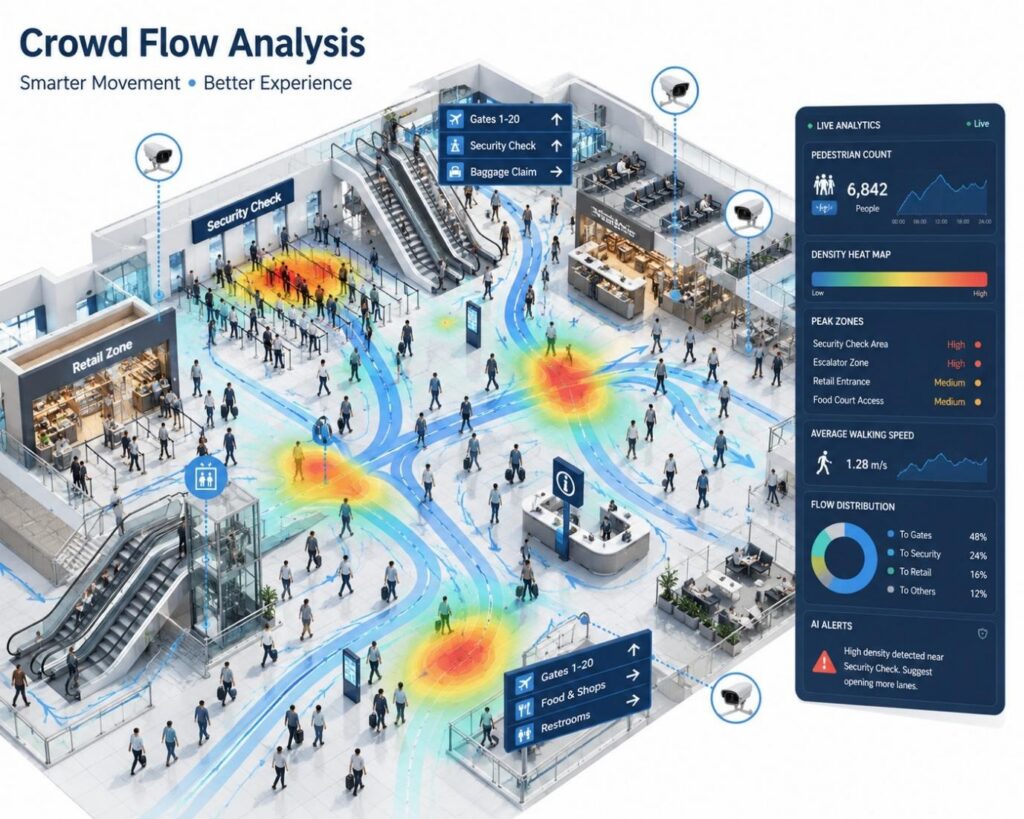
Beyond Walking: Understanding How People Navigate Public Spaces
Pedestrian movement is influenced by much more than corridor width or the number of available exits. Every person constantly responds to their surroundings, making countless small decisions that collectively shape the movement of a crowd. Factors such as visibility, personal space, destination, obstacles, signage, waiting times, and nearby pedestrian density all affect the routes people choose.
For example, two corridors with the same width may perform very differently if one offers better visibility or more intuitive wayfinding. Likewise, passengers often follow the behaviour of those around them instead of choosing the shortest route, particularly in unfamiliar places such as airports, railway stations, or metro systems.
Crowd Flow Analysis examines these behavioural interactions to understand why pedestrian movement slows and where improvements can be made. Rather than relying solely on assumptions or experience, engineers assess circulation using measurable performance indicators that reveal how effectively a space functions throughout the day.
Some of the key questions engineers investigate include:
- Which areas experience recurring pedestrian congestion?
- Where do opposing walking directions create movement conflicts?
- How efficiently are corridors, escalators, and entrances being utilized?
- Which circulation routes remain underused?
- How do retail layouts, information displays, or security checkpoints influence pedestrian behaviour?
- Can operational improvements reduce congestion without changing the building structure?
Answering these questions helps planners improve both the visitor experience and operational performance while avoiding unnecessary infrastructure costs.
Reading the Language of Pedestrian Movement
Unlike traditional occupancy counts, Crowd Flow Analysis focuses on how people move rather than simply how many people occupy a space. Engineers study movement patterns using a combination of observational surveys, digital models, sensor data, and simulation platforms to better understand the relationship between pedestrian behaviour and facility performance.
The analysis typically evaluates several important movement characteristics:
- Pedestrian Flow Rate – The number of people passing through a specific location during a given period.
- Walking Speed Distribution – Differences in walking speed caused by crowd density, age groups, luggage, or environmental conditions.
- Crowd Density – The concentration of pedestrians within a defined area, commonly measured as people per square metre.
- Directional Flow – The interaction between pedestrians travelling in the same or opposite directions.
- Queue Formation – The creation and growth of waiting lines around service points.
- Travel Time – The time required for pedestrians to move between key destinations.
- Level of Service (LOS) – An internationally recognised measure used to evaluate pedestrian comfort, available walking space, and overall circulation quality.
Together, these indicators provide a comprehensive understanding of how efficiently a public space supports pedestrian movement under different operating conditions.
Imagine This: Why One Airport Terminal Felt More Crowded Than Another
During the morning departure rush, two airport terminals process nearly the same number of passengers. Surprisingly, Terminal A receives regular complaints about long walking distances, overcrowded security areas, and confusing passenger circulation, while Terminal B—with similar passenger volumes—operates much more efficiently.
Airport planners initially believe that expanding the terminal is the best solution. Before committing to an expensive construction project, however, they conduct a Crowd Flow Analysis using MassMotion to evaluate passenger movement from terminal entrances to boarding gates. The results are then analysed in PTV Viswalk, allowing engineers to examine queue interactions, pedestrian conflicts, and circulation efficiency during peak travel periods.
The analysis reveals that the problem is not a lack of terminal capacity. Instead, several operational factors are contributing to congestion:
- Security screening queues extend into primary circulation corridors.
- Flight information displays encourage passengers to stop near busy intersections.
- Retail kiosks unintentionally reduce the width of important pedestrian pathways.
- Most passengers naturally choose the most visible security checkpoint, leaving others underutilized.
Instead of expanding the terminal, airport management introduces dynamic wayfinding, redistributes security staff during peak travel periods, redesigns queue barriers, and adjusts retail layouts to create clearer circulation routes. These practical operational improvements significantly enhance pedestrian movement while avoiding costly structural modifications.
This example demonstrates that effective Crowd Flow Analysis is driven by operational intelligence rather than physical infrastructure alone.
Engineering Insight
A common assumption is that increasing floor space automatically improves pedestrian circulation. In reality, movement efficiency depends far more on how people interact with the environment than on the size of the facility itself. Well-designed wayfinding systems, queue layouts, decision points, and service locations often deliver greater improvements than widening corridors or constructing additional entrances.
Software That Powers Modern Crowd Flow Analysis
Today’s pedestrian movement studies combine engineering expertise with advanced analytical software to evaluate how people move under a wide range of operational conditions.
| Software | Primary Application |
| MassMotion | Simulates pedestrian movement, passenger circulation, and crowd behaviour in airports, metro stations, commercial complexes, and public venues. |
| PTV Viswalk | Analyses pedestrian interactions, multimodal transportation hubs, urban walkways, and crossing behaviour to optimise circulation. |
| Legion | Models high-density passenger movement within airports, railway stations, stadiums, and event venues while evaluating operational efficiency. |
| AnyLogic | Integrates pedestrian movement with vehicles, logistics, and operational systems for smart cities and complex infrastructure projects. |
| SimWalk | Supports pedestrian flow analysis, transportation planning, and large-scale circulation studies with realistic behavioural modelling. |
Rather than relying on a single software platform, engineers frequently compare multiple simulation scenarios to understand how layout changes, operational policies, or varying pedestrian volumes influence movement performance. This integrated approach enables data-driven decisions that improve circulation while maintaining safety and user comfort.
Measuring the Quality of Movement: Why Level of Service (LOS) Matters
Not all crowded spaces perform poorly, and not all lightly occupied spaces function efficiently. Two metro stations may handle similar passenger volumes, yet one allows commuters to move comfortably while the other experiences frequent bottlenecks, delays, and pedestrian conflicts. The difference often lies in the quality of movement, which engineers evaluate using Pedestrian Level of Service (LOS).
Originally developed by transportation engineer John J. Fruin, the Level of Service (LOS) framework provides a standardized method for measuring pedestrian comfort, freedom of movement, and operational efficiency. Rather than focusing solely on the number of people in a space, LOS evaluates how easily pedestrians can move under different crowd conditions.
For engineers, LOS serves as an important performance indicator during the planning, design, and operation of public infrastructure. It helps determine whether a corridor is functioning efficiently, whether waiting areas are becoming overcrowded, or whether circulation routes require redesign before they begin affecting visitor experience.
As pedestrian density increases, walking speeds gradually decrease, personal space becomes limited, and movement conflicts become more frequent. By continuously monitoring these changes, engineers can identify the point at which normal circulation begins to deteriorate and implement corrective measures before congestion becomes a serious operational issue.
Table 1. Pedestrian Level of Service (LOS) Classification
| Level of Service | Pedestrian Condition | Typical Characteristics | Operational Recommendation |
| LOS A | Free Flow | Comfortable walking, unrestricted movement, excellent visibility | Maintain current layout and monitor demand |
| LOS B | Stable Flow | Minor interactions between pedestrians | Continue monitoring during peak periods |
| LOS C | Moderate Flow | Reduced personal space, occasional speed adjustments | Improve wayfinding and corridor management |
| LOS D | Restricted Flow | Frequent interactions and slower walking speeds | Evaluate circulation routes and queue layouts |
| LOS E | Congested Flow | Limited movement and significant delays | Introduce operational improvements and redistribute pedestrian traffic |
| LOS F | Breakdown Flow | Stop-and-go movement with severe congestion | Immediate intervention through crowd management strategies and circulation redesign |
Understanding LOS enables facility managers to move beyond subjective observations and make evidence-based decisions that improve both operational performance and visitor comfort.
Turning Movement Data into Better Design Decisions
Collecting pedestrian data is only valuable when it leads to informed planning decisions. After analysing movement patterns, engineers interpret the results to determine why congestion occurs, where circulation can be improved, and which operational changes will have the greatest impact.
Rather than immediately recommending expensive infrastructure expansion, crowd flow analysis often reveals that relatively small adjustments can significantly improve pedestrian movement.
Typical recommendations include:
- Repositioning digital information displays away from busy intersections.
- Redesigning queue barriers to prevent spillback into circulation corridors.
- Introducing dynamic wayfinding during peak operating hours.
- Redistributing security or service staff based on pedestrian demand.
- Modifying retail layouts to create wider pedestrian pathways.
- Adjusting escalator directions during high-demand periods.
- Optimising entry and exit gate allocation to balance pedestrian distribution.
These improvements not only reduce congestion but also enhance visitor satisfaction, improve accessibility, and increase the operational efficiency of the entire facility.
Planner’s Checklist
Before implementing major infrastructure changes, engineers typically ask:
- Are congestion hotspots consistent throughout the day or only during peak periods?
- Which pedestrian routes experience the highest demand?
- Are queues interfering with normal circulation?
- Can improved signage reduce unnecessary pedestrian conflicts?
- Are all entrances and exits being used efficiently?
- Would operational changes solve the problem before structural modifications are considered?
Answering these questions helps organizations prioritise cost-effective solutions while maintaining safe and efficient pedestrian movement.
Turning Movement Data into Better Design Decisions
Collecting pedestrian movement data is valuable only when it supports better planning and decision-making. After analysing movement patterns, engineers interpret the findings to understand why congestion develops, where circulation can be improved, and which operational changes will deliver the greatest benefits.
Instead of immediately recommending costly infrastructure expansion, Crowd Flow Analysis often shows that relatively small operational adjustments can produce significant improvements in pedestrian movement.
Typical recommendations include:
- Repositioning digital information displays away from busy intersections.
- Redesigning queue barriers to prevent spillback into circulation corridors.
- Introducing dynamic wayfinding during peak operating hours.
- Redistributing security or service staff based on pedestrian demand.
- Modifying retail layouts to create wider pedestrian pathways.
- Adjusting escalator directions during periods of high demand.
- Optimizing entry and exit gate allocation to achieve a more balanced pedestrian distribution.
These improvements not only reduce congestion but also enhance the visitor experience, improve accessibility, and increase the overall operational efficiency of the facility.
Planner’s Checklist
Before introducing major infrastructure changes, engineers typically consider the following questions:
- Are congestion hotspots present throughout the day or only during peak periods?
- Which pedestrian routes experience the highest demand?
- Are queues disrupting normal pedestrian circulation?
- Can improved signage reduce unnecessary pedestrian conflicts?
- Are all entrances and exits being used efficiently?
- Could operational improvements resolve the issue before structural modifications are considered?
Answering these questions helps organizations identify cost-effective solutions while maintaining safe, efficient, and reliable pedestrian movement.
Figure 2: Operational Pedestrian Flow Intelligence Map
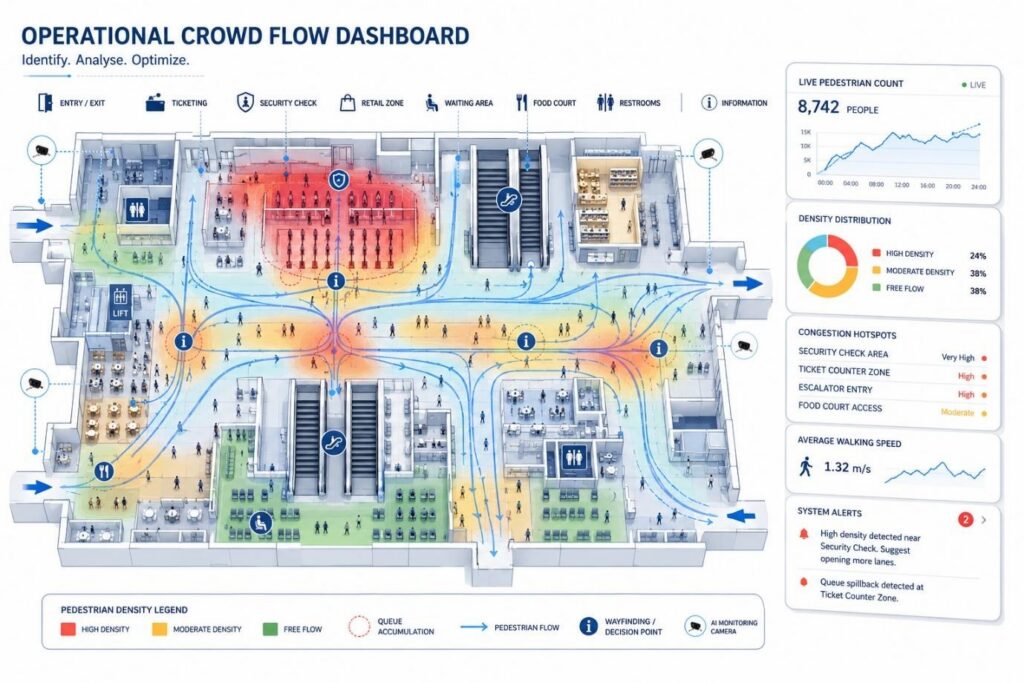
Figure 3: Pedestrian Flow Optimization Framework
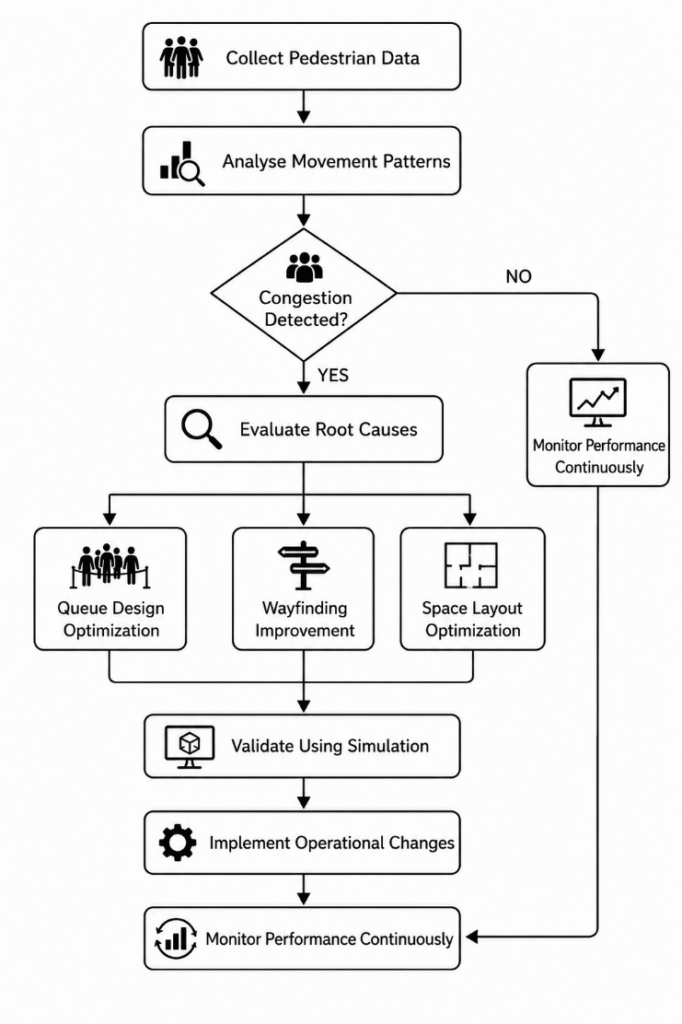
Unlike traditional workflows, this framework illustrates how engineering decisions evolve from data collection through continuous operational improvement.
How Simbi Labs India Helps Improve Crowd Movement
At Simbi Labs India, we help airports, metro systems, commercial developments, public venues, event organisers, and infrastructure projects improve pedestrian movement through our Crowd Management as a Service (CMaaS) solutions. Our team works closely with clients to understand pedestrian movement patterns, identify congestion hotspots, assess crowd-related risks, and develop practical strategies that enhance circulation and operational preparedness. By combining crowd analytics, predictive assessments, real-time monitoring, and crowd management planning, we enable organizations to make informed decisions that improve the visitor experience while supporting safer and more efficient movement in high-footfall environments.
Looking Ahead: The Future of Crowd Flow Analysis
Crowd Flow Analysis is evolving far beyond traditional planning studies. Advances in AI-powered video analytics, IoT sensors, Digital Twin technology, and real-time operational dashboards now allow facility managers to monitor pedestrian movement continuously instead of relying only on periodic assessments. These technologies help organizations detect congestion at an earlier stage, optimize circulation dynamically, and make proactive decisions that improve both operational performance and public safety.
As cities become smarter and public infrastructure continues to grow in complexity, Crowd Flow Analysis will play an increasingly important role in creating environments that are efficient, resilient, and designed around the needs of people.
Looking to improve pedestrian movement in your airport, metro station, shopping mall, public venue, or infrastructure project? Simbi Labs India provides data-driven movement analysis, crowd analytics, predictive planning, and operational strategies that help organizations strengthen crowd management, improve circulation, and create safer public spaces.
Book a free consultation for appointment
Email us at :grow@simbi.in