
Temple and Pilgrimage Crowd Management: Using Simulation to Prevent Stampedes
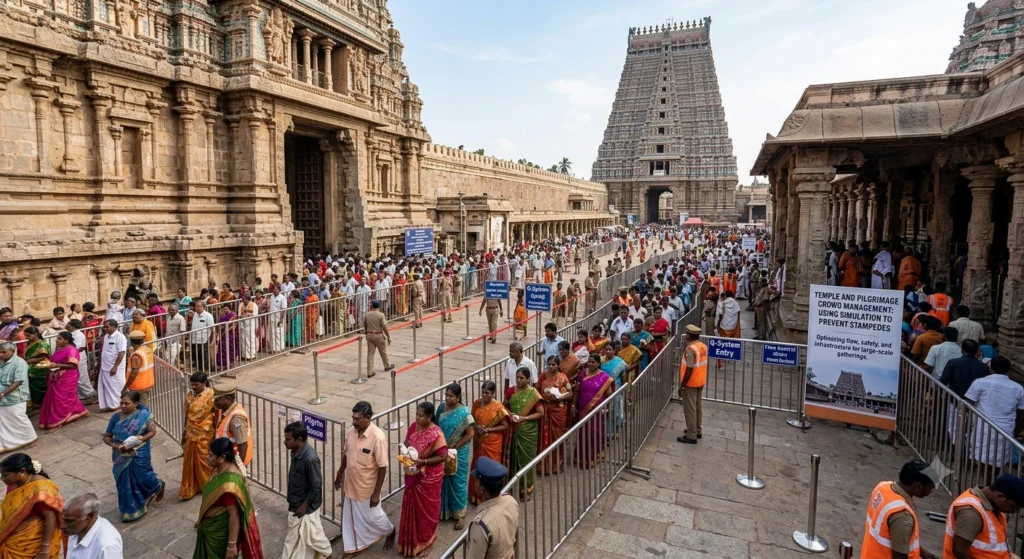
Millions of Devotees. One Shared Goal. One Critical Responsibility.
Every year, millions of pilgrims visit temples and visited sites in search of spiritual bliss. From the annual yatra to a hill shrine to a big festival at a well-known temple to a special religious ceremony, such events unite people of all ages and physical handicaps in a comparatively small space.
Pilgrims also do not walk around, like spectators at a sports event or shoppers in a shopping mall, but go with their whole heart. Many would like to visit the sanctum at the earliest opportunity to stay longer for darshan or groups of family. These natural behaviors, combined with narrow pathways, uneven terrain and limited entry points, can result in some incredibly high crowd densities. Most of the tragic events that have occurred at religious institutions involving crowds are not only based on panic. These can be caused by non-managed congestion, poor routing, lack of communication, or any one of a number of potential bottle necks that could have been identified in advance.
History has shown that most crowd-related tragedies at religious sites are not caused by panic alone. They are often the result of unmanaged congestion, poor route planning, inadequate communication, or bottlenecks that could have been identified in advance.
The importance of employing specific crowd management techniques at pilgrimage sites.The need for special crowd management at pilgrimage sites. The management of people at religious locations is quite a bit different than the management of people in commercial settings.
Why Pilgrimage Sites Require Specialized Crowd Management
Managing crowds at religious sites is fundamentally different from managing crowds in commercial venues.
Pilgrimage locations often have unique challenges such as:
- Fixed darshan routes that cannot be changed easily
- Narrow corridors and historic structures
- Seasonal surges during festivals
- Pilgrims arriving continuously over many hours or days
- Elderly visitors and families with children
- Limited space for queue expansion
- Multiple entry and exit routes converging near the sanctum
These factors make careful planning essential to ensure both a meaningful spiritual experience and public safety.
READ ALSO: Hospital Evacuation Planning
Understanding the Pilgrim Journey
Every stage of a pilgrim’s visit influences overall crowd movement.
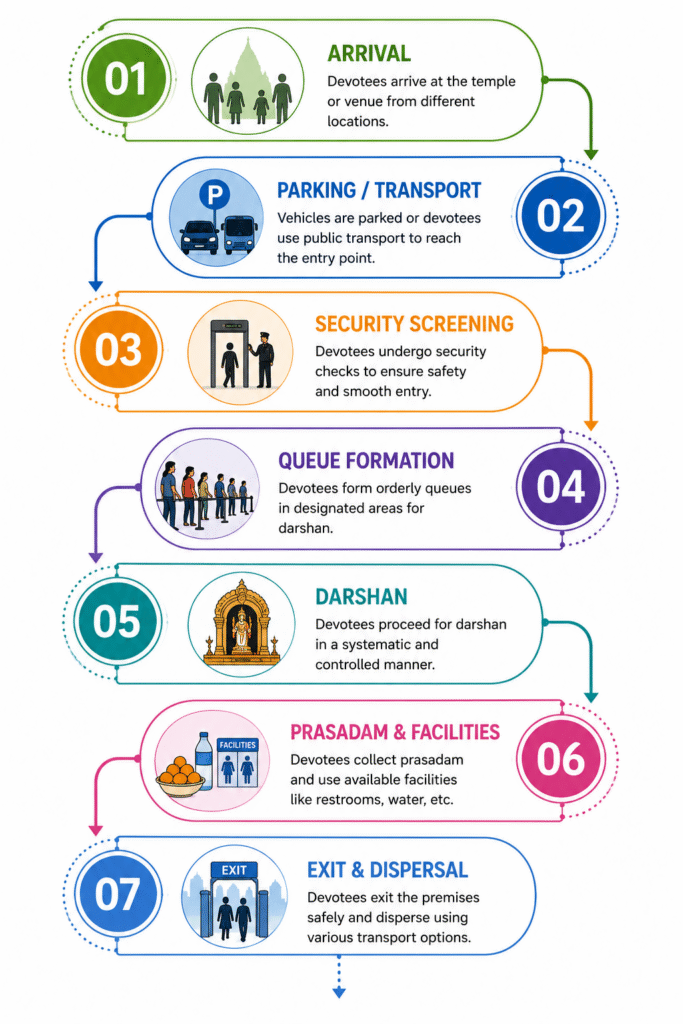
Even a short delay at one stage can affect the entire flow of pilgrims.
Where Congestion Usually Begins
Crowd congestion at temples rarely develops in a single location. It often builds gradually as movement slows at key points.
The most common congestion areas include:
Temple Entrances
Security checks, ticket verification, and baggage screening can slow incoming visitors during peak periods.
Darshan Queues
When devotees pause for longer than expected inside the sanctum, queues quickly extend into surrounding pathways.
Barricaded Corridors
Temporary barricades help organize movement but may also reduce walking capacity if not properly designed.
Prasadam Counters
Food distribution areas often attract large groups immediately after darshan, creating localized congestion.
Exit Routes
Visitors leaving the temple may intersect with incoming pilgrims, leading to unnecessary crowd conflicts.
Using Crowd Simulation Before Festivals
One of the greatest advantages of simulation is that it allows planners to test crowd behavior before the first devotee arrives.
By creating a digital model of the temple complex, engineers can simulate:
- Festival attendance
- Hourly arrival patterns
- Queue formation
- Darshan duration
- Walking speeds
- Barricade layouts
- Emergency evacuations
- Staff deployment
This enables authorities to compare different operational plans and select the safest option.
Four Key Areas Where Simulation Improves Pilgrimage Crowd Safety
1. Smarter Queue Management
Popular pilgrimage places often have long lines of people in the week leading up to festivals and weekends. Otherwise an area for waiting may become too cramped and too uncomfortable.
Crowd simulation can be used to estimate the number of pedestrians in a queue, the time spent in line, and the capacity of pedestrians in the queue as a function of the number of visitors. The police can also experiment with different queue formations, allocate time for darshan or redesign the waiting areas to facilitate movement. This has created a more streamlined and efficient experience for believers, and helped to prevent potential hazards of too many people in one location.
2. Better Darshan Planning
The most populated area in the temple is the sanctum. A mere difference in the time that each devotee takes during darshan can make a huge difference to the movement of thousands of devotees behind them.
Using simulation, planners can assess the effects of various darshan management approaches on the overall flow of crowds. Using the flow of visitors, their service times and the levels of occupancy by route, the authorities can tailor the service times and improve the progression of the queue, whilst maintaining the spirit of the services.
3. Effective Barricading and Route Design
Barricades are extensively utilized to arrange pilgrim movement, but their placement is a very delicate engineering process. Narrow passages, sharp turns and merging points caused by poorly-positioned barricades make roads more congested.
Crowd simulation enables planners to test various barricade setups, review configurations of workable corridors and understand places where pedestrians could queue up. This helps to create safer one-way traffic routes and reduce bottlenecks in advance of mass gatherings.
4. Emergency Response Preparedness
While it is accepted that no emergency should occur, the Temple has to be ready for any event such as fire or medical problems, extreme weather, structural issues or a sudden rush of people.
Crowd simulation can be used to create evacuation scenarios, predict clearances, define alternative evacuation routes and decide where the police, volunteers and medical staff can be deployed. Virtual practice helps to enhance coordination, and to make responses quicker and more effective during actual emergencies.
Practical Engineering Measures
In addition to simulation, there are a number of engineering and operational changes that are significant to improving Pilgrimage Crowd Safety.
| Challenge | Recommended Solution |
| Long darshan queues | Timed entry and digital token systems |
| Narrow pathways | One-way circulation planning |
| Merging crowd streams | Separate entry and exit routes |
| Poor visibility | Digital signage and public announcements |
| Congested waiting areas | Additional holding zones |
| Emergency evacuation | Clearly marked exits and refuge areas |
| Crowd monitoring | AI CCTV analytics and occupancy sensors |
Technology Supporting Modern Temple Crowd Management
Today, crowd safety combines traditional management practices with advanced digital technologies.
| Technology | Application |
| MassMotion | Pilgrim movement simulation |
| Pathfinder | Emergency evacuation analysis |
| AnyLogic | Large-scale operational simulation |
| GAMA Platform | Agent-based crowd behavior studies |
| NetLogo | Research and behavioral modeling |
| AI CCTV Analytics | Live crowd density monitoring |
| IoT Occupancy Sensors | Real-time visitor counting |
| GIS (ArcGIS / QGIS) | Spatial route planning |
| Digital Twin Platforms | Real-time pilgrimage management |
| Autodesk Revit (BIM) | Temple infrastructure modeling |
These technologies together enable authorities with predictive planning tools and real-time awareness.
Case Study: Managing Pilgrim Movement During the Kumbh Mela
The Kumbh Mela is one of the largest religious events in the world, which attracts millions of pilgrims for several weeks.
The Challenge
Authorities have to handle huge volumes of people on temporary and permanent infrastructure and ensure safe traffic flow to the bathing ghats, temples, and transport and accommodation centres.
The Solution
These GIS mapping, pedestrian flow analysis, AI-powered surveillance, drone monitoring, and crowd simulation tools are employed by planning agencies for studying movement patterns, optimizing barricade planning, designing one-way routes and coordinating emergency response. Temporary bridges, holding areas and dynamic route management strategies are also put in place according to the anticipated number of people.
The Outcome
The use of technology has enhanced the distribution of people, helped to alleviate congestion at key sites, bolstered emergency preparedness, and helped authorities make operational decisions in real time during one of the world’s biggest mass gatherings.
Best Practices for Temple Authorities
Good crowd control starts well before the festival starts.
Authorities should:
- Conduct crowd simulations for major festivals.
- Forecast visitor numbers using historical data.
- Introduce staggered or time-slot-based darshan where appropriate.
- Separate entry and exit routes wherever possible.
- Install AI-based crowd monitoring systems.
- Train volunteers and security personnel regularly.
- Coordinate with police, health services, and disaster management teams.
- Review operational plans after every major event and incorporate lessons learned.
The Future of Pilgrimage Crowd Safety
As pilgrimage destinations continue to attract larger numbers of devotees, technology will play an increasingly important role in ensuring safe and efficient operations.
Future developments include:
- AI-powered congestion prediction
- Digital twins of temple complexes
- Mobile apps providing live queue information
- Smart wearable devices for volunteer coordination
- Drone-assisted crowd monitoring
- Predictive evacuation planning
- Real-time occupancy dashboards
- Integrated transport and pilgrimage management systems
The innovations will support temple trusts and governments to safeguard pilgrims while maintaining the spiritual ambiance of religious sites.
Conclusion
More than barricades and security personnel are needed to manage crowds at temples and pilgrimage sites. Requires planning, engineering skill and knowledge about the movement of thousands of pilgrims through sacred space. Using crowd simulation in conjunction with Temple Crowd Management allows authorities to assess the queue system, plan darshan optimally, design barricades and plan for emergencies prior to large crowds entering the temple.
The integration of these cutting-edge technologies—including MassMotion, Pathfinder, AnyLogic, GAMA Platform, NetLogo, AI-driven CCTV analytics, and digital twins—provides temple trusts and government bodies with the means to enhance the safety of pilgrimages, preserve the dignity, accessibility, and spiritual essence of these sacred sites, and deliver a richer experience of the holy.
Book a free consultation for appointment
Email us at :grow@simbi.in