
Metro Station Evacuation Planning: Engineering Safe Passenger Movement Through Advanced Crowd Simulation
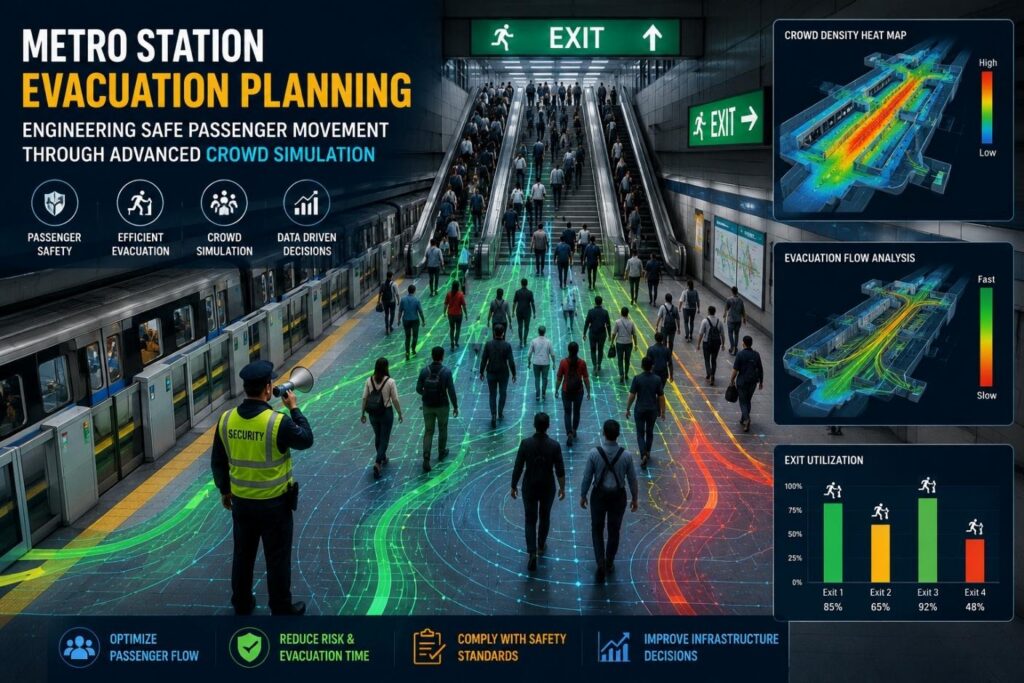
How Metro Evacuation Analysis and Metro Crowd Simulation Help Build Safer Underground Transportation Systems
Underground metro stations serve millions of passengers every day, yet a single emergency can rapidly transform normal passenger movement into a complex evacuation challenge. During incidents such as fires or smoke infiltration, people often hesitate, follow familiar routes instead of the nearest exits, or gather around specific escape points. These behaviours can quickly create congestion at staircases, corridors, escalators, and emergency exits.
Metro evacuation analysis and metro crowd simulation enable engineers to study these movement patterns, identify potential bottlenecks, evaluate different emergency scenarios, and improve station layouts to support safer and more efficient passenger evacuation.
The key question is:
Can passengers evacuate the station safely under realistic emergency conditions?
This is exactly the challenge that metro evacuation analysis and metro crowd simulation are designed to address. Using these advanced engineering techniques, researchers and transportation specialists can examine how people behave in complex underground environments, uncover hidden safety risks, and refine evacuation strategies long before an actual emergency takes place.
READ THIS : Hospital Evacuation Planning
The Complexity of Evacuating Underground Metro Stations
Underground metro stations are among the most demanding transportation environments to assess because they combine large passenger volumes with limited evacuation options.
Unlike airports, stadiums, or open transport terminals, underground stations confine passenger movement within enclosed spaces. Instead of dispersing in multiple directions, passengers must travel through carefully planned circulation networks that include platforms, corridors, staircases, escalators, and emergency exits. Every part of this network influences the overall evacuation process, and even a minor design limitation in one location can affect passenger movement throughout the entire station.
For example, a staircase may appear to have sufficient capacity when assessed on its own. However, if passengers cannot move away efficiently after reaching the bottom, congestion begins to build. As the queue grows, it can extend back toward the platforms, increasing overall evacuation time and reducing passenger safety. This interconnected movement is what makes underground evacuation planning a highly complex engineering challenge.
Some of the major challenges include:
| Underground Station Challenge | Impact on Passenger Evacuation |
| Multiple underground levels | Requires efficient vertical movement through stairs and escalators |
| Limited escape routes | Restricts passenger distribution during emergencies |
| High passenger density | Creates congestion and reduced walking speed |
| Complex station layouts | Increases uncertainty for unfamiliar passengers |
| Smoke or visibility reduction | Influences route selection and movement behaviour |
| Escalator dependency | Creates potential bottlenecks between levels |
| Passenger interaction | Causes unpredictable crowd movement patterns |
Why Traditional Evacuation Planning Is Not Enough
For many years, evacuation planning relied mainly on regulatory calculations and established safety standards. Engineers assessed several key design factors, including:
- Number of available emergency exits
- Width and accessibility of evacuation exits
- Staircase capacity and passenger flow rates
- Maximum station occupancy levels
- Required evacuation travel distances
These factors continue to play an essential role in station safety design. However, they offer only a partial picture of how people actually behave during an emergency. A metro station may comply with every design requirement and still experience severe congestion when an evacuation takes place.
The reason is straightforward:
People do not move like mathematical models.
In emergency situations, passengers make decisions based on what they see, what they know, and how others around them behave.
- A passenger may choose a longer evacuation route simply because it is more familiar.
- A group may move more slowly because its members want to stay together.
- People often follow a large crowd, even when another exit provides a quicker escape.
- Some passengers may pause to listen to announcements or watch how others are reacting before deciding where to go.
- When these individual decisions are repeated across thousands of passengers, they can produce significant congestion and greatly influence the overall evacuation process.
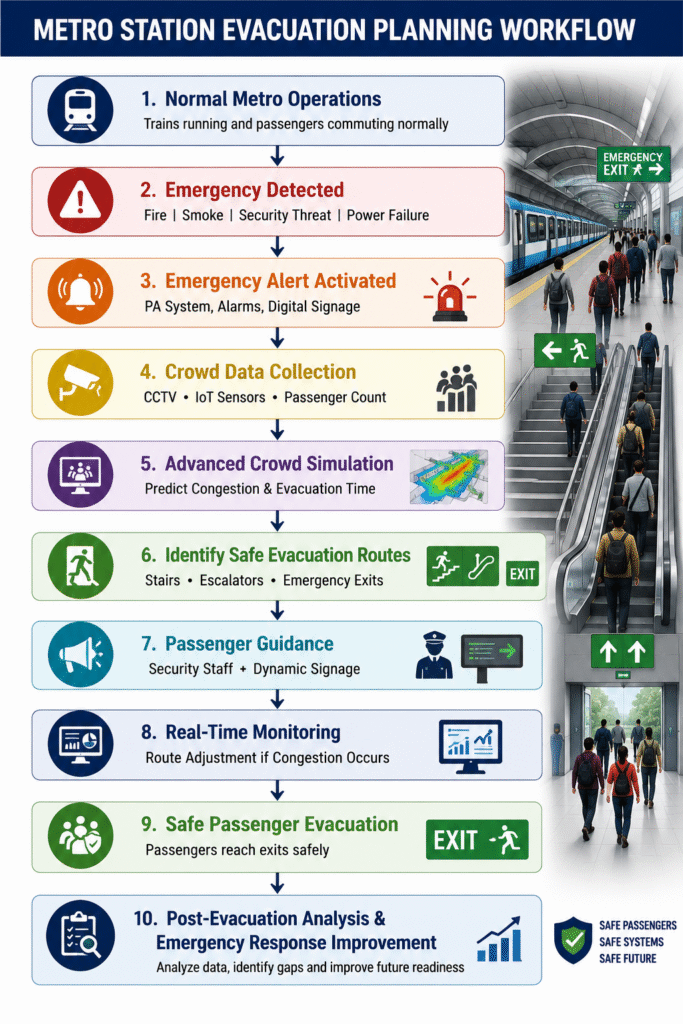
Understanding Passenger Behaviour During Emergencies
Human behaviour plays a critical role in determining how efficiently an evacuation takes place.
A common assumption is that passengers will immediately locate the nearest emergency exit and move directly toward safety. In reality, evacuation behaviour is far more complex. During an underground metro emergency, passengers may experience:
- Uncertainty about what is happening
- Difficulty understanding emergency instructions
- Fear caused by smoke or other environmental conditions
- Dependence on the actions of nearby passengers
- Limited awareness of alternative evacuation routes
For example, imagine two emergency exits located at nearly the same distance from a platform. One exit is used regularly during everyday travel, while the other is rarely noticed under normal operating conditions. Even if both exits offer the same capacity, most passengers are likely to choose the familiar route during an emergency.
The result is an uneven distribution of people. One evacuation route becomes heavily congested, while the other remains underutilized. Using metro crowd simulation, engineers can recreate these behavioural patterns and determine whether the station layout supports safe and efficient passenger movement.
What Is Metro Crowd Simulation?
Metro crowd simulation is an advanced computer-based engineering method used to recreate passenger movement within a virtual model of a metro station. Unlike basic visual animations, modern simulation software captures the interaction between:
- Station infrastructure
- Passenger demand
- Human behaviour
- Emergency conditions
- Operational procedures
Creating a Digital Replica of the Metro Station
The first step in metro crowd simulation is building an accurate digital representation of the station. The model includes every major area involved in passenger movement, including:
- Platforms
- Ticket halls
- Transfer corridors
- Staircases
- Escalators
- Elevators
- Emergency exits
- Waiting areas
- Retail zones
- Access points
The objective is not simply to reproduce the station’s physical layout.
- A corridor is more than just a physical passage.
- It functions as a channel for passenger movement.
- A staircase is more than a structural feature.
- It can become a major evacuation bottleneck.
- An emergency exit is more than an opening in a wall.
- It serves as a decision point where passenger behaviour directly influences evacuation performance.
Building Realistic Passenger Profiles
Advanced metro crowd simulation models represent different passenger characteristics to create realistic evacuation scenarios. Commuters, visitors, elderly passengers, families, and large groups all move differently, so simulations account for factors such as walking speed, age, mobility limitations, familiarity with the station, preferred routes, and reaction time.
By incorporating these differences, engineers can evaluate real-world passenger behaviour instead of relying on simplified or idealized assumptions.
The Science Behind Crowd Movement
When thousands of passengers move through the same space, their interactions create complex movement patterns. These behaviours are studied through pedestrian dynamics and incorporated into modern crowd simulation models.
Some of the most important crowd behaviours include:
Density Formation: As more passengers occupy a limited area, walking speeds naturally decrease. High-density conditions often develop near staircases, escalators, and narrow corridors.
Bottleneck Formation: Even a small restriction in passenger flow can influence movement throughout the station. For example, a narrow corridor may slow passengers several metres behind the actual point of congestion.
Flow Conflicts: Different groups of passengers may compete for the same space.
Examples include:
- Passengers leaving trains while others enter the platform.
- Transfer passengers crossing evacuation routes.
- Multiple station areas directing people toward the same staircase.
Crowd Following Behaviour: During uncertain situations, passengers often follow nearby groups rather than making independent decisions, influencing how evacuation routes and exits are used.
Escalators: The Critical Link in Underground Evacuation
In underground metro stations, vertical movement has a major influence on evacuation performance.
During normal operations, passengers travel downward on escalators to reach platforms. In an emergency, however, this movement reverses as thousands of passengers attempt to move upward toward station exits at the same time.
This makes escalators one of the most critical elements evaluated during metro evacuation analysis.
Under normal conditions, escalators are designed to improve passenger convenience and support efficient daily operations. During an evacuation, however, engineers must answer several important questions:
- Should escalators continue operating during the evacuation?
- Should some escalators reverse direction?
- Will stopping escalators increase congestion on nearby staircases?
- How will passengers respond if their usual route is unavailable?
- Can escalator landing areas safely accommodate waiting passengers?
These decisions cannot be based on assumptions alone.
Example: How Escalator Failure Changes Passenger Movement
Consider a three-level underground interchange station where one escalator becomes unavailable because of smoke during an emergency. Metro crowd simulation demonstrates how passengers immediately shift to alternative routes, increasing demand on nearby staircases, creating longer queues, reducing walking speeds, and spreading congestion throughout the station.
This example shows that evacuation performance depends on the interaction of every movement system rather than a single component. Through simulation, engineers can evaluate different evacuation strategies and identify safer solutions before a real emergency occurs.
Staircases: The True Capacity Challenge
Although escalators receive considerable attention, staircases often become the limiting factor during underground evacuations.
When escalators stop operating or become unavailable, passengers naturally move toward nearby staircases. However, moving vertically presents greater challenges than walking across a flat surface.
Passengers using staircases typically experience:
- Reduced walking speed
- Greater physical effort
- Limited opportunities to overtake others
- Increased interaction with surrounding passengers
- Longer overall evacuation times
| Staircase Performance Factor | Engineering Importance |
| Passenger density | Identifies overcrowding risk |
| Flow rate | Determines movement capacity |
| Queue formation | Shows waiting locations |
| Vertical travel time | Measures evacuation efficiency |
| Passenger interaction | Evaluates movement conflicts |
| Accessibility requirements | Ensures inclusive evacuation planning |
Emergency Exits: Designing Routes That Passengers Will Actually Use
One of the most important findings from metro evacuation analysis is that simply providing multiple emergency exits does not always guarantee an efficient evacuation. The way passengers behave during an emergency has a significant influence on how those exits are actually used. For instance, a station may have six emergency exits, yet most passengers may choose only a few routes that are familiar, clearly visible, or already being used by others. As a result, some exits become heavily congested while others remain largely underutilized.Using metro crowd simulation, engineers can evaluate a range of improvements, including clearer signage, enhanced emergency lighting, passenger guidance systems, staff-assisted evacuation, and optimized evacuation procedures. In many situations, improving the way passengers are guided during an emergency can enhance evacuation safety more effectively than constructing additional infrastructure.
The Importance of Testing Multiple Emergency Scenarios
A reliable evacuation strategy cannot be developed by studying only one emergency condition.Modern metro systems must be prepared for a wide range of situations.
Advanced simulations evaluate scenarios such as:
| Emergency Scenario | Simulation Objective |
| Fire and smoke event | Understand route changes and visibility impact |
| Blocked emergency exit | Evaluate passenger redistribution |
| Escalator failure | Measure alternative route pressure |
| Power outage | Test reduced infrastructure availability |
| Train breakdown | Analyze passenger accumulation |
| Platform overcrowding | Evaluate extreme passenger conditions |
| Large public event | Prepare for temporary demand surges |
| Tunnel emergency | Assess station response strategy |
Improving Evacuation Performance Through Simulation
A proposed underground metro interchange station was evaluated using advanced metro crowd simulation before construction.
The station design included:
- Three underground passenger levels
- Two metro platforms
- Multiple transfer corridors
- Several escalators and staircases
- Eight emergency exits
- High peak-hour passenger demand
Challenge 1: Uneven Passenger Distribution
The simulation showed that passengers naturally moved toward the most familiar exits.
Although alternative exits were available, many passengers ignored them.
This created:
- High-density zones
- Longer queues
- Reduced movement speed
Engineering Improvement:
The design team evaluated:
- Revised emergency signage.
- Better visibility of alternative routes.
Challenge 2: Hidden Corridor Bottleneck
A connecting corridor between the platform and concourse appeared adequate during normal operation.However, during evacuation simulation, thousands of passengers reached this area simultaneously.
The result was:
- Reduced walking speed.
- Passenger accumulation.
- Delayed movement toward exits.
Several improvement options were tested digitally:
| Proposed Solution | Simulation Purpose |
| Corridor expansion | Evaluate increased capacity |
| Passenger redistribution | Reduce congestion concentration |
| Signage modification | Encourage alternative routes |
| Operational control | Manage movement during emergencies |
Challenge 3: Optimizing Escalator Operations
The initial emergency plan assumed that escalators would stop during evacuation.
However, simulation results showed that stopping all escalators increased pressure on staircases.
Alternative strategies were tested, including:
- Maintaining selected escalator operation.
- Redirecting passenger movement.
- Using staff guidance at critical locations.
The final strategy improved passenger distribution and reduced congestion.
This example highlights why engineering decisions should be supported by simulation evidence rather than assumptions.
Measuring Evacuation Performance: Beyond Total Evacuation Time
A common question during evacuation planning is:“How long will it take everyone to leave the station?”
Although evacuation time is important, engineers evaluate several additional performance indicators.
A complete metro evacuation analysis considers:
| Performance Indicator | What It Shows |
| Total evacuation time | Overall emergency performance |
| Passenger density | Potential overcrowding areas |
| Flow rate | Movement efficiency |
| Queue length | Location of delays |
| Exit utilization | Effectiveness of evacuation routes |
| Walking speed | Impact of congestion |
| Delay time | Effect of decision-making and bottlenecks |
| Level of Service | Passenger movement quality |
Digital Twins: The Future of Metro Evacuation Planning
The future of metro safety is evolving beyond standalone simulation studies toward continuously updated digital environments.
Digital twin technology creates a virtual replica of a metro station by integrating:
- Station geometry
- Passenger movement data
- Sensor information
- Operational conditions
- Real-time crowd monitoring
By combining these data sources, transportation operators gain a clearer understanding of how passenger movement changes throughout the day and how a station is likely to respond under unusual or emergency conditions.
A digital twin can help answer important questions such as:
- Where are congestion risks beginning to develop?
- How will future passenger growth affect station safety?
- Which infrastructure upgrades will deliver the greatest improvement?
- How can emergency response procedures be refined and strengthened?
Artificial Intelligence and Predictive Passenger Management
Artificial intelligence is reshaping crowd management and evacuation planning by processing large volumes of operational data to detect unusual crowd build-up, changes in passenger movement patterns, high-density areas, and emerging safety risks. When combined with metro crowd simulation, AI allows engineers to evaluate potential outcomes before operational decisions are implemented.
Future metro systems will increasingly rely on intelligent platforms to forecast congestion, deliver dynamic passenger guidance, provide emergency response teams with real-time situational awareness, and continuously optimize station operations for both safety and efficiency.
Book a free consultation for appointment
Email us at :grow@simbi.in