
Crowd Control Management Plan: A Practical Framework for Safer Events
The Love Parade festival in Duisburg, Germany, was the site of 21 people being accidentally run down and killed by the crush on 24 July 2010. The visitors coming in and out were directed through the same entrance tunnel and the bottleneck was not considered. However, subsequent investigations revealed that there was no evidence of panic nor of any intentional pushing. To capture such a gap on paper, there is a crowd control management plan. This article outlines the process of creating one, ranging from maximum numbers at the peaks to the control room.
READ MORE: Crowd Control Solutions for Safe Public Spaces
Crowd Control Management: Planning for Demand, Space and Output
Crowd control management is rooted in an easy-to-understand yet revolutionary concept from the National Disaster Management Authority guide “Managing Crowd at Events and Venues of Mass Gathering (2014)” – a crowd situation is a situation of imbalance between the demand and supply of the crowd and can be addressed at three points – input, venue and output. In the same guide, planning is divided into five related components.
Know the visitors: crowd type, expected numbers, motives and the roles of local communities and stakeholders.
- Set the strategy: capacity planning, crowd behaviour and a unified control structure that lets several agencies work from one plan.
- Analyse the risks: identify threats, score them, and assign a course of action with owners, timing and resources.
- Prepare services: visitor information, security, medical and sanitation facilities, transport and parking.
- Execute through command: an incident response system with a control room, unified command and an emergency operations centre.
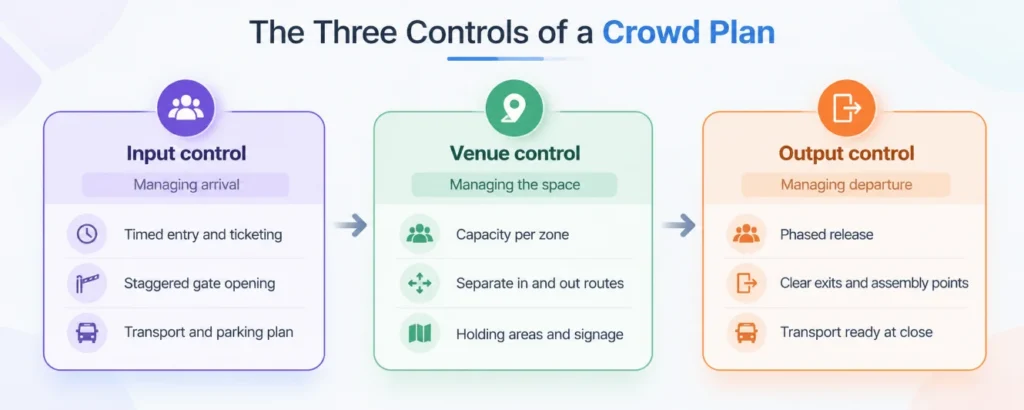
Figure 1: Input, venue and output control close the gap between expected crowd and available space.
Peak Crowd Management: The Hour That Decides the Event
Attendance is not balanced. Most people come in a short time before the start, therefore peak crowd management requires its own calculation and not an average. Figure 2 displays an example event where 28 per cent of people come in one 15 minute period. If fewer can get through the gates, then a line of people does start at the peak of the density and the queue is the risk.
Plan towards the peak. Divide the peak-interval arrivals by minutes for people per minute, divide by throughput after checking for one lane and the answer is the number of lanes required. If that number is not possible, the solution is not to hope for the queue to clear, but to “flatten the peak” by changing when people arrive, offering incentives for early arrivals, and allowing staggered gate openings.
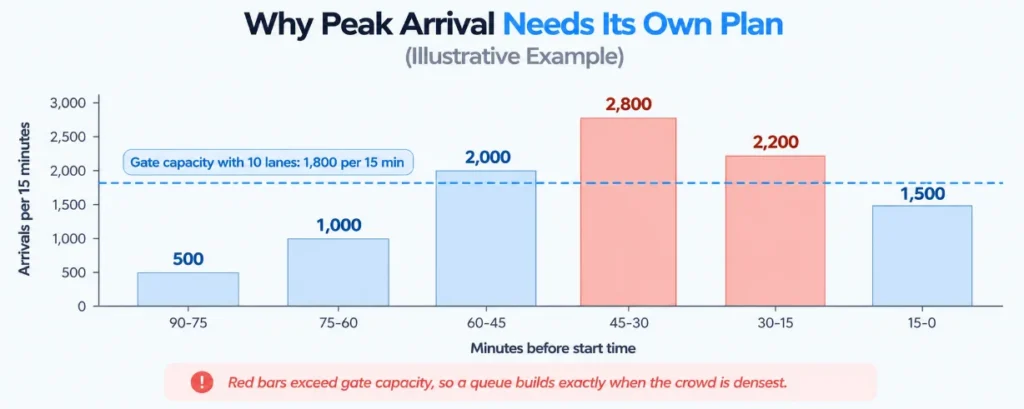
Figure 2: Illustrative arrival profile for a 10,000-person event against gate capacity (example figures, not measured data).
Event Crowd Management Plan: Components and Benchmarks
Event crowd management plan is a series of interconnected, interdependent components, each with an owner and measurable indicator. The figures in the table below come from the NDMA guide, including minimum staffing for the control room and the spacing of stalls, to allow the plan to be checked, in addition to being read.
| Plan Component | What to Define | Benchmark Worth Setting |
| Risk analysis | Hazards at gates, stairs, stages and exits, each scored for severity, frequency and difficulty of detection | A ranked list, so the highest-scoring risks get mitigation first |
| Venue and holding areas | Capacity per zone, separate inbound and outbound routes, spaces to stage people before release | Capacity derived from time and motion study, not from guesswork |
| Control room | A grid map with CCTV at grid points, named roles for commander, police and administration | A control team of at least three people, with no one else directing it |
| Communication | Public address, radio channels with a backup, dedicated hospital hotline | At least three announcers; radio range tested with a repeater where needed |
| Stall and layout planning | Food and sales stalls grouped so they do not block movement | Clusters of five or six stalls with 3 to 4 metre gaps for escape |
| Emergency and evacuation | Assembly areas, evacuation method, contingency transport, nearest medical facilities | A target evacuation time that has been rehearsed |
| Review | Daily review of the action plan on multi-day events, and a full debrief afterwards | Incident action plan reviewed every 24 hours |
A plan that names no owner or benchmark is a statement of intent. Adding either turns a line item into something a supervisor can verify on the day.
Crowd Management in Event Management: What Duisburg Teaches
Researchers Dirk Helbing and Pratik Mukerji analyzed the Love Parade video, and identified crowd quakes as one of the main reasons. As the density increases, people are pushed together and forces transmit through the crowd in a chain; if the chain is broken, the pressure wave can cause people to be knocked over. No evidence of a stampede or mass panic or pushing. If you are in charge of crowd management in event management, three lessons are offered here.
Crowd Management Plan Example: A 10,000-Person Concert
This crowd management plan example includes some assumed numbers to illustrate the logic. If 10,000 people are expected and 28% of them arrive in the busiest 15 minutes, how many people arrive in the remaining 85% of the time?If 10,000 people are expected and 28% show up in the busiest 15 minutes, how many people show up in the remaining 85%? That’s approximately 11.6 people a second. To prevent a queue during peak periods, if one screened lane is able to serve 12 people per minute, then the gates require 16 lanes. The following steps convert that number into a plan.
Fix the numbers: confirm expected attendance, the shape of the arrival curve and the throughput per lane from a trial.
- Size the gates: provide 16 lanes, or fewer lanes plus timed entry that lowers the peak.
- Stage the crowd: set up holding areas outside the gates so a surge waits in space rather than pressing on the entrance.
- Zone the venue: set capacity for the stage front, food area and exits, with separate routes in and out.
- Staff the control room: place a three-person team with a grid map and CCTV, and brief all stewards before deployment.
- Plan the exit: release the crowd in phases, keep exits clear and have transport ready at closing time.
Crowd Control and Management on the Day
On the day, crowd control and management will depend on the ability to see trouble before it happens and having authority to correct it. The three habits are the most important.
Debrief the event afterwards and reflect on congestion points, incidents and response times and incorporate into the next plan.
Simbi Labs’ Crowd Management and Safety Solutions
Simbi Labs supports event organisers and venues with crowd management planning, risk assessment and on-ground safety solutions, so that a plan is tested against real numbers before the gates open.
Explore Crowd Management Services
Frequently Asked Questions
1.What is a crowd control management plan?
It is a documented plan that covers arrival, movement, density, communication, emergencies and departure, with named owners and measurable benchmarks for each, so the event can be run and reviewed against it.
2. What is peak crowd management?
Peak crowd management plans for the busiest interval of arrival or departure, usually a short window, by sizing gates and routes for that peak and flattening it through timed entry and staggered opening.
3. What should an event crowd management plan include?
It should include a risk analysis, venue capacity and routes, a control room with defined roles, communication channels, emergency and evacuation procedures and a review process after the event.
4. How is crowd control and management different from crowd management in event management?
Crowd management is the planned work of keeping movement safe and efficient. Crowd control is the set of measures used to regulate or restrict movement when density or behaviour requires it. A good plan uses management to reduce the need for control.
5. Is there a crowd management plan example I can follow?
The 10,000-person concert above is one. Work backwards from the peak arrival interval to the number of gate lanes, add holding areas and zone limits, staff a control room and plan a phased exit.
6. When should planning for crowd control management begin?
As early as the venue and date are fixed, because gate numbers, routes and permits take time to change. Risk analysis and capacity calculations should be complete well before ticket sales.